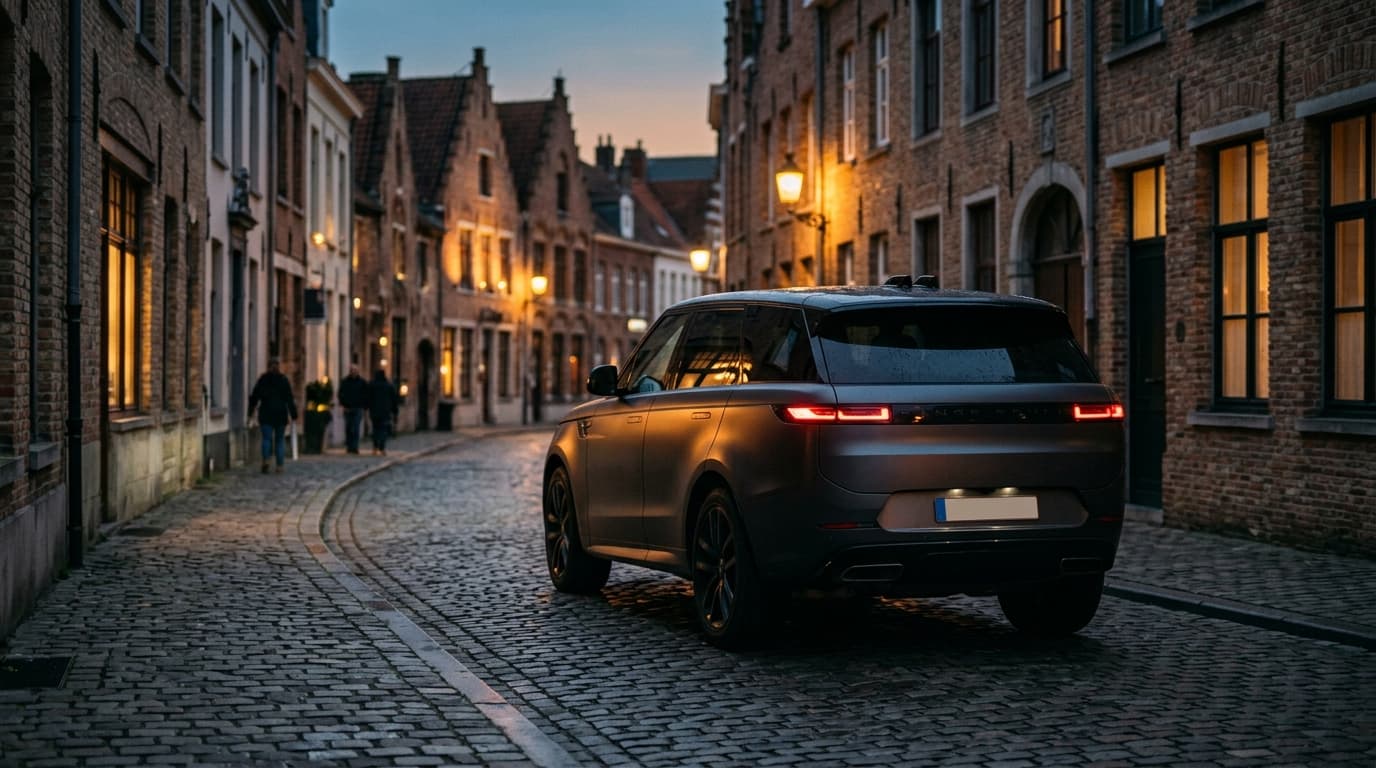
On a compact petrol SUV bought at 38,000 € and kept five years at 15,000 km a year, one kilometre costs 0.615 €. That is 9,227 € a year. The official Belgian scale stops at 0.4761 € per kilometre, and the gap widens further as soon as you drive less.
0.615 € per kilometre, line by line
The calculation assumes a specific vehicle, and ours is laid out in the open: a compact petrol SUV rated at 11 fiscal horsepower, bought at 38,000 € including tax, registered in Wallonia, kept five years, driven 15,000 km a year, using 7.5 l per 100 km in real conditions and resold at 17,100 €, which is 45% of its list price.
Change one of those assumptions and the result moves.
| Item | Total over 5 years | Per kilometre |
|---|---|---|
| Depreciation (38,000 € down to 17,100 €) | 20,900 € | 0.2787 € |
| Fuel (7.5 l/100 km at 2.0580 €/l) | 11,576 € | 0.1544 € |
| Third-party and comprehensive insurance (1,100 €/yr) | 5,500 € | 0.0733 € |
| Servicing and repairs (600 €/yr) | 3,000 € | 0.0400 € |
| Annual road tax (561.00 €/yr) | 2,805 € | 0.0374 € |
| Tyres (two sets at 569.12 €) | 1,138 € | 0.0152 € |
| TMC registration tax (one-off) | 1,122 € | 0.0150 € |
| Roadworthiness test (two visits) | 92 € | 0.0012 € |
| Total | 46,133 € | 0.615 € |
Two items make up 70% of the bill. Loss of value and fuel, in that order. The other six lines put together weigh less than depreciation alone.
Every amount has a source. The fuel price is the legal maximum recorded on 17 September 2026 in the official price scale for petroleum products published by the SPF Économie (the federal economy department), at 2.0580 € a litre of 95 E10 petrol. The 142.28 € tyre in 17 inches comes from our own survey of the Belgian market, detailed in our piece on winter-approved all-season tyres. The 561.00 € annual tax matches an 11 CV vehicle in Wallonia and in Brussels for the year running from 1 July 2026 to 30 June 2027. The 46.10 € roadworthiness test is the petrol rate in force since 1 January 2026.
That leaves two lines nobody can source properly, us included: servicing and depreciation. Servicing depends on the network, on the age of the car, on how careful the previous owner was. Depreciation depends on the model, the colour and the state of the market on the day. We settled on 600 € a year and 45% residual value at five years, the middle of the range observed in Belgium. A site quoting a cost per kilometre without saying what sits behind those two lines is quoting a decorative number.
The official Belgian scale stops at 0.4761 € per kilometre
The Belgian state publishes its own price per kilometre. Circular no. 767 of 8 June 2026, published in the Moniteur belge on 16 June, sets the mileage allowance at 0.4761 € per kilometre for the period from 1 July 2026 to 30 June 2027. That is what an employer may reimburse to a worker driving their own car, free of social security contributions and tax.
Set against our 0.615 €, that rate covers 77% of the real cost.
The shortfall comes to one figure: 0.139 € per kilometre, or 2,085 € a year for someone driving 15,000 km. The scale never claimed to represent an SUV, mind you. It represents an average fleet, all sizes mixed, and it has just risen from 0.4449 € to 0.4761 € on 1 July, a 7% correction chasing pump prices that moved faster than it did.
At what mileage does the calculation tip over?
Around 22,800 km a year. Below that, the official scale does not cover the real cost of the vehicle. Above it, the scale starts to exceed it.
The mechanism is easy to see once the two families of cost are separated. Insurance, the annual tax, the spread-out registration tax and the roadworthiness test do not move by a single euro whether you drive 8,000 or 30,000 km. Nor does depreciation, or barely, over five years. Fuel, tyres and servicing, on the other hand, follow the odometer.
| Kilometres per year | Fixed costs per km | Variable costs per km | Cost per kilometre |
|---|---|---|---|
| 8,000 | 0.760 € | 0.210 € | 0.970 € |
| 10,000 | 0.608 € | 0.210 € | 0.818 € |
| 15,000 | 0.406 € | 0.210 € | 0.615 € |
| 20,000 | 0.304 € | 0.210 € | 0.514 € |
| 25,000 | 0.243 € | 0.210 € | 0.453 € |
| 30,000 | 0.203 € | 0.210 € | 0.412 € |
Rounded to the nearest thousandth, on the same vehicle and the same holding period.
The ratio between the two ends of the table reaches 2.35. Same SUV, same petrol, same insurance policy: the kilometre costs more than twice as much at 8,000 km a year as at 30,000. And the most useful conclusion in that table is the one that mentions neither engine nor model. Below 10,000 km a year, no arbitration between petrol, diesel and electric rescues the cost structure, because the expensive part is no longer the use but the ownership itself. At that mileage the relevant question is not which SUV to buy, but whether to own one at all.
For scale: Car-Pass, the body that records the odometer of every car in the Belgian fleet, measured an average of 16,589 km per private car in 2022. Half the country therefore drives below that line, on the wrong side of the crossing point.
Diesel against petrol: thirteen cents per 100 km
On 17 September 2026, the ceiling price for B7 diesel stood at 2.4680 € a litre. 95 E10 petrol was at 2.0580 €. Forty-one cents apart, and diesel is on the wrong side.
The reversal is recent and brutal. Over one year the diesel ceiling gained 42.91% and the petrol ceiling 24.65%, daily readings on record. The fuel that served as the closing argument of every family SUV salesman has become the dearer of the two at the pump, and the consumption gap no longer makes up for it.
The sums take two lines. A diesel SUV at 6.2 l per 100 km spends 15.30 € on fuel. Its petrol equivalent at 7.5 l spends 15.44 €. Thirteen cents per 100 km, which is about 100 € over the 75,000 km of our model. Across five years of ownership.
Diesel keeps its advantages on very high mileage and on towing torque, nobody disputes that. But it drags three cost lines petrol does not have: a roadworthiness test at 56.50 € instead of 46.10 €, a 15% surcharge on the Flemish road tax for Euro 6 and 25% for Euro 5, and a door closed in the Brussels LEZ (low emission zone) for Euro 5 cars since 1 January. We set out those thresholds in our article on the LEZ rules in Brussels, Antwerp and Ghent.
Does an electric SUV really change the bill?
On energy and taxes, yes, and clearly so. On the total, far less than advertised.
Two lines collapse when you switch to electric. Fuel first: at 0.30 € per kilowatt-hour, the average all-in price recorded on the Belgian market in September 2026, an electric SUV using 20 kWh per 100 km costs 6.00 € per 100 km against 15.44 € for petrol. Over 75,000 km the saving approaches 7,100 €. Road tax next: 107.18 € a year instead of 561.00 €, which is 2,269 € less over five years.
Nine thousand three hundred euros saved, then. And yet the account does not balance.
Because the line that dominates the table is still depreciation, and electric sits worse there. At five years an electric vehicle holds roughly 40% of its value where a combustion car keeps 45 to 50%, and it starts from a higher list price. An equivalent electric SUV invoiced at 46,000 € and resold at 18,400 € loses 27,600 €, which is 6,700 € more than our petrol car. The net advantage shrinks to about 2,600 € over five years, meaning 0.035 € per kilometre. And it vanishes for anyone charging mainly on public points, where the kilowatt-hour costs two to three times the domestic rate.
So the thing to check before signing is not the price of a full charge. It is the trade-in value the seller quotes, and how solid it is. The CREG (the federal electricity and gas regulator) also publishes an official rate for reimbursing home charging of company cars, a useful benchmark for anyone costing their own wallbox.
Does the region move the price per kilometre?
By less than one cent, on this profile. The compact petrol SUV pays 561.00 € of annual tax in Wallonia and in Brussels, roughly 475 € in Flanders, and its roadworthiness test costs 13.50 € more in the south. Over five years and 75,000 km, the gap between the dearest and the cheapest region reaches 457 €, or 0.006 € per kilometre.
On a large electric SUV the trade-off changes scale entirely: the Walloon TMC registration tax can exceed 1,890 € where Flanders asks for 61.50 €. The mechanism, its three scales and its mass pivot are set out in our article on the TMC and road tax on an SUV.
Redo the sums on your own paperwork
Six figures are enough, and you have all of them at home.
- The price paid and the trade-in value quoted today, for depreciation.
- The mileage recorded at two consecutive roadworthiness tests, which gives your real annual mileage rather than the one you think you drive.
- The average consumption shown by the trip computer since the last reset, raised by 5 to 10%.
- The annual premium written on your insurance renewal notice, comprehensive cover included.
- The amount on your latest road tax payment notice.
- The servicing invoices of the last three years, divided by three.
The Moniteur Automobile calculator does the work if you would rather not reach for a calculator. To compare two models on mass, power and consumption before even opening a simulator, use our comparison tool. And if depreciation is your main worry, our survey of the SUVs that hold their value best attacks the heaviest line in the table.
One last marker, useful for measuring the distance travelled. In March 2022 the RTBF costed the price per kilometre of a compact petrol SUV at 0.35 €, on 30,000 km a year and 4,200 € of annual fuel. The same tank would cost almost half as much again today.
Frequently asked questions
How do you calculate the cost per kilometre of a car? You add up every expense over the holding period, then divide by the kilometres covered in that same period. Eight items are enough in Belgium: loss of value at resale, fuel, insurance, servicing and repairs, the annual road tax, tyres, the one-off TMC (taxe de mise en circulation, the regional registration tax) and the roadworthiness test. Loss of value alone accounts for close to half the total.
Does an SUV really cost 0.615 € per kilometre in Belgium? At 15,000 km a year, yes, on the profile we costed: a compact petrol SUV bought at 38,000 € and kept five years in Wallonia. The figure climbs to 0.818 € if you only drive 10,000 km a year and drops to 0.453 € at 25,000 km. Fixed costs do not move with mileage, so the price per kilometre follows a curve, never a single value.
Is diesel still cheaper than petrol in Belgium? Barely. On 17 September 2026 the official ceiling price for B7 diesel stood at 2.4680 € a litre against 2.0580 € for 95 E10 petrol, a gap of 41 cents a litre. A diesel SUV at 6.2 l per 100 km spends 15.30 € on fuel where its petrol equivalent at 7.5 l spends 15.44 €. The gap comes to about 100 € over 75,000 km, before counting the dearer diesel roadworthiness test and the driving restrictions.
Frequently asked questions
You add up every expense over the holding period, then divide by the kilometres covered in that same period. Eight items are enough in Belgium: loss of value at resale, fuel, insurance, servicing and repairs, the annual road tax, tyres, the one-off TMC (taxe de mise en circulation, the regional registration tax) and the roadworthiness test. Loss of value alone accounts for close to half the total.
At 15,000 km a year, yes, on the profile we costed: a compact petrol SUV bought at 38,000 € and kept five years in Wallonia. The figure climbs to 0.818 € if you only drive 10,000 km a year and drops to 0.453 € at 25,000 km. Fixed costs do not move with mileage, so the price per kilometre follows a curve, never a single value.
Barely. On 17 September 2026 the official ceiling price for B7 diesel stood at 2.4680 € a litre against 2.0580 € for 95 E10 petrol, a gap of 41 cents a litre. A diesel SUV at 6.2 l per 100 km spends 15.30 € on fuel where its petrol equivalent at 7.5 l spends 15.44 €. The gap comes to about 100 € over 75,000 km, before counting the dearer diesel roadworthiness test and the driving restrictions.
We dig through the Belgian market data — TÜV reliability, real-world ADAC consumption, company-car taxation, list prices — to call it straight. No brand pays us.