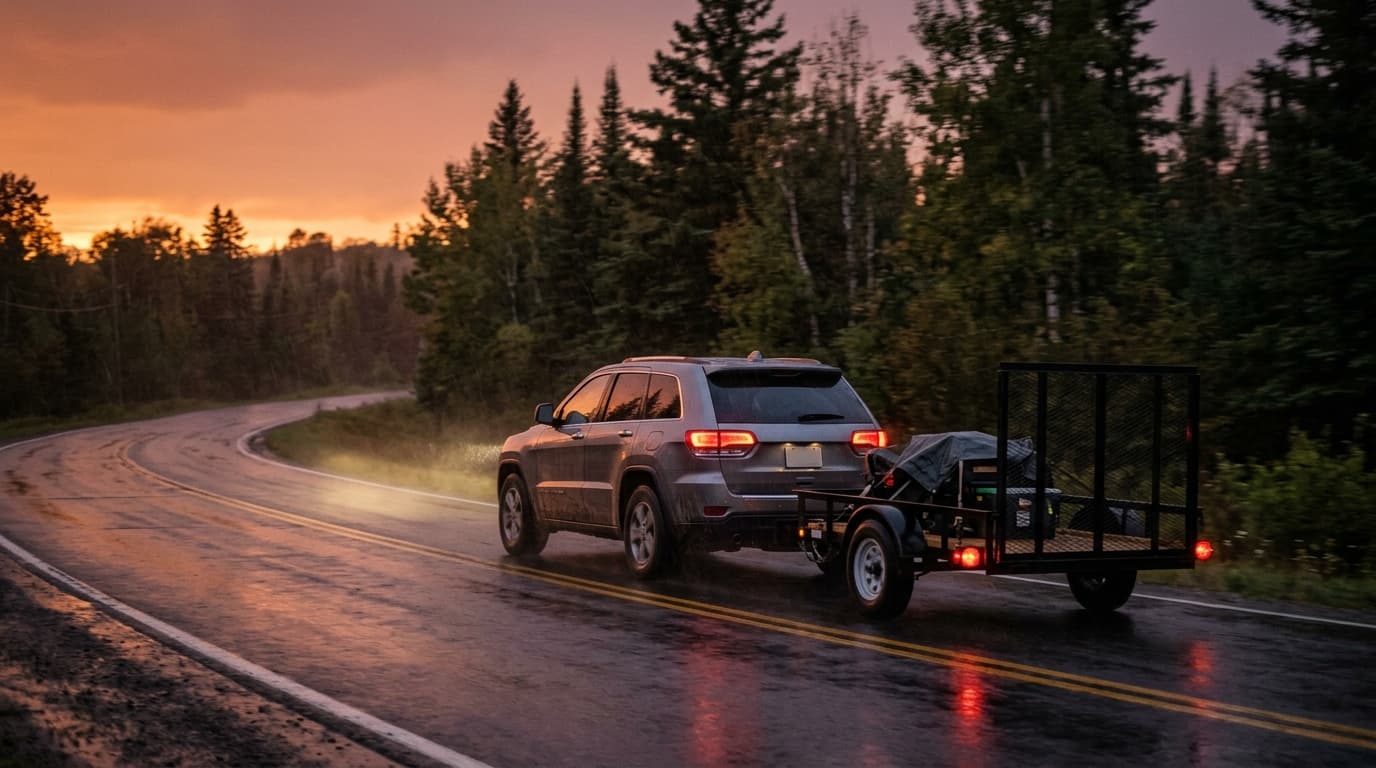
In Belgium, the tax on a trailer depends on your address. A Walloon resident pays 50.16 € a year up to 500 kg of maximum authorised mass (MMA, the legal gross weight) and 104.15 € above that. Brussels and Flemish residents pay nothing for an ordinary trailer of 750 kg or less. Same trailer, same SUV, three bills.
Wallonia, Brussels, Flanders: the three systems side by side
The pivot is the same everywhere: 750 kg of MMA. Below it, the trailer runs with a copy of the car's number plate. Above it, the trailer gets its own registration at the DIV, the federal vehicle registration office. Taxation follows that pivot in only two regions out of three.
| Wallonia | Brussels | Flanders | |
|---|---|---|---|
| Trailer up to 500 kg | 50.16 € a year | exempt | exempt |
| Trailer from 501 to 750 kg | 104.15 € a year | exempt under 750 kg | exempt |
| Trailer from 751 to 3,500 kg | 104.15 € a year | flat rate based on MMA | taxed according to MMA |
| Caravan or boat trailer | 48.61 € a year | declaration and separate rate | declaration, even under 751 kg |
| Paperwork under 750 kg | online declaration before use | none | none, with exceptions |
| Proof on board | fiscal identification mark | none | none |
| Registration tax (TMC) | no | no | not stated in our sources |
Sources: the trailer and caravan pages of SPW Finances (in French), scale from 1 July 2026 to 30 June 2027; Bruxelles Fiscalité online help (in French); the page of the municipality of Retie (in Dutch), which relays the rules of the Vlaamse Belastingdienst, the Flemish tax service. Checked on 3 October 2026.
How much is trailer tax in Wallonia?
50.16 € a year if the MMA does not exceed 500 kg, 104.15 € from 501 to 3,500 kg. Caravans and boat trailers have their own flat rate, 48.61 €.
These amounts apply from 1 July 2026 to 30 June 2027 and are indexed every summer. Last 1 July the small bracket went from 48.18 to 50.16 € and the large one from 100.06 to 104.15 €, a rise of 4.1 %. The longer view says more: in 2015, the Walloon budget minister quoted 36.04 € and 74.84 € in reply to a member of parliament. The tax has therefore gained 39 % in eleven years.
The procedure changes with the weight. A trailer above 750 kg is registered with the DIV, which passes the data on to SPW Finances: the payment notice arrives by itself. A trailer of 750 kg or less exists in no database. So it is up to you to declare it, through the online form, before the first trip on a public road.
Once the tax is paid, the administration posts you a fiscal identification mark (signe distinctif fiscal). The SPW leaflet (in French) asks you to keep it with the towing vehicle's documents. It is tied to no number plate: the same trailer can follow the household SUV one day and the city car the next, as long as the paper follows too.
Three traps come up again and again. The flat rate is not refunded pro rata if you sell the trailer during the year. The tax keeps running until you have revoked the declaration through the same form. And without the mark at a roadside check, the driver pays the tax on the spot plus a fine, which the Tournaisis police zone (in French) put at 100 € minimum in 2019.
Brussels exempts under 750 kg, on one condition
You often read that Brussels applies the Walloon scale. Bruxelles Fiscalité writes the opposite: trailers and semi-trailers under 750 kg are exempt from road tax, and buying one requires no declaration.
The condition concerns the towing vehicle. The exemption holds if the trailer is exclusively hitched to a passenger car, an estate-type "mixed" car, a minibus, a van, a motorcycle, a motorhome, an ambulance, a bus or a coach. An SUV falls into the first category.
Above 750 kg, or for a trailer designed to carry a boat, a declaration in MyTax is mandatory again, with a flat rate calculated on the MMA. The notice arrives about two months later, you have two months to pay, and the administrative fine starts at 50 €. We could not record the amount of the Brussels flat rate: the grid is displayed in a MyTax selector, not on a public page.
Does Flanders still tax trailers?
Hardly. For an ordinary trailer of 750 kg or less belonging to a private individual, there is neither a declaration nor a tax.
The exceptions are precise, and the Vlaamse Belastingdienst's list of vehicles "to be declared" spells them out: a trailer under 751 kg towed by a vehicle registered to a leasing company, a caravan or boat trailer under 751 kg, a glider trailer. The Flemish driver of an SUV on private lease who buys a luggage trailer therefore falls back into the tax, while a neighbour who owns the same SUV escapes it.
Above 750 kg, the trailer is registered and taxed according to its MMA, as Touring points out (in Dutch).
Why is Wallonia the only region taxing a small trailer?
Because the tax pays there, where the federal government had concluded the opposite. On 6 October 2006, the Council of Ministers approved the abolition of the tax on trailers of 750 kg or less towed by a car, with an argument that the official press release (in Dutch) puts bluntly: the tax brings in less than it costs to process the declarations.
Nineteen years later, the Walloon mobility minister says exactly the reverse. Questioned on 4 December 2025 by MP Vincent Palermo, François Desquesnes called the system "historical" and its management cost "very low overall". His reply of 30 December 2025 (in French) gives the 2024 figures, and they explain everything.
| Trailers taxed in Wallonia, 2024 | Number | Revenue |
|---|---|---|
| Up to 500 kg | 75,144 | 3,336,831 € |
| From 501 to 750 kg | 32,255 | 2,863,650 € |
| From 751 to 3,500 kg | 53,916 | 4,946,597 € |
| Total | 161,315 | 11,147,079 € |
The figure that matters: 107,399 trailers of 750 kg or less, the ones Brussels and Flanders let roll for free, bring the Walloon Region 6.2 million euros a year. Two taxed trailers out of three are small ones.
The MP's objection still stood up. The tax threshold sits at 500 kg, the registration threshold at 750 kg, and between the two lies a trailer the DIV does not know but the tax office charges at the rate of a 3.5 tonne car transporter. The minister announced no harmonisation.
500 or 750 kg: a gap of 53.99 € a year
For a Walloon owner, the manufacturer's plate is worth money. A luggage trailer approved at 500 kg MMA costs 50.16 € a year, the same body approved at 750 kg costs 104.15 €. Over ten years at constant rates, the gap reaches 539.90 €.
In practice, that gives a simple trade-off: if the loaded trailer always stays under 500 kg, the 500 kg version is enough. Moving from one bracket to the other later remains possible, but you first have to revoke the original declaration.
Who pays when the trailer crosses a regional border?
The tax follows the home address of whoever uses the trailer, not the road taken. A Brussels resident driving down to Durbuy with a 600 kg trailer owes SPW nothing.
The awkward case is borrowing. A Walloon towing a Flemish friend's trailer has, by definition, no fiscal mark to show. The Walloon budget minister settled it in 2015, in reply to a parliamentary question (in French): a free loan certificate, with the owner's details and signature, kept in the car. The other way round, whoever lends a Walloon trailer hands over the fiscal mark with it.
Five checks before buying a trailer
On the Belgian market, the purchase price is only the first line. Before signing:
- the MMA stamped on the plate, which sets the Walloon tax bracket and the need for registration;
- your region of residence, and the status of the towing vehicle if you live in Flanders (owned or leased);
- the type of trailer, since caravans and boat trailers follow a separate regime in all three regions;
- your SUV's towable mass, in box O.1 for a braked trailer and O.2 for an unbraked one;
- the licence required once the combination exceeds 3,500 kg, detailed in our guide to the B licence and caravans.
To avoid: buying a 750 kg trailer "just in case" when you live in Namur and carry two bikes. To keep: the 500 kg one in Wallonia, any trailer under 750 kg in Brussels and Flanders. The rest of the towing car's taxation is in our article on SUV registration and road tax, the electric case in the one on towing with an electric car, and our comparison tool lines up towable masses model by model.
Frequently asked questions
It depends on your region. In Wallonia, a trailer with a 750 kg MMA pays 104.15 € a year, on the scale valid from 1 July 2026 to 30 June 2027. In Brussels, a trailer under 750 kg towed by a passenger car is exempt. In Flanders, a private owner's ordinary trailer of up to 750 kg is neither declared nor taxed.
A Walloon resident pays 50.16 € a year, the lowest bracket of the scale, which covers every trailer up to 500 kg of maximum authorised mass. Brussels and Flemish residents pay nothing for an ordinary trailer of that weight. What counts is the MMA stamped on the manufacturer's plate, not the empty weight.
Through the online form of SPW Finances (the Walloon tax administration), reached from Mon espace, before the trailer is first used on a public road. The step only concerns trailers of 750 kg or less: above that, registration with the DIV (the federal vehicle registration office) triggers the payment notice. Once you have paid, the fiscal identification mark arrives by post.
No. None of the three regions taxes the tow bar fitted to the car: the taxed object is the trailer. Fitting a tow ball to your SUV changes neither its registration tax nor its annual road tax. In Wallonia the trailer itself is not subject to registration tax (TMC), only to the annual tax.
At a roadside check, the driver must pay the tax on the spot, plus a fine. A Walloon police zone put that fine at 100 € minimum in 2019. The fiscal identification mark should therefore travel with the vehicle documents, including when you lend the trailer.
We dig through the Belgian market data — TÜV reliability, real-world ADAC consumption, company-car taxation, list prices — to call it straight. No brand pays us.