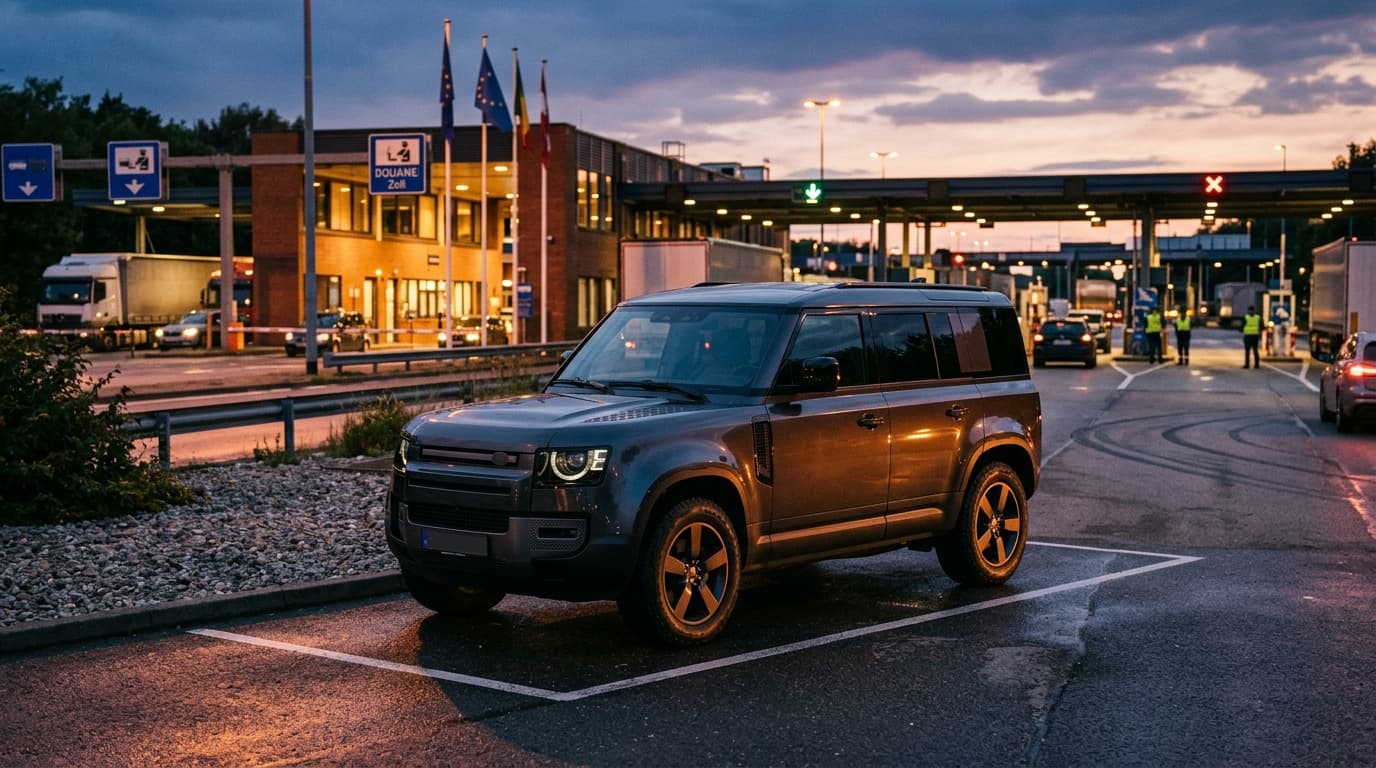
Importing is legal, free of customs duties, and the procedure fits into six steps. On the Belgian side, budget 250 to 400 € in fixed costs, excluding the registration tax. The line that catches people out is not the paperwork: it is the 21% VAT on a vehicle Germany sells you as a used car.
How much does a German import cost, all in?
Between 250 and 400 € in fixed Belgian costs, provided the vehicle travels with its European certificate of conformity. If it does not, add roughly a hundred euros and two weeks of waiting.
The detail matters, because half of these items are regional and nobody spells them out for you in Cologne.
| Item | 2026 amount | When |
|---|---|---|
| German export plate and temporary insurance | around 150 € for a short validity | before leaving Germany |
| E705 declaration on MyMinfin | free, up to 5 working days of processing | as soon as you are back |
| Import roadworthiness test, petrol | 46.10 € in Brussels and Flanders, 59.60 € in Wallonia | after the declaration |
| Diesel supplement | 15.60 € in Brussels and Flanders, included in Wallonia | same visit |
| Conformity check, if no COC | 100.50 € in Brussels, 101.10 € in Wallonia, up to 134.70 € with brake measurement | same visit |
| Belgian number plate, DIV via bpost | 30 € | after the DIV file |
| TMC (registration tax) | regional, from a few dozen to several thousand euros | after registration |
These inspection rates are set by ministerial decree and published by region since 1 January 2026; the legal basis goes back to the Royal Decree of 15 March 1968, article 23 undecies. The 30 € standard European plate, manufacturing and bpost delivery included, is the DIV rate.
In practice that gives a simple order of magnitude: on a three-year-old used SUV bought for 28,000 € in the Rhineland, you come home with about 300 € of Belgian costs, plus the export plate. The TMC is calculated separately and swings fourfold depending on whether you live in Namur, Brussels or Antwerp. We worked it out region by region in our article on the registration tax and road tax on an SUV.
Six steps, from the German contract to the Belgian plate
The order is not negotiable. Swapping the roadworthiness test and the customs declaration costs you a full extra trip.
- Sign the Kaufvertrag and collect both parts of the registration certificate. The Teil II, formerly the Fahrzeugbrief, is the title of ownership. Without it no Belgian registration is possible, and a seller who promises to post it later is a seller you walk away from.
- Get an export plate fitted. The Ausfuhrkennzeichen is issued by the Zulassungsstelle of the seller's municipality, together with temporary third-party insurance. Validity runs from fifteen days to one year.
- Declare the vehicle through the E705. Since 4 February 2019 customs no longer stick a paper sticker on your file: they issue an electronic signal after a request filed on MyMinfin. Processing takes up to five working days.
- Take the roadworthiness test. Bring the 705 signal, the German registration certificate and the COC. The vehicle must run on valid plates to be presented.
- Take out Belgian third-party insurance. It is signed after the customs formalities and before registration, exactly as for a purchase made in Belgium.
- File your application with the DIV. Since 2019, registering a vehicle coming from the European Union is done online. You receive the Belgian registration certificate and the plate by bpost.
The full sequence is described by the European Consumer Centre Belgium, the clearest official source on the subject, and the electronic 705 sticker was announced in a federal press release when the switch happened.
Which documents should you demand from the German seller?
Five items, and none of them can be recovered after the handshake.
- The Kaufvertrag stating the chassis number, the recorded mileage and the price, excluding tax if the vehicle is new for tax purposes.
- The Zulassungsbescheinigung Teil I, the registration certificate that travels with the car.
- The Zulassungsbescheinigung Teil II, the title of ownership, without which the DIV rejects the file.
- The European certificate of conformity (COC), to be claimed from the seller or the manufacturer's network: this is what spares you a three-figure conformity check.
- The latest Hauptuntersuchung (HU) report and the stamped service book, with invoices.
The number that counts: two months. A full roadworthiness test passed in Germany within the two months preceding the sale entitles you to the simplified visual check in Belgium, which is considerably faster. At the slightest defect found during that visual check, the station switches to a full test and the invoice follows.
Do you owe 21% Belgian VAT on a German used car?
Yes as soon as the vehicle is new for tax purposes, and that definition has nothing to do with everyday language. Less than six months since first registration or less than 6,000 km: one criterion is enough.
This is the classic German demonstrator trap. A demo car registered four months ago, with 9,000 km on the clock, is sold as a used car by the German dealer and remains fiscally new for the SPF Finances, because it is under six months old. On an invoice of 38,000 € excluding tax, the Belgian VAT due when filing the E705 comes to 7,980 €. The saving on the sticker price evaporates in a single line.
The logic holds up once you see it: VAT on a new vehicle belongs to the country of consumption, not the country of sale. The German seller must therefore invoice you without German VAT, and you must be able to prove it. A serious professional does this spontaneously. A seller who charges you 19% German VAT on a four-month-old car leaves you paying twice, and the claim is argued in Germany. The declaration procedure is detailed in the SPF Finances E705 guide.
The import test costs 13.50 € more in Wallonia
On a petrol car the visit comes to 46.10 € in Brussels and Flanders against 59.60 € in Wallonia. On a diesel, the gap narrows to 3.10 €.
| Engine | Brussels and Flanders | Wallonia |
|---|---|---|
| Petrol | 46.10 € | 59.60 € |
| Diesel | 56.50 € | 59.60 € |
| Fully electric | 40.90 € | 53.40 € |
| Petrol hybrid | 46.10 € | 59.60 € |
You are free to choose your inspection station in Belgium. Someone living in Walloon Brabant but working in Brussels can therefore present an import on the other side of the regional border. One caveat: if the certificate comes out red, the re-inspection must take place in the same station.
Why is the Car-Pass of a German import almost empty?
Because the Belgian database knows nothing about the vehicle's German life. The first mileage recorded is the one taken at the import test, and everything before that stays undocumented.
This is not a weakness of the system, it is its boundary: Car-Pass collects readings from Belgian professionals, not from German workshops. The one exception concerns the Netherlands, where Car-Pass queries the central mileage database run by the RDW, so a Dutch import arrives with a readable history where a German import arrives bare.
The consequences are measurable. The 2025 annual report of the Car-Pass non-profit gives an irregularity rate of 0.50% on imported vehicles against 0.12% on Belgian-origin vehicles, a factor of four, for an average of 80,000 km wiped per detected fraud. On a seven-year-old German SUV advertised at 90,000 km, the gap between the odometer and reality can represent several thousand euros of value, and it will show up neither at the roadworthiness test nor on the Car-Pass. Demand the stamped service book, the workshop invoices and the previous HU report. Those three documents are the only ones that rebuild the history, and you ask for them before travelling, not standing in front of the car.
When are you better off buying in Belgium?
Below a 1,500 € price gap, importing does not pay. Fixed costs, the trip, the export plate and the odometer risk swallow the saving.
Three other situations rule out importing. A Euro 5 diesel first: it no longer enters the Brussels low emission zone, and a bargain you cannot drive into the city centre is not a bargain. A complex drivetrain next, plug-in hybrid or dual-clutch, where a warranty dispute would be argued in German 300 km from home. A tight budget finally, where 300 € of Belgian costs and 150 € of export plate weigh proportionally far too much.
The Belgian used market is broad, and its rules work in your favour: a one-year minimum statutory warranty from a professional, a complete Car-Pass, and a sale roadworthiness test paid for by the seller. We compared the purchase channels in our guide on where to buy a used SUV in Belgium, and the models that go the distance in our selection of the most reliable used SUVs. To arbitrate between several models before even looking at German listings, use our comparison tool.
Importing keeps its point on one precise niche: big engines and high trim levels, rare in Belgium and abundant on mobile.de or AutoScout24.de, where German supply is simply ten times deeper. There the gap often exceeds 4,000 € and comfortably covers the procedure.
Frequently asked questions
Can a private individual import a car from Germany to Belgium? Yes. Germany and Belgium are both in the single market, so there are no customs duties and no quotas. You only have to declare the vehicle to the SPF Finances (federal tax authority) through the E705 application on MyMinfin, present it for the roadworthiness test, take out third-party insurance, then register it with the DIV (Direction pour l'Immatriculation des Véhicules, the Belgian vehicle registration office). The procedure is the same for an SUV and for a city car.
How much does importing a car from Germany to Belgium cost? Budget 250 to 400 € in fixed Belgian costs: the import roadworthiness test between 46.10 and 59.60 € depending on region and engine, a 30 € number plate from the DIV, your insurance premium and file fees. On top of that come the German export plate, around 150 € for a short validity, and above all the TMC (taxe de mise en circulation, the regional registration tax), by far the heaviest single line.
Do you pay Belgian VAT on a car bought in Germany? Only if the vehicle is new for tax purposes, meaning less than six months since first registration or less than 6,000 km on the clock. One criterion is enough. In that case you pay 21% Belgian VAT when you file the E705, and the German seller must invoice you excluding tax. Beyond those thresholds German VAT was paid at source and nothing is due in Belgium.
Is the Car-Pass valid for a car imported from Germany? The document exists, but its history starts at the import test. Car-Pass does not collect odometer readings from German workshops, so everything before the vehicle entered Belgium stays undocumented. The one exception is Dutch: for a vehicle coming from the Netherlands, Car-Pass queries the central mileage database run by the RDW and the Dutch history appears on the document.
Which documents must you bring back from Germany? The sales contract (Kaufvertrag) showing the chassis number and price, both parts of the German registration certificate (Zulassungsbescheinigung Teil I and Teil II), the European certificate of conformity or COC, the latest German roadworthiness report (Hauptuntersuchung, HU) and the service book with invoices. Without the Teil II, the DIV cannot register the vehicle.
Do you have to take the Belgian roadworthiness test again? Yes, unless you were already the registered keeper of the vehicle abroad. There is one exception: a vehicle that passed a full roadworthiness test in Belgium or in another member state within the two months preceding the sale only goes through a simplified visual check. Any defect spotted during that visual check switches the vehicle to a full test.
What warranty do you get on a car bought in Germany? From a German professional seller, German statutory warranty law applies, but you enforce it in Germany, in German, before a German court. Between private individuals, the wording gekauft wie gesehen appears on almost every contract and excludes any warranty. The European Consumer Centre Belgium can step in free of charge in a dispute with a professional established in the European Union.
Frequently asked questions
Yes. Germany and Belgium are both in the single market, so there are no customs duties and no quotas. You only have to declare the vehicle to the SPF Finances (federal tax authority) through the E705 application on MyMinfin, present it for the roadworthiness test, take out third-party insurance, then register it with the DIV (Direction pour l'Immatriculation des Véhicules, the Belgian vehicle registration office). The procedure is the same for an SUV and for a city car.
Budget 250 to 400 € in fixed Belgian costs: the import roadworthiness test between 46.10 and 59.60 € depending on region and engine, a 30 € number plate from the DIV, your insurance premium and file fees. On top of that come the German export plate, around 150 € for a short validity, and above all the TMC (taxe de mise en circulation, the regional registration tax), by far the heaviest single line.
Only if the vehicle is new for tax purposes, meaning less than six months since first registration or less than 6,000 km on the clock. One criterion is enough. In that case you pay 21% Belgian VAT when you file the E705, and the German seller must invoice you excluding tax. Beyond those thresholds German VAT was paid at source and nothing is due in Belgium.
The document exists, but its history starts at the import test. Car-Pass does not collect odometer readings from German workshops, so everything before the vehicle entered Belgium stays undocumented. The one exception is Dutch: for a vehicle coming from the Netherlands, Car-Pass queries the central mileage database run by the RDW and the Dutch history appears on the document.
The sales contract (Kaufvertrag) showing the chassis number and price, both parts of the German registration certificate (Zulassungsbescheinigung Teil I and Teil II), the European certificate of conformity or COC, the latest German roadworthiness report (Hauptuntersuchung, HU) and the service book with invoices. Without the Teil II, the DIV cannot register the vehicle.
Yes, unless you were already the registered keeper of the vehicle abroad. There is one exception: a vehicle that passed a full roadworthiness test in Belgium or in another member state within the two months preceding the sale only goes through a simplified visual check. Any defect spotted during that visual check switches the vehicle to a full test.
From a German professional seller, German statutory warranty law applies, but you enforce it in Germany, in German, before a German court. Between private individuals, the wording gekauft wie gesehen appears on almost every contract and excludes any warranty. The European Consumer Centre Belgium can step in free of charge in a dispute with a professional established in the European Union.
We dig through the Belgian market data — TÜV reliability, real-world ADAC consumption, company-car taxation, list prices — to call it straight. No brand pays us.