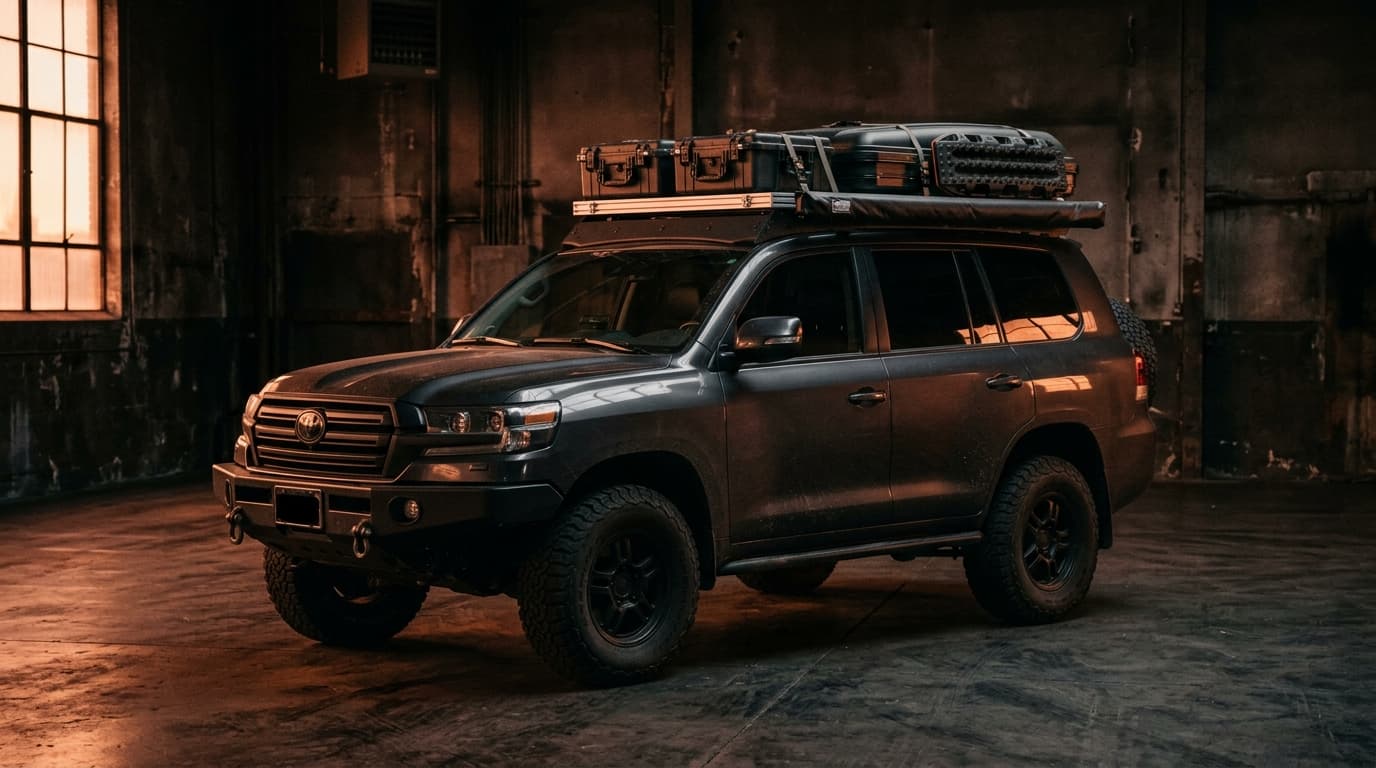
Less than you think. An SUV sold in Belgium usually accepts 75 to 100 kg on the roof while driving, and that figure includes the rack itself. A 30 kg flat platform can therefore eat up to 40 % of it. We looked up seven models and three rack setups to put numbers on that subtraction.
Seven SUVs sold in Belgium, between 75 and 100 kg on the roof
The figure that matters is called the roof load, and it is almost always a dynamic value: the weight the roof accepts on the move, braking and cornering included.
On 15 October 2026 we looked up that value in the technical catalogue of the ADAC, the German automobile club, for seven SUVs you see every day on Belgian roads. One version per model, the most recent listed in the catalogue.
Why a value on the move rather than parked? Because hard braking, a speed bump taken a little fast or a crosswind gust on the Vilvoorde viaduct multiply the forces the load passes on to the feet and the roof. The manufacturer therefore sets a ceiling that allows for those peaks, and that ceiling is low.
| SUV (version looked up) | Roof load | Stated height |
|---|---|---|
| Dacia Duster hybrid 155 | 80 kg | 1,656 mm |
| Peugeot 3008 1.2 Hybrid 145 | 80 kg | 1,641 mm |
| Toyota RAV4 2.5 Hybrid (generation launched in June 2026) | 85 kg | 1,680 mm |
| Volkswagen Tiguan 1.5 eTSI | 75 kg | 1,658 mm |
| Skoda Kodiaq 1.5 TSI mHEV | 75 kg | 1,683 mm |
| Nissan Qashqai 1.5 e-Power | 75 kg | 1,625 mm |
| Kia Sportage 1.6 T-GDI Hybrid | 100 kg | 1,645 mm |
Two things jump out. First, the size of an SUV says nothing about its roof load. The Kodiaq, available with seven seats and weighing more than 1.7 tonnes empty, tops out at 75 kg, the same as the Qashqai. The Sportage, 54 kg lighter, goes up to 100 kg. Second, the gap between the most generous and the stingiest reaches 25 kg, almost the weight of a complete roof platform.
An SUV's roof load cannot be guessed. It has to be read.
And it is read in the owner's manual, under roof bars, never in the brochure. The Dacia Duster manual puts it bluntly: 80 kg maximum on the bars, "including the carrying equipment". Everything you put on the roof to carry the rest counts within those 80 kg.
Rack, basket, platform: three objects, three weights
The vocabulary is loose, and it misleads. In everyday French, "galerie de toit" (roof rack) covers anything from two crossbars to an expedition tray bolted onto a 4x4. On an SUV, three setups cover most uses.
- Bare bars, mounted on feet matched to the roof. They carry a bike rack, a ski rack or a roof box.
- A roof basket, a frame with a raised edge fixed to the bars, for bags, a cool box, muddy kit.
- A platform, a flat tray that replaces the bars or sits on them, for long items and bolted-on accessories.
To weigh these three setups, we took a single manufacturer, Thule, and recorded on 15 October 2026 the weights and prices shown in its Belgian online shop. The calculation assumes an SUV with raised rails, using Evo Raised Rail feet (1.91 kg, 176.95 €) and WingBar Evo 127 bars (2.86 kg, 218.95 €).
| Setup | Weight on the roof | Price shown on 15 October 2026 | The setup's own limit |
|---|---|---|---|
| WingBar Evo 127 bars on Evo Raised Rail feet | 4.77 kg | 395.90 € | 100 kg |
| The same bars with a Canyon XT basket (13 kg, 509.95 €) | 17.77 kg | 905.85 € | 68 kg (the basket) |
| Caprock L platform (28.2 kg, 699.95 €) on Evo Raised Rail feet | 30.11 kg | 876.90 € | 150 kg (the platform) |
The paradox fits in one line: the platform costs 29 euros less than the bars and basket combination, and weighs 12.34 kg more. A detail in passing, which says something about the market: the Caprock L was shown as sold out in the Belgian shop on the day we checked.
How much luggage is left once the rack is fitted?
The calculation is a subtraction, and nobody publishes it model by model. Here it is, with the three setups from the previous table fitted to the seven SUVs we looked up.
| SUV | Roof load | Left with bare bars | Left with bars and basket | Left with the platform |
|---|---|---|---|---|
| Dacia Duster, Peugeot 3008 | 80 kg | 75.2 kg | 62.2 kg | 49.9 kg |
| Toyota RAV4 | 85 kg | 80.2 kg | 67.2 kg | 54.9 kg |
| VW Tiguan, Skoda Kodiaq, Nissan Qashqai | 75 kg | 70.2 kg | 57.2 kg | 44.9 kg |
| Kia Sportage | 100 kg | 95.2 kg | 68 kg (basket limit) | 69.9 kg |
In practice, it looks like this: on a Tiguan, a Kodiaq or a Qashqai, the platform alone absorbs 40.1 % of the roof load before the first bag. On a Duster, 37.6 %. Even on the Sportage, the most generous of the group, it takes 30 %.
The basket does better, at 22 to 24 % depending on the roof. Bare bars cost next to nothing, 6 % on an 80 kg roof.
One line is worth reading twice. On the Sportage, the basket does not leave 82.2 kg but 68 kg, because Thule rates the Canyon XT at 68 kg and states on its product sheet that the lowest of the limits involved always applies. The roof would allow more, the basket does not.
Three honest caveats. The ADAC sheets describe versions sold in Germany, and the figure for your car is the one in its manual. We did not check, model by model, that each of these SUVs has raised rails compatible with the chosen feet: a roof with flush rails or a bare roof needs other feet, of a different weight. And these seven values belong to one specific version; another engine or a panoramic roof can change the permitted load, hence the check in your own manual.
The rack often sets its own limit, lower than the roof's
The Front Runner range, sold by Dometic, includes Slimline II rack kits that clamp onto factory flush rails. On the sheet for the 1,255 × 1,156 mm kit, checked on 15 October 2026 in Dometic's Portuguese online shop at 1,099 euros, the manufacturer quotes 20.08 kg installed and limits the load to 50 kg spread evenly, describing the kit as a "light duty" solution.
On a 75 kg roof, the arithmetic would give 54.9 kg. The sheet says 50.
Three limits therefore stack up on an SUV roof: the vehicle's, the feet and bars', and the rack's or basket's. Only the lowest counts, and Thule says so in the FAQ for its Canyon XT basket. The accessory seller will talk to you about the third one, the dealer about the first. Nobody will do the addition for you.
What does the Belgian highway code say about a roof load?
Nothing specific to the roof, and that is precisely the trap: the general loading rules apply to a rack exactly as they do to the boot, and two of them change the way you load it.
Article 46 of the highway code, as restated by the public highway code service on 2 July 2025, sets for a car a maximum height of 4 metres, roof included, a width of 2.55 metres including the load, a rear overhang limited in principle to 1 metre and no overhang at the front at all. That last point is the one that surprises rack owners: a ladder, a kayak or planks laid lengthwise may not stick out over the bonnet, not even by a few centimetres, while the rear tolerates a metre. Since the code is federal, the rule is the same in Namur, Brussels and Ghent.
The 4 metres bother nobody on a 1.65 m SUV. The front overhang does.
When it comes to penalties, Touring states that this is a second-degree offence, usually settled with an on-the-spot payment of 116 euros, and a fine of up to 2,000 euros if the case goes to court. An indivisible object sticking out more than a metre at the rear must be marked under article 47, with a square panel of red and white diagonal stripes.
To avoid, then:
- a long load centred on the rack but sticking out in front of the windscreen;
- a load that hides the lights or the number plate, which applies to a bike rack too;
- a strap that whistles or flaps at 120 kph, a sign it is not tight enough;
- a rack loaded to its own limit without checking the roof's.
31 centimetres under a 2.00 m car park
The legal height is not the constraint. The underground car park almost always is.
Our survey of underground car park heights in Belgium found 2.00 metres or less at five sites out of six. Using the height stated by the ADAC, that leaves 375 mm above a Qashqai and 317 mm above a Kodiaq for the feet, the tray and the load. A low platform may get through empty. Loaded with a cool box or two stacked bags, it will not. Measure the loaded car once with a tape measure, and stick the figure on the sun visor.
Can a roof tent go on an SUV roof rack?
The ADAC restated on 26 March 2026 the distinction that decides everything. On the move, the tent and its support together must fit within the dynamic roof load, usually between 50 and 100 kg. Parked, the static load often exceeds 350 kg, which explains how two people can sleep in a tent on a roof that only accepts 75 kg on the motorway.
Applied to our survey, the rule rules out many combinations. On a Kodiaq or a Tiguan, a tent on bare bars has 70.2 kg available. On a 30 kg platform, it has only 44.9 kg. The ADAC also notes longer braking distances and greater sensitivity to crosswinds with a tent fitted, and tent prices between 1,000 and 8,000 euros, which makes the platform a poor compromise if the tent is the main project.
The calculation to make before buying fits in three lines: your roof's dynamic load, minus the weight of the feet and bars, compared with the tent weight its manufacturer quotes. If the margin is under five kilos, it is not a margin, it is a bet on the accuracy of a spec sheet.
Platform, basket or nothing: the verdict by use
For bikes, skis or a roof box, bare bars are enough, and they weigh under 5 kg. For bags, a cool box or muddy kit you do not want in the cabin, the basket offers the best ratio between weight and payload, provided you accept its own limit. The platform makes sense for long items or permanently bolted accessories, ideally on a roof rated at 85 kg or more. On a 75 kg roof it leaves 44.9 kg of cargo for nearly 900 euros, and an SUV's boot swallows far more, for free.
Before ordering anything, four checks:
- the car's rail type (raised, flush or bare roof), which decides the feet;
- the roof load in the owner's manual, for your exact version;
- the weight of the feet, bars and rack together, to subtract before any luggage;
- the rack's or basket's own limit, to compare with what is left.
Fuel consumption remains a public unknown: the ADAC measured the roof box, not the open rack. Our article on roof box fuel consumption gives the measurements available, and our comparison of tow bar and roof bike racks shows how to free the roof for bikes. If roof load weighs in your choice of SUV, the comparison tool lets you put models side by side.
Frequently asked questions
The vehicle's roof load minus the weight of the rack and its feet, without exceeding the rack's own limit. On a Skoda Kodiaq rated at 75 kg, a 30 kg platform leaves less than 45 kg. The car's figure is in the owner's manual, the rack's on its product sheet.
No. The rack sits on feet, and the feet depend on the roof: raised rails, flush rails or a bare roof. Thule states, for instance, that its Evo Raised Rail feet do not fit flush rails. Check the rail type before choosing anything else.
A roof box for soft luggage that has to stay dry, a rack for long, dirty or bulky items. A flat platform often weighs more than a box and therefore leaves less payload. The ADAC measured roughly one litre per 100 km extra for a box at 130 kph; no comparable public measurement exists for an open rack.
While driving, the tent and the rack together must fit within the dynamic roof load, between 50 and 100 kg according to the ADAC. Parked, the static load often exceeds 350 kg, which is why you can sleep in it. The first figure rules out many heavy tents on a compact SUV.
We dig through the Belgian market data — TÜV reliability, real-world ADAC consumption, company-car taxation, list prices — to call it straight. No brand pays us.