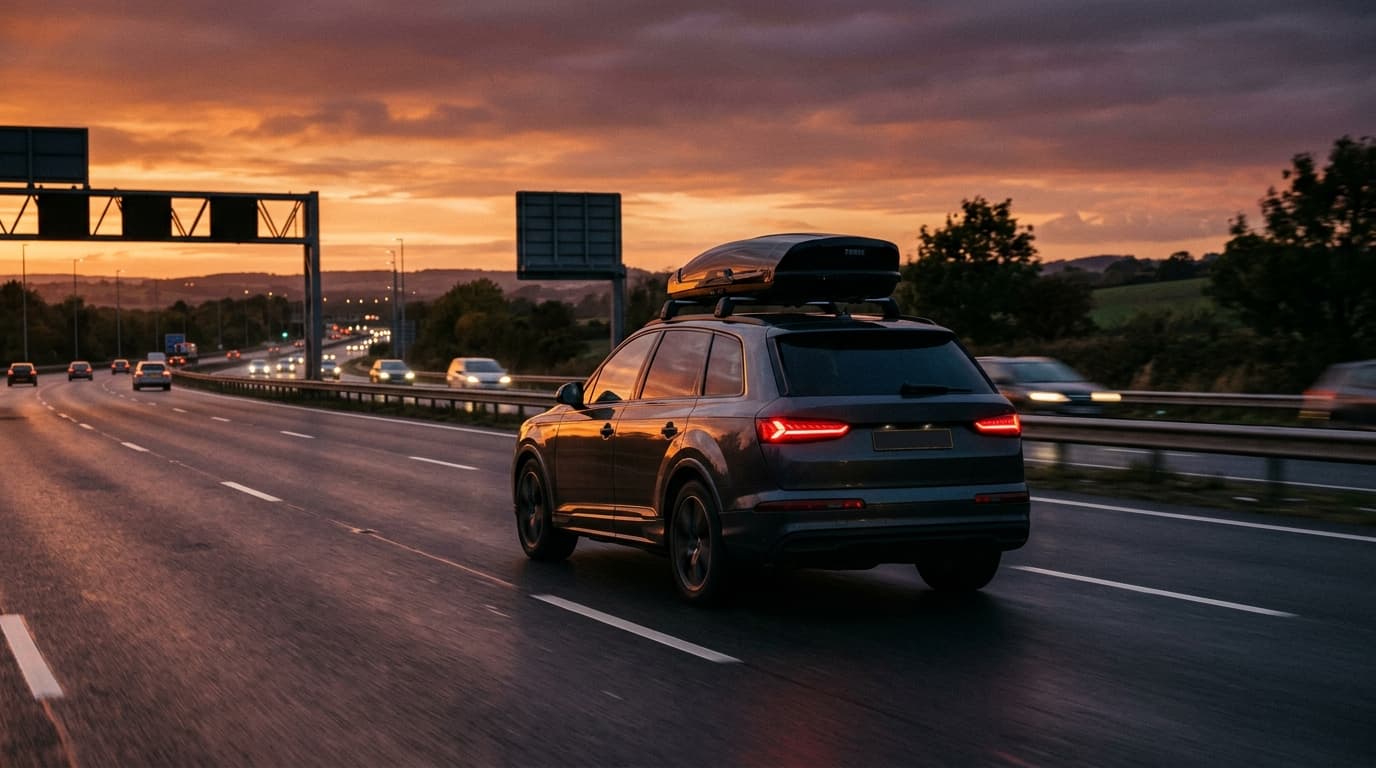
About one litre per 100 km. That is the extra consumption the ADAC measured for a roof box at 130 kph, more than 18 % on top of the baseline. Over a return trip to southern France, the petrol bill comes to roughly forty euros. A trailer, on the other hand, mostly costs you elsewhere.
A roof box costs about one litre per 100 km
The figure that matters comes from the ADAC: at 130 kph, a car fitted with a roof box burns on average 18 % more fuel, roughly one extra litre per 100 kilometres.
This is not a back-of-the-envelope estimate. In the test of ten roof boxes run with Stiftung Warentest, the reference car was a Volkswagen Touran 2.0 TDI, using 6.1 litres per 100 km at 130 kph with a bare roof. With the thriftiest box of the group, a Kamei Oyster 450, consumption rose by 0.94 litre. With the thirstiest, a Northline Tirol 420, by 1.29 litres. Three and a half tenths of a litre separate the best from the worst, on the same roof, at the same speed.
The second finding is less widely known: the penalty does not wait for motorway speed. The ADAC already records around 11 % more consumption at 80 kph. Even a steady run on a main road costs something.
A word on speed, because the German recommendation needs translating for a Belgian number plate. The ADAC advises staying under 130 kph with a box, and notes that no specific rule governs the speed of a car loaded this way, a box counting legally as cargo. On a Belgian motorway the legal ceiling is 120 kph. The ADAC's cautious recommendation therefore sits above what we are allowed to do in the first place.
What does it cost on a Brussels to Montpellier run?
Forty euros and change.
The official maximum price for 95 RON E10 petrol has been set at 2.0580 euros per litre since 3 September 2026. A Brussels to Montpellier return trip covers roughly 2,000 kilometres. Applying the gaps measured by the ADAC to that price and that distance puts the roof box bill in black and white.
| Setup | Extra use at 130 kph | Extra petrol over 2,000 km | Cost at the 3 September 2026 rate |
|---|---|---|---|
| Bare roof (ADAC baseline) | 6.1 L/100 km | 0 L | 0 € |
| Thriftiest box in the test | +0.94 L/100 km | 18.8 L | 38.69 € |
| ADAC average | +1.00 L/100 km | 20.0 L | 41.16 € |
| Thirstiest box in the test | +1.29 L/100 km | 25.8 L | 53.10 € |
Forty euros for a summer is hardly ruinous. It is in fact less than most people assume when they read the 25 % figures floating around. The sum changes entirely, though, if the box stays bolted on all year, which is what usually happens.
How much weight will your roof actually take?
Between 50 and 100 kg, and the exact figure is in your owner's manual.
That limit, and the ADAC is emphatic here, includes the weight of the empty box and of the bars. A 15 kg box on a 5 kg set of bars already eats 20 of the 75 kg allowed on many SUVs. Fifty-five kilos of luggage remain, and a full suitcase quickly weighs 20.
The car's maximum authorised mass is a separate constraint, printed on the registration certificate. Touring points out that exceeding that MMA costs 100 euros in Belgium, with an obligation to unload the excess luggage on the spot. In front of the police, at the roadside, with two children in the car.
Five checks before loading the roof:
- The maximum roof load, in the owner's manual, never in the sales brochure.
- The empty weight of the box and bars, to be subtracted from that load before counting a single bag.
- The car's maximum authorised mass, box F.1 on the registration certificate.
- The total height once the box is fitted, measured against the car park you actually use.
- The maximum speed recommended by the box manufacturer, often below 130 kph.
The height point deserves a detour. The ADAC flags it in a single line, and our survey of underground car park heights in Belgium shows why: five of the six sites posted 2.00 metres or less. An SUV with a box on top rarely clears that.
Roof bars stay on eleven months out of twelve
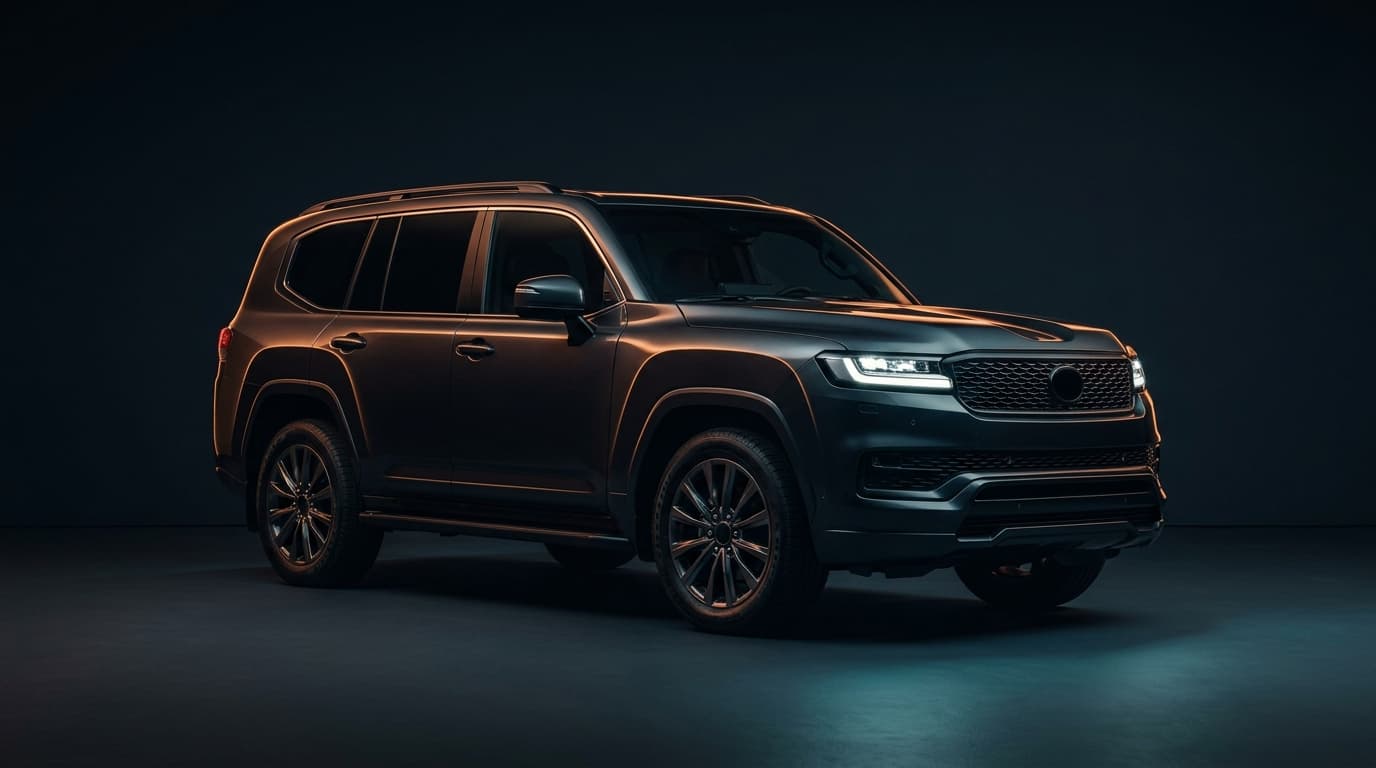
A set of bars comes off in ten minutes with two spanners. Most cars fitted with them keep them on all year.
The ADAC recommends taking the box off as soon as the holiday is over. The same applies to the bars, which disturb the airflow even with nothing on them. No public test puts a clean figure on their penalty in isolation for a given model, which is an awkward gap given how many cars drive around with unused bars for eleven months.
Does a trailer use less fuel than a roof box?
On paper, yes. Measured properly, nobody knows.
The aerodynamic reasoning is simple: a trailer stays close to the ground, in the car's wake, whereas a roof box intrudes on the area where the airflow is cleanest. An SUV, with its already tall roofline and vertical tailgate, does not react to the same accessory the way an estate does.
The catch is that a trailer's extra consumption depends on its shape, its height, its load and the towing car, to a degree that makes any single percentage meaningless. The figures doing the rounds, often around 30 %, trace back to no published protocol comparable to the ADAC's. We will not repeat any of them.
A trailer does have a thoroughly documented Belgian cost, though, and it is not in the fuel tank.
50.16 euros in Wallonia, nothing in Flanders, for the same trailer
A luggage trailer with a 400 kg maximum authorised mass costs fifty euros a year in Namur and zero in Antwerp.
SPW Finances is explicit for Wallonia. Below 750 kg, the trailer is not registered with the DIV, but its owner must file a declaration with the Walloon tax administration before any use on the public road, then display a signe distinctif fiscal (fiscal identification sticker) in the car proving payment. The scale running from 1 July 2026 to 30 June 2027 sets 50.16 euros up to 500 kg and 104.15 euros from 501 to 3,500 kg, indexed every 1 July. A replica of the towing car's number plate must also be fitted at the rear, under article 30 of the royal decree of 20 July 2001.
In Flanders, that same 400 kg trailer towed by a private individual's car is exempt from road tax as long as its maximum authorised mass stays at or below 750 kg. No paperwork, no sticker.
In Brussels, Bruxelles Fiscalité explicitly lists trailers among taxed vehicles, the amount depending on the maximum authorised mass. The rate table is worth checking with the regional administration before buying.
Three regions, three treatments, for an object that crosses a regional border in twenty minutes on the ring road. Above 750 kg the trailer shifts into another regime again, with its own registration, and our article on towing a caravan on a category B licence sets out the six cases and the licence thresholds.
Which solution for which trip?
| Criterion | Bare bars and a roof bag | Roof box | Luggage trailer |
|---|---|---|---|
| Volume gained | the smallest of the three | 300 to 600 L according to Touring | the largest |
| Measured extra consumption | no isolated public test | about +1 L/100 km at 130 kph (ADAC) | no comparable public protocol |
| Payload | the car's roof load limit | same, bars and empty box included | the trailer's own MMA |
| Added height | slight | prohibitive below 2.00 m | none |
| Annual tax | none | none | 50.16 € in Wallonia below 500 kg, 0 € in Flanders below 750 kg, taxed in Brussels |
| Paperwork | none | none | prior declaration in Wallonia, registration above 750 kg |
| Parking on arrival | not an issue | not an issue | you need somewhere to leave it |
The verdict comes down to three profiles. For one week a year and two suitcases that no longer fit, the roof box remains the simplest answer, forty euros of petrol aside, provided you take it off on the way back. For a camping trip with bulky, light gear, the trailer wins, but only if you live in Flanders or accept the Walloon declaration and its fifty euros a year. And if your luggage fits in the boot once packed a little better, the cheapest accessory is the one you never buy.
Bicycles raise a separate question, covered in our comparison of tow bar, tailgate and roof bike racks. And if boot volume is your real buying criterion, the comparison tool filters directly on the quoted capacity.
Frequently asked questions
By around one litre per 100 km at 130 kph, more than 18 %, according to ADAC measurements. The penalty starts well below motorway speed: the ADAC records roughly 11 % more as early as 80 kph. Between the thriftiest and the thirstiest box in its test, the gap reaches 0.35 litre per 100 km.
Yes, and the ADAC says so explicitly. No public test puts a clean figure on bare bars for a given model, but the drag they add does not vanish once the box is back in the garage. Taking them off takes about ten minutes and costs nothing.
On paper, probably, since the towed mass stays at ground level and disturbs the airflow above the roof far less. No serious public comparison proves it on an identical car, and the shape of the trailer changes everything. In Belgium the real cost gap lies in tax and paperwork.
Between 50 and 100 kg depending on the car, according to the ADAC, with the exact figure printed in the owner's manual. The weight of the bars and of the empty box counts against that limit before the first suitcase. The car's maximum authorised mass is a separate figure, shown on the registration certificate.
We dig through the Belgian market data — TÜV reliability, real-world ADAC consumption, company-car taxation, list prices — to call it straight. No brand pays us.