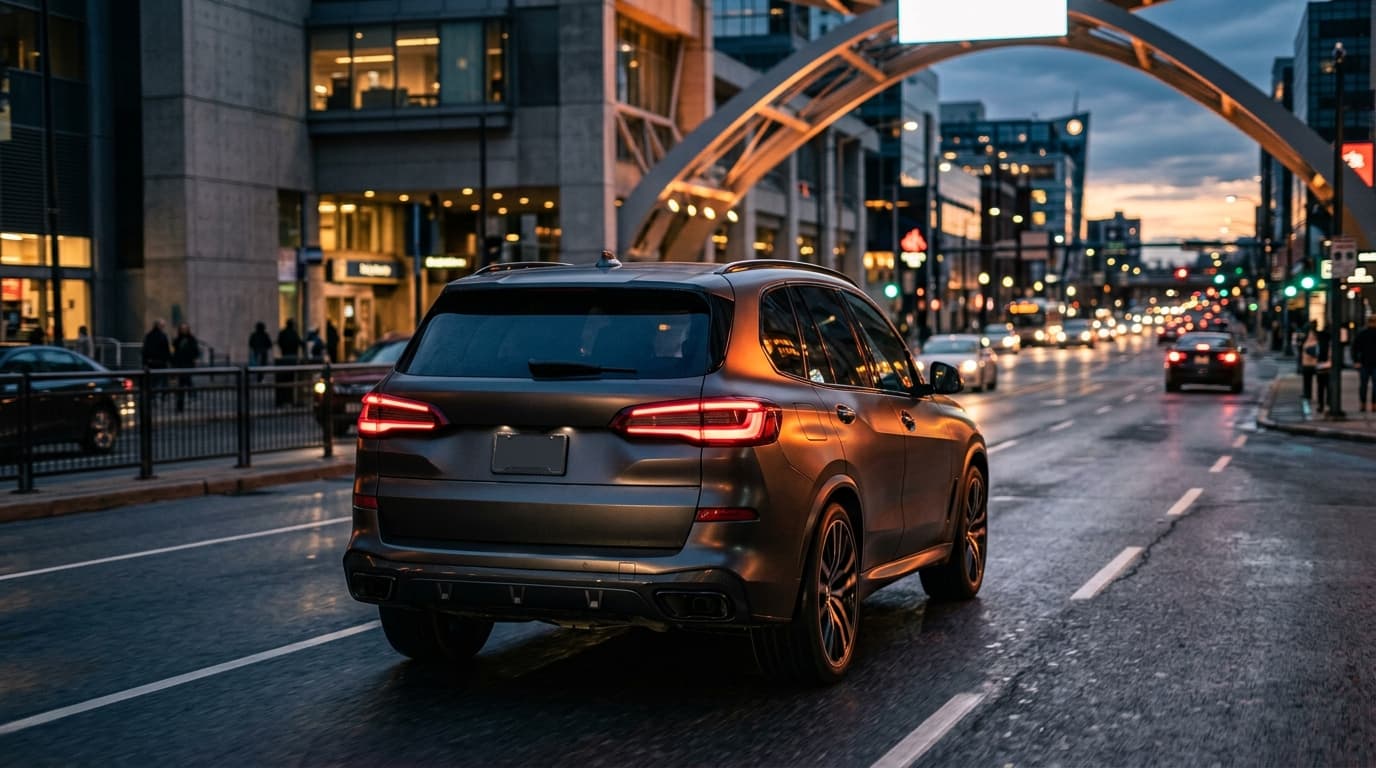
It depends on your fuel, not on your certificate. On diesel, a Euro 6b SUV leaves the Brussels low emission zone on 1 January 2028 while a Euro 6d lasts until 2030. On petrol, both keep driving until 2035. Same wording in field V9, seven years apart.
Your certificate says "Euro 6", the Brussels calendar counts three
The official Brussels LEZ calendar does not have one Euro 6 row. It has three.
Recorded on 21 September 2026 on the access calendar at lez.brussels, the passenger car table stacks, from the top down: Euro 7, then "Euro 6d - Euro 6e", then "Euro 6d-TEMP", then "Euro 6 (b, c)", then Euro 5. Each one has its own exit date.
Field V9 of your registration certificate, meanwhile, most often writes nothing but EURO 6. No letter. It is the source the administration treats as authoritative, and it does not answer the question.
How do you tell whether your SUV is a 6b, a 6c or a 6d?
By the date of first registration in the European Union, or failing that by the type-approval code. The cut-offs are fixed and public: Touring sets them out in its correspondence table, from 1 September 2015 to 31 August 2018 for Euro 6b, until 31 August 2019 for 6c, until 31 December 2020 for 6d-TEMP, from 1 January 2021 for 6d.
A plug-in hybrid SUV adds a line to that list: Euro 6e bis, in force since 1 January 2025, was written specifically for PHEVs and for the way they declare the electric share of their journeys. A plug-in hybrid delivered in early 2025 can therefore carry a marking that exists on no other type of car.
Four traps make the identification less simple than it looks.
- A used-car listing that writes "Euro 6" covers eleven years of production, from September 2015 to today, and three different rows of the Brussels calendar.
- A manufacturer may have moved early to the next standard: a car registered in July 2018 is sometimes already type-approved as a 6c, which the date alone will not tell you.
- On a German or Dutch import, what counts is the date of first registration in the EU, not the Belgian registration date, which is often several years later.
- The Car-Pass, Belgium's official mileage history document, repeats the wording of the certificate. Same imprecision, copied across.
The quickest route remains the chassis number: Ecoscore, the tool built for the Belgian regions, returns the emission class from the VIN, with no document to dig out of a drawer. Failing that, the type-approval code sits on the European certificate of conformity, and Bruxelles Fiscalité, the Brussels tax administration, publishes the matching correspondence table.
Euro 6b, 6d-TEMP, 6d: the table of Belgian deadlines
| Sub-standard | First EU registration | Brussels, diesel or diesel hybrid | Brussels, petrol, LPG, CNG or petrol hybrid | Antwerp and Ghent | Wallonia |
|---|---|---|---|---|---|
| Euro 6b | 01/09/2015 to 31/08/2018 | Until 31 December 2027 | Until 2035 | Free access | No restriction |
| Euro 6c | 01/09/2018 to 31/08/2019 | Until 31 December 2027 | Until 2035 | Free access | No restriction |
| Euro 6d-TEMP | 01/09/2019 to 31/12/2020 | Until 2030 | Until 2035 | Free access | No restriction |
| Euro 6d and 6e | From 01/01/2021 | Until 2030 | Until 2035 | Free access | No restriction |
Converted into months of access left from September 2026, the gap jumps out. A Euro 6b diesel SUV has some fifteen months in Brussels. A Euro 6d has close to forty. And the very same Euro 6b, on petrol, has about a hundred.
One caveat is needed on these dates. The Region itself writes that the rules beyond 2028 may still change, and Energuide, the information service run by grid operator Sibelga, repeats the warning at the head of its table. The Brussels calendar has already been postponed once, then reinstated by the Constitutional Court in September 2025. What follows is the state of the calendar on 21 September 2026, not a promise.
Why does the same 6b last seven years longer on petrol than on diesel?
Because Brussels has never sorted petrol on the sub-standard. The petrol calendar climbs step by step from Euro 2, it is due to reach Euro 4 in 2028, and it ends in one go in 2035 with the end of petrol engines in the zone. In between, a Euro 6b, a Euro 6d and a Euro 6e are treated as equals.
On diesel, the logic runs the other way. Real-world NOx emissions from the first Euro 6 engines were the story of the whole decade, and the tightening of the test protocol between 6b and 6d is precisely what separates the two calendar rows. The Region therefore turned the sub-standard into an access criterion, which it had no reason to do on the petrol side.
For a hybrid SUV the consequence is direct and often misread. A hybrid follows the calendar of its fuel, and the Region says so in as many words: petrol for a full hybrid or a petrol plug-in hybrid, diesel for the rare diesel hybrids on the market. Two hybrid SUVs registered in the same month of 2017, both Euro 6b, are therefore seven years apart on the strength of field P3 alone. The petrol one keeps Brussels open until 2035. The diesel one loses it on 1 January 2028. Our reference points on the access rules of the three Belgian LEZ set out the rest of the sorting.
Antwerp, Ghent and Wallonia do not sort within Euro 6
Neither Flemish LEZ goes down to sub-standard level: their access criteria stop at Euro 6. Wallonia, for its part, has had no low emission zone at all since its decree was dropped in April 2024.
The letter does have a tax effect, though, and it is a Flemish one. The Flemish registration tax (TMC, taxe de mise en circulation) and annual road tax formulas bring in a correction factor for air pollution that depends on the fuel and on the Euro standard, on top of CO2 and vehicle age: the Flemish tax portal simulator shows it on a real case. Brussels and Wallonia tax on engine power and cubic capacity, and ignore the question. Our calculation of the registration tax and road tax region by region sets out the full gap.
Should you sell a Euro 6b SUV now?
On petrol, no, and the question will not arise for a long time. On diesel, everything hangs on one thing: how much Brussels features in your driving.
A Walloon or Flemish household going up to the capital three or four times a year has no reason to move. From January 2028 those trips will cost 35 € a day in pass fees, capped at 24 passes a year per plate, so 840 € in the worst case. Selling an SUV in good condition to save 140 € of annual passes is arithmetically absurd.
The reasoning flips for a Brussels resident, for a daily commuter or for a parent dropping children at a school inside the nineteen municipalities. There, the vehicle becomes unusable in 2028, and the resale window closes before that date, because the market prices deadlines in before they land. Our analysis of the SUVs that hold their value in Belgium sizes up the drop.
One thing to do before buying a used diesel SUV advertised as "Euro 6": ask for the date of first EU registration and the certificate of conformity, not the wording of the listing. Between a 6b from August 2018 and a 6c from September 2018, the difference in access is nil today. Between a 6c from August 2019 and a 6d-TEMP from September 2019, it is worth two years of Brussels LEZ, and it shows up nowhere in the photographs. The comparison tool lets you filter models by powertrain before deciding.
Frequently asked questions
Field V9 of the registration certificate usually stops at EURO 6, with no letter. When it does, the date of first registration in the European Union decides: 6b from 1 September 2015 to 31 August 2018, 6c until 31 August 2019, 6d-TEMP until 31 December 2020, 6d after that. The type-approval code on the certificate of conformity gives the exact answer.
Yes, in September 2026, and with no paperwork at all. The regional calendar has it excluded on 1 January 2028, at the same time as the 6c. The Region flags that milestones beyond 2028 may still move, so check lez.brussels before basing a purchase on them.
Only if it is a diesel. A hybrid follows the calendar of its fuel: a Euro 6b petrol hybrid falls under the petrol calendar, which ends in 2035. A Euro 6b diesel hybrid goes out with the diesels on 1 January 2028.
In Flanders only. The Flemish registration tax (TMC) and annual road tax formulas include a correction factor for air pollution that depends on the Euro standard and the fuel. Wallonia and Brussels tax on engine power and cubic capacity, and never look at the letter.
We dig through the Belgian market data — TÜV reliability, real-world ADAC consumption, company-car taxation, list prices — to call it straight. No brand pays us.