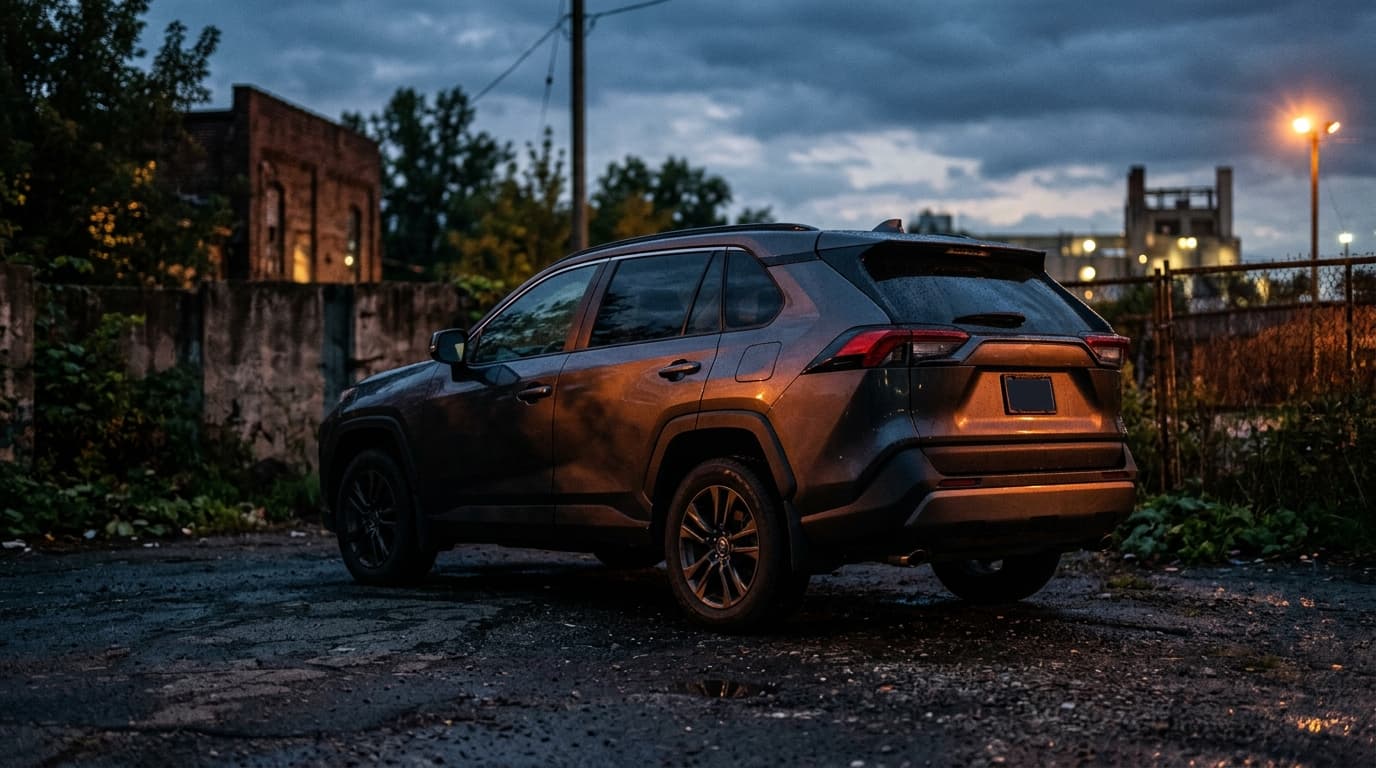
In Belgium, the SUV that holds its value best is the Toyota RAV4 Hybrid: about 28 to 33% depreciation at three years, when an average electric SUV loses 45 to 55%. But every SUV sheds close to 40% of its price in the first two years. Here are the models that resist, and the ones to avoid.
Which SUVs hold their value best in Belgium?
The Toyota RAV4 Hybrid, the Dacia Duster and the Peugeot 3008. The first for its reliability and hybrid demand, the second for a purchase price so low that the euro loss stays contained, the third for a very active Belgian used market. All keep 60 to 70% of their value at three years.
On the Belgian market, residual value comes down to two levers: used demand and perceived reliability. The RAV4 Hybrid ticks both. The Moniteur Automobile has long ranked it among the best resales in the segment, and 2026 valuations put its depreciation around 28 to 33% at three years. On a new price of €45,000, that still leaves €30,000 to €32,000 on the clock.
The Dacia Duster plays a different tune. Its purchase price around €20,000 is so low that the euro loss stays modest, even with a relative depreciation near 45%. The Belgian valuations from AutoHero and Vente Directe (2026) grant it close to 55% residual value at three years, one of the best on a small budget. The number that counts: a Duster often loses less than €9,000 in three years, where a premium SUV sheds €25,000.
The Peugeot 3008 and the Škoda Kodiaq round out the leading trio. The 3008, a best-seller in Belgium, benefits from sustained used demand and keeps its depreciation to 30-36%. The Kodiaq trades on its rarity as a 7-seater, with about 60 to 65% residual value at three years. Conversely, an Audi Q5 keeps a fine premium image but loses big in euros: often half its value at three years, meaning €25,000 to €30,000 gone.
| Model | BE price from | 3-year depreciation | Residual value | Resale strength |
|---|---|---|---|---|
| Toyota RAV4 Hybrid | ~€45,000 | ~28-33% | ~70% | reliability, hybrid demand |
| Dacia Duster | ~€20,000 | ~45% (low € loss) | ~55% | low price, liquid market |
| Peugeot 3008 | ~€38,000 | ~30-36% | ~66% | best-seller, strong BE demand |
| Škoda Kodiaq | ~€42,000 | ~35-40% | ~62% | sought-after 7-seater |
| Audi Q5 | ~€55,000 | ~45-50% | ~52% | premium image, big € loss |
| Tesla Model Y | ~€45,000 | ~45-50% | ~52% | active market, hit by price cuts |
Why does an SUV lose so much value in the first two years?
Because most of the depreciation lands the moment it leaves the showroom. In Belgium, an SUV loses about 40% of its value in two years, and more if it is little in demand, as the Moniteur Automobile notes. Year one is the harshest: the 21% VAT and the dealer margin vanish at the second registration.
In practice, the mechanism is simple. A new car includes 21% VAT that the used market does not recover, plus the registration cost and the first-owner premium. From the first kilometre, the vehicle drops into another price bracket. On a €45,000 SUV, year one alone can cost €9,000 to €12,000 in value.
After that, the curve flattens. Between the third and fifth year, an in-demand SUV loses 5 to 8% a year, a shunned model double that. This is where brand, engine and colour widen the gap. A careful Belgian buyer therefore chooses a new SUV already thinking about resale at three years, the most common horizon before renewal.
Do electric SUVs really depreciate faster?
Yes, clearly. An electric SUV loses 45 to 55% of its value in four years, against 30 to 40% for an equivalent hybrid. Repeated new-car price cuts and battery uncertainty drag the values down.
The Tesla case shows it well. By cutting its new prices again and again — Model Y down to around €33,000 and a €4,000 trade-in bonus in 2026 — the brand mechanically crushed the value of its used cars, with drops of 30 to 35% in a single tough year, according to Automobile Propre. Every cut on new prices immediately weighs on the used ones.
In Belgium, a local factor makes the trend worse: taxation. Since 2026, only zero-emission (0 g CO₂) vehicles remain 100% deductible for a company, which has pushed fleets towards electric. These company SUVs will flood the used market at three or four years, swelling supply and weighing on prices. Before buying an electric SUV, read our comparison of the best electric SUVs in Belgium and our company-car tax guide. What we would avoid: a niche electric, whose resale will depend on uncertain demand.
Diesel, petrol or hybrid: which engine resells best?
Hybrid, ahead of petrol; diesel brings up the rear. In Belgium, the collapse in diesel demand has pushed used prices down, while hybrid SUVs resell fast and dear.
Diesel is paying for the spread of low-emission zones. Brussels, Antwerp and Ghent tighten access for older diesels every year, and Brussels is aiming for a near-total diesel ban by 2030. The result: a diesel SUV over five years old is dumped cheap, except for the motorway high-mileage driver who still finds a consumption case for it.
Conversely, hybrid benefits from displaced demand. A RAV4 Hybrid or a Kia Sportage HEV moves fast used, carried by buyers who want to cut their consumption without going fully electric. Belgian market data show that pure petrol holds an intermediate position: fine on small SUVs, weaker on big thirsty engines. To settle the engine question, see our hybrid-versus-electric comparison.
How can you limit your SUV's depreciation in Belgium?
Four levers. Keep the mileage in check (under 15,000 km/year is a selling point), keep the service book up to date, choose a sober colour and a common trim, and favour a model already popular used. Each one pays off at resale.
Mileage and history weigh heavily. All else equal, an SUV serviced at a dealer with invoices sells for several thousand euros more than one with no history. Colour matters too: grey, black and white move without extra depreciation, where a bright shade scares off the average buyer and lengthens the time to sell.
The most profitable lever is the timing of the purchase. By taking an SUV one to two years old rather than new, you let the first owner absorb the initial 40% loss. On a reliable model like the RAV4 Hybrid, it is the best compromise between purchase price and future resale; our full method is set out in the guide to reliable used SUVs.
Which SUVs should you avoid if you already have resale in mind?
Three families. Big premium diesel SUVs, brands without an established network, and rare trims or colours. Each speeds up depreciation for a different reason.
Big premium diesel SUVs — Audi Q7, BMW X5 diesel — stack the handicaps: a massive euro loss, often more than €25,000 at three years, and direct exposure to low-emission zones. Brands without a solid network in Belgium, notably some Chinese newcomers, depreciate faster for lack of used demand and after-sales confidence; our analysis of Chinese SUVs in Belgium quantifies it, up to −42% at three years on some models.
Finally, beware exotic configurations. A rare trim, a bright shade or oversized wheels appeal at purchase but shrink the buyer pool at resale. What we would also avoid: ordering a plug-in hybrid SUV through a company after 2026, now non-deductible and therefore hard to place back on the professional market.
Frequently asked questions
The Toyota RAV4 Hybrid. Its proven reliability and strong used demand keep depreciation to about 28 to 33% over three years, the best in the segment. The Dacia Duster follows closely on euro loss, because its low purchase price (around €20,000) limits the damage even with a higher relative depreciation.
Between 30 and 50% depending on the model and engine. An SUV already loses close to 40% in the first two years, the drop being steepest in year one. A popular hybrid stays at 30-35%, an average electric at 45-55%, a big premium diesel can exceed 50% in absolute value.
Yes, clearly. An electric SUV loses 45 to 55% of its value in four years, against 30 to 40% for an equivalent hybrid. Repeated new-car price cuts, uncertainty over the battery and the mass return of company vehicles to the used market all drag the values down.
Hybrid, ahead of petrol; diesel brings up the rear. In Belgium, the collapse in diesel demand and the spread of low-emission zones in Brussels, Antwerp and Ghent have pushed used diesel prices down. A recent hybrid SUV, by contrast, resells fast and dear.
Drive sensibly (under 15,000 km/year is a strong selling point), keep the service book up to date, choose a sober colour (grey, black, white) and a common trim. Buying an SUV that is one to two years old rather than new also lets you skip the steepest part of the depreciation.
Big premium diesel SUVs (think Q7 or X5 diesel), penalised by low-emission zones and a huge euro loss; brands with no established network in Belgium, whose depreciation speeds up for lack of demand; and rare trims or colours, harder to move on. A PHEV ordered by a company after 2026 also resells poorly, for lack of tax deductibility.
Yes, proportionally. The harshest depreciation hits the first two years: by buying an SUV that is 12 to 24 months old, you let the first owner absorb close to 40% of the loss. On a reliable, in-demand model like the RAV4 Hybrid, it is the best compromise between purchase price and resale.
We dig through the Belgian market data — TÜV reliability, real-world ADAC consumption, company-car taxation, list prices — to call it straight. No brand pays us.