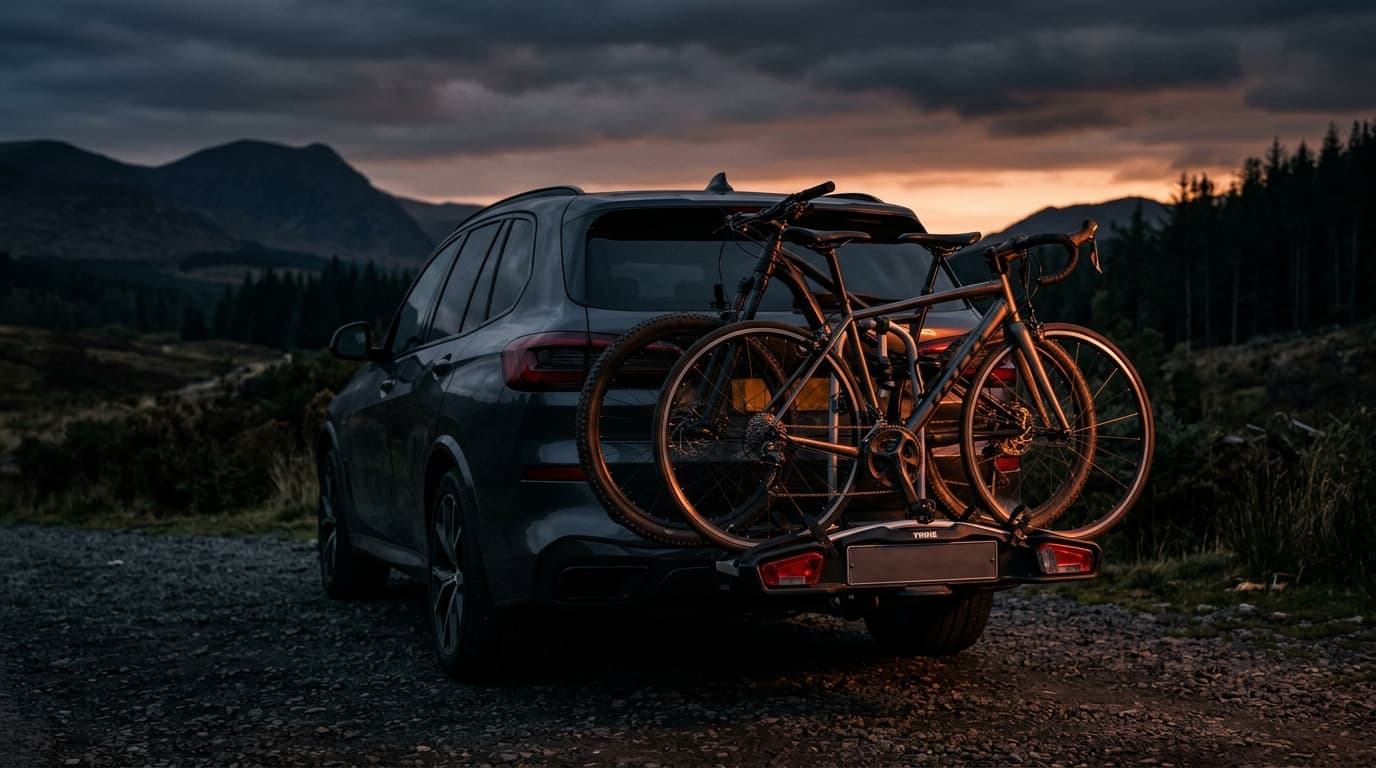
On an SUV, the tow bar rack wins almost every time. But the number that decides is not its price: it is your tow bar's nose weight, somewhere between 32 and 100 kg depending on the vehicle. Two e-bikes and a folding rack, and you are already there.
The real ceiling is nose weight, not the number of bikes
Everyone asks how many bikes. The right question is how many kilos on the ball.
Nose weight, also called tongue weight, is the maximum load that may press vertically on the tow ball. It is printed in the owner's manual, on the tow bar's rating plate, and sometimes on a sticker in the door pillar or the boot. According to the Test Achats guide on fitting a bike rack, it usually sits between 32 and 100 kg depending on the vehicle and the tow bar fitted.
That figure includes everything. The empty rack, the bikes, the locks, the panniers left on a rear carrier. A two-tonne SUV changes nothing: the limit comes from the tow bar frame and its mounting points, not from the mass of the car. Exceeding it damages the frame, lightens the front axle and dulls the steering; in extreme cases the bar breaks.
On the Belgian market this is the point sales pages never lead with. You are sold a "60 kg" rack, you conclude you can load 60 kg, and nobody tells you the rack's own 18 kg are already counted against your car.
How much does a rack loaded with two e-bikes really weigh?
Between 68 and 74 kg. That calculation rules out half the setups Belgian families have in mind, and it takes thirty seconds.
An electrically assisted bike weighs 20 to 30 kg, against 12 to 16 kg for a non-assisted mountain bike. The folding tow bar rack itself weighs 17.9 kg empty for a Thule EasyFold XT 2 and 21 kg for a Norauto E-FIT 300-2, according to their respective product sheets. Both quote 60 kg of payload and 30 kg maximum per bike.
| Setup | Empty rack | Bikes | Total on the ball | Nose weight required |
|---|---|---|---|---|
| Thule EasyFold XT 2 + 2 non-assisted MTBs (15 kg) | 17.9 kg | 30 kg | 47.9 kg | 50 kg |
| Thule EasyFold XT 2 + 2 light e-bikes (22 kg) | 17.9 kg | 44 kg | 61.9 kg | 65 kg |
| Thule EasyFold XT 2 + 2 heavy e-bikes (28 kg) | 17.9 kg | 56 kg | 73.9 kg | 75 kg |
| Norauto E-FIT 300-2 + 2 e-bikes (25 kg) | 21 kg | 50 kg | 71 kg | 75 kg |
The number that matters: 73.9 kg. An SUV whose tow bar is rated at 70 kg of nose weight, which is common, cannot carry two touring e-bikes on that rack, even though the rack itself is sold for 60 kg of bikes. The two limits stack, and the lower one applies.
The serious objection: a tailgate rack costs ten times less
It is a fair one, and it deserves an answer before you spend several hundred euros.
A strap-mounted rack sits on the tailgate without a tow bar, needs no fitting work on the car and folds into a bag. The Mottez Ariane 3, made in France, carries three bikes and states a 45 kg maximum load on the manufacturer's own sheet, with conformity verified by France's LNE laboratory. Checked on 22 August 2026 at a Belgian retailer, it sells for around 80 €. By comparison, the bike racks lab-tested by Test Achats start at 679.95 €.
Except that 45 kg for three bikes works out at 15 kg per bike. A single e-bike already exceeds that ceiling. The strap rack is therefore for non-assisted bikes only, full stop, and any other reading of the spec sheet is a miscalculation dressed up as a saving.
On an SUV two practical problems come on top. The tailgate is tall, often curved, sometimes topped by a spoiler and increasingly powered: compatibility has to be checked model by model in the maker's instructions, not by eye. And once the bikes are on, the plate and the lights nearly always disappear behind the wheels, which brings you back to the obligations described below. A tailgate rack still makes sense for two mountain bikes taken out three weekends a year. Beyond that, it does not.
What about the roof?
No, barring special cases. An SUV carries its roof bars more than 1.80 m off the ground: lifting a 25 kg e-bike at arm's length to that height is not a manoeuvre, it is an accident in the making. Test Achats also measures a 20 to 30 % rise in fuel consumption with a bike rack, and the roof is by far the worst position since it presents the largest surface to the wind. Keep it for light bikes, on a compact SUV, when there is no tow bar.
What Belgian law requires behind your SUV
The number plate and the rear lights must stay visible at all times. This is a federal traffic code rule, identical in Wallonia, Brussels and Flanders, unlike car taxation, which does change from one region to the next.
As soon as the rack or the bikes hide them, even partly, you must add a plate holder and an approved lighting board. Local police forces regularly remind drivers of these obligations before the holiday season, and Touring Carselect sets out the legal framework for tow bars in Belgium, fitting and costs included.
On the wiring side, a 7-pin socket powers the position lights, brake lights, indicators and plate lighting, which covers the legal requirement. A 13-pin socket becomes necessary for a reversing light, an electric release on the rack or an accessory supply. Most racks designed for e-bikes ship with 13-pin wiring.
Points to check before you leave:
- The permitted nose weight, read off the tow bar plate rather than estimated.
- The real weight of the bikes, weighed once rather than taken from a catalogue.
- Visibility of the plate and of all six lighting functions, with the bikes loaded.
- The clamping force, neither too loose nor excessive, as per the instructions.
- Panniers, computers and removable batteries taken off the bikes.
- The tilt angle, which does not always clear a large SUV tailgate.
No specific speed limit applies in Belgium with a bike rack. Manufacturers generally add a 130 km/h sticker and Test Achats advises dropping to 90 or 100 km/h in crosswinds. If you cross a border, check the local rules: they differ across Europe, notably on repeated plates and reflective panels.
Is your bike rack covered by your omnium policy?
Almost never, and it is the most common unpleasant surprise.
Most Belgian insurers explicitly exclude bike racks from omnium (comprehensive) cover, on the grounds that the rack is not permanently attached to the vehicle and comes off in seconds. Test Achats notes that Baloise and AG Insurance allow it to be insured through an extension of the casco cover, and that AG Insurance will also co-insure the bike being carried.
Read the condition carefully, because it strips much of the value out of the cover: the bike is only insured against theft if the car is stolen too. A bike lifted off the rack in a motorway service area triggers no payout at all. What we would avoid: setting off assuming that 4,000 € of bikes hanging off the back are insured because the car is.
When not to buy anything
Do the full sum first. If your SUV has no tow bar, you have to count fitting the bar and its wiring loom, then the rack, then possibly the insurance extension. For two cycling weekends a year, renting a rack from a car centre or borrowing a strap rack is unbeatable, and a regional train with the bikes settles the question without buying anything.
Buying makes sense from the moment you leave several times a year with e-bikes: there the folding tow bar rack is the only format that holds up, provided your nose weight follows. In practice that gives three clear cases. Nose weight of 50 kg or less: two non-assisted bikes maximum, no e-bikes. Between 60 and 70 kg: two light e-bikes, weighed before you buy. Above 75 kg: you have the choice, three and four-bike racks included.
The rest comes down to size and use. If the boot is enough once the wheels are off, our ranking of SUV boot space in real litres may save you the purchase. If you are adding a tow bar, it is worth checking what your SUV can actually pull in our guide to SUVs that can tow a caravan. And if the fuel penalty worries you, it hits already-heavy models hardest: our survey of the most fuel-efficient SUVs gives the best starting points, while our selection of the best 7-seater SUVs in Belgium covers families who need to load the bikes and the children.
Frequently asked questions
What nose weight do I need to carry two e-bikes on an SUV? At least 70 to 75 kg. A folding tow bar rack weighs 15 to 21 kg empty, and two e-bikes weigh 40 to 56 kg depending on the type. All of it rests on the ball. Your vehicle's figure is on the tow bar's rating plate, in the manual, or on a sticker in the boot. If it reads 50 kg, two e-bikes are out of the question, whatever rack you buy.
Does a tailgate bike rack work on an SUV? For two or three non-assisted bikes, yes, provided the rack maker explicitly lists your model. For e-bikes, no: a strap rack such as the Mottez Ariane 3 tops out at 45 kg for three bikes, or 15 kg per bike. On an SUV two extra problems appear: the tailgate is often tall, curved and sometimes powered, and the bikes almost always hide the plate and the lights.
Do I need a 13-pin socket for a bike rack in Belgium? Not always, but it is the default choice. A 7-pin socket powers the position lights, brake lights, indicators and plate lighting, which meets Belgian rules. A 13-pin socket is required if the rack has a reversing light, unlocks electrically or powers an accessory. Most racks designed for e-bikes ship with 13-pin wiring.
Is there a speed limit with a bike rack in Belgium? No, Belgium sets no specific limit. Manufacturers generally add a sticker capping use at 130 km/h, and Test Achats advises staying between 90 and 100 km/h with a rear load, especially in crosswinds. Check before crossing a border: rules differ across Europe, notably on repeated plates and reflective panels.
Frequently asked questions
At least 70 to 75 kg. A folding tow bar rack weighs 15 to 21 kg empty, and two e-bikes weigh 40 to 56 kg depending on the type. All of it rests on the ball. Your vehicle's figure is on the tow bar's rating plate, in the manual, or on a sticker in the boot. If it reads 50 kg, two e-bikes are out of the question, whatever rack you buy.
For two or three non-assisted bikes, yes, provided the rack maker explicitly lists your model. For e-bikes, no: a strap rack such as the Mottez Ariane 3 tops out at 45 kg for three bikes, or 15 kg per bike. On an SUV two extra problems appear: the tailgate is often tall, curved and sometimes powered, and the bikes almost always hide the plate and the lights.
Not always, but it is the default choice. A 7-pin socket powers the position lights, brake lights, indicators and plate lighting, which meets Belgian rules. A 13-pin socket is required if the rack has a reversing light, unlocks electrically or powers an accessory. Most racks designed for e-bikes ship with 13-pin wiring.
No, Belgium sets no specific limit. Manufacturers generally add a sticker capping use at 130 km/h, and Test Achats advises staying between 90 and 100 km/h with a rear load, especially in crosswinds. Check before crossing a border: rules differ across Europe, notably on repeated plates and reflective panels.
We dig through the Belgian market data — TÜV reliability, real-world ADAC consumption, company-car taxation, list prices — to call it straight. No brand pays us.