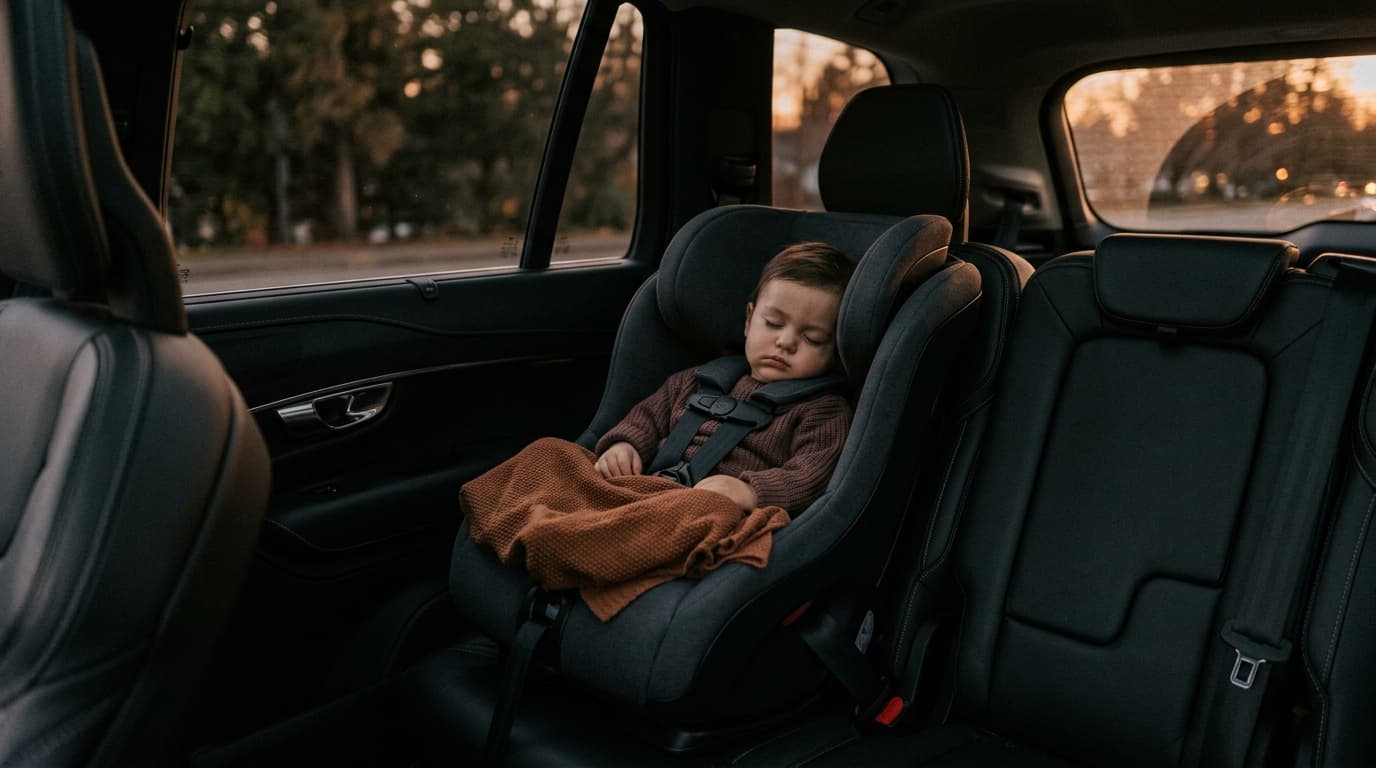
Rear-facing, for as long as possible: it is the position that best protects a child's neck in a frontal crash. Under the R129 standard, a car seat may only be turned forward-facing from 15 months and 76 cm. ADAC advises waiting two years, Sweden four. In an SUV, the real limit is space.
Rear-facing against forward-facing: six criteria
The table settles the question before the detail. Six criteria, two positions, and a verdict that only tips on the last one.
| Criterion | Rear-facing | Forward-facing |
|---|---|---|
| Frontal crash, head and neck | head and body held at the same time, neck load clearly lower according to ADAC | the head is thrown forward, held back only by the neck |
| Minimum age under R129 (i-Size) | from birth | 15 months and 76 cm at least |
| Minimum age under R44 (older seat) | from birth | 9 kg, sometimes reached at around six months |
| Front seat | possible, frontal airbag must be deactivated | possible, but Trafikverket advises against any active frontal airbag below 140 cm |
| Space in an SUV | the front seat often has to move well forward | no constraint on the front seat |
| Daily use | longer, the child is harder to buckle in | simpler, the child sees the road |
The verdict fits in one line: rear-facing wins on everything to do with safety, forward-facing wins on parents' convenience. The two 0 to 4 year seats we looked at closely, from Cybex and Maxi-Cosi, work in both directions up to 105 cm. The choice costs nothing at the till; you pay for it in centimetres.
At what age should a car seat face forward in Belgium?
Not before 15 months and 76 cm with an i-Size seat.
The Belgian highway code itself sets no age. Article 35 of the Royal Decree of 1 December 1975 requires a suitable restraint for every child under 18 who is shorter than 135 cm, as the Germinalt police zone (in French) recalls. Neither the Brussels Region's page on carrying children (in French) nor the police pages we read on 13 October 2026 give an age for turning the seat. The rule comes from the seat's approval, and it changes with the orange label.
The R129 standard requires rear-facing until at least 15 months and sets 76 cm as the minimum height for a forward-facing seat, as the manufacturer Cybex explains in its overview of the standards. The older R44 let the child turn from 9 kg, a weight "sometimes reached at 6 months", notes the French consumer magazine Que Choisir on 4 June 2025. Since 1 September 2024, only R129 seats are sold new in the European Union, but an R44-03 or R44-04 already bought remains usable.
| Your seat | Forward-facing allowed from | Our advice |
|---|---|---|
| R129 (i-Size), approved rear and forward | 15 months and 76 cm, both conditions | wait at least two years |
| R44-04 or R44-03, group 0+/1 | 9 kg | ignore the 9 kg threshold, aim for at least 15 months |
| R44-02 or R44-01 | no use at all | banned since 2008, replace it |
| R129 rear-facing-only seat (infant carrier) | never | move to a next-stage seat, not to a forward-facing one |
The rule is federal: nothing changes between Wallonia, Brussels and Flanders.
The protection gap is all about the neck
ADAC, the German automobile club, puts it plainly in its guide to rear-facing seats published on 10 June 2026 (in German): in a frontal crash, a rear-facing seat holds the head and body at the same time, and the load on the neck is "clearly lower" than forward-facing. Facing forward, at the moment of impact, the harness holds the body and the head keeps moving: all the effort goes through the neck.
Sweden goes further. The Trafikverket brochure (French-language edition), from the Swedish Transport Administration, recommends rear-facing "preferably until the age of 4" and estimates that a forward-facing child runs "five times the risk of being killed or seriously injured". The document dates from May 2012, and we found no more recent Belgian study putting a figure on the gap.
The country even has its own test. The Plus Test by the Swedish institute VTI, launched in 2007 and revised in 2023, simulates a frontal crash at about 56 km/h and measures the forces on the neck. It is only carried out on rear-facing seats.
Until what age should a child stay rear-facing?
Two years at the very least, four if the car and the seat allow it.
ADAC sets the floor at two years. Sweden aims for four. In between, the seats decide, and those available in Belgium go a long way: the Cybex Sirona T i-Size stays rear-facing up to 105 cm, and so does the Maxi-Cosi Pearl 360 Pro, according to ADAC's test sheets. A four-year-old is often around one metre tall. The seat therefore follows the Swedish recommendation with no change of equipment.
Before turning the seat, four checks:
- the orange label, to know whether the seat is R129 or R44;
- the two R129 thresholds, 15 months and 76 cm, to be met together rather than one or the other;
- the forward-facing range in the manual, 76 to 105 cm on both seats mentioned here;
- the front passenger's position: if they can no longer sit normally, it is the car that forces the change, not the child.
Does an SUV leave enough room for rear-facing?
Often, but not always where you expect it.
A rear-facing seat up to 105 cm takes its space in the cabin, not in the boot. ADAC says so clearly: these seats need a lot of room, and the passenger seat sometimes has to move so far forward that "a correct seating position is no longer guaranteed". In its October 2023 test sheets, the club notes an "increased space requirement" for the Sirona T. In practice, that gives a simple rule in a compact SUV: fit the seat behind the passenger, never behind the driver, whose driving position is not negotiable. An SUV's seat height helps you lower the shell without breaking your back; the length of the cabin does the rest.
Measure on the test drive, with the passenger seat set for an adult. Our comparison of compact SUVs for a baby car seat shows that 33 cm of overall length separate the Toyota Yaris Cross from the Hyundai Tucson, and those are precisely the centimetres the front passenger misses when a rear-facing seat is fitted behind them. If you often move the seat between cars, our article on the so-called universal ISOFIX base explains what a base changes day to day.
Rear-facing in the front: allowed, airbag off
The federal police (in French) pointed it out on 17 June 2025: a child may sit in the front at any age, but with a rear-facing seat "there can be no activated frontal passenger airbag". It would deploy a few centimetres from the child's head.
Avoid this: switching the airbag off for one trip, then forgetting it is still off the next day for an adult. Check the warning light every time you set off.
Two rear-facing seats up to 105 cm, with ADAC scores
| Seat | Rear-facing | Forward-facing | ADAC score (safety) | Price |
|---|---|---|---|---|
| Cybex Sirona T i-Size + Base T | 45 to 105 cm | 76 to 105 cm | 2.3 (1.7), October 2023 | 379.95 € on Cybex's Belgian shop on 13 October 2026; about 600 € according to ADAC |
| Maxi-Cosi Pearl 360 Pro + FamilyFix 360 Pro | 61 to 105 cm | 76 to 105 cm | 2.1 (1.9), October 2023 | about 670 € according to ADAC, not checked in Belgium |
Sources: ADAC test sheets for the Sirona T and the Pearl 360 Pro (in German; ADAC scores run from 0.6, very good, to 5.5), Cybex's Belgian product page for the Sirona T i-Size (R129/03 approval, ISOFIX and load leg, 360° rotation).
We have tested neither. The gap between the Belgian price and the ADAC price may come down to the base, sold alone or bundled depending on the shop: check in the basket what is included. The Sirona T rotates 360°, and the Pearl 360 Pro is sold as a rotating seat: in an SUV, you put the child in with the door open before turning them rear-facing, and that move matters more than half a point of score. On the Sirona T, ADAC notes an increased space requirement, a child who takes longer to buckle in and a reduced view outside.
The figure that matters: 105 cm. As long as your child has not reached it and the front passenger travels normally, nothing forces you to turn the seat. For the next stage, booster seats and the 135 cm rule, see until what age a car seat is compulsory, and to check cabin space before a test drive, use the comparison tool.
Frequently asked questions
Not before 15 months and 76 cm with an R129 (i-Size) seat, the only type sold new since 1 September 2024. The Belgian highway code itself sets no age: the seat's approval decides. ADAC recommends waiting until at least age two, and the Swedish Transport Administration about four.
Yes, in principle, as long as the seat is an R44-03 or R44-04 used according to its manual. These seats remain legal to use in Belgium. But 9 kg can be reached at around six months, well before the R129 threshold of 15 months: legal does not mean wise.
Yes, provided the front passenger airbag is deactivated, or the car has none. The federal police point out that an airbag deploying right next to the child's head can injure or kill. The rule is the same in Wallonia, Brussels and Flanders.
Yes. Since 2018, the R129 standard also approves seats fitted with the vehicle's seat belt, and some of them install rear-facing. Check on the orange label that the seat is approved for belt installation, and follow the belt routing shown in its manual.
174 € as an on-the-spot fine for a child under 135 cm carried without a suitable restraint, according to the federal police. Turning a seat forward too early is not among the offences described by the police, but a seat used outside its approval range is in principle no longer a suitable restraint.
We dig through the Belgian market data — TÜV reliability, real-world ADAC consumption, company-car taxation, list prices — to call it straight. No brand pays us.