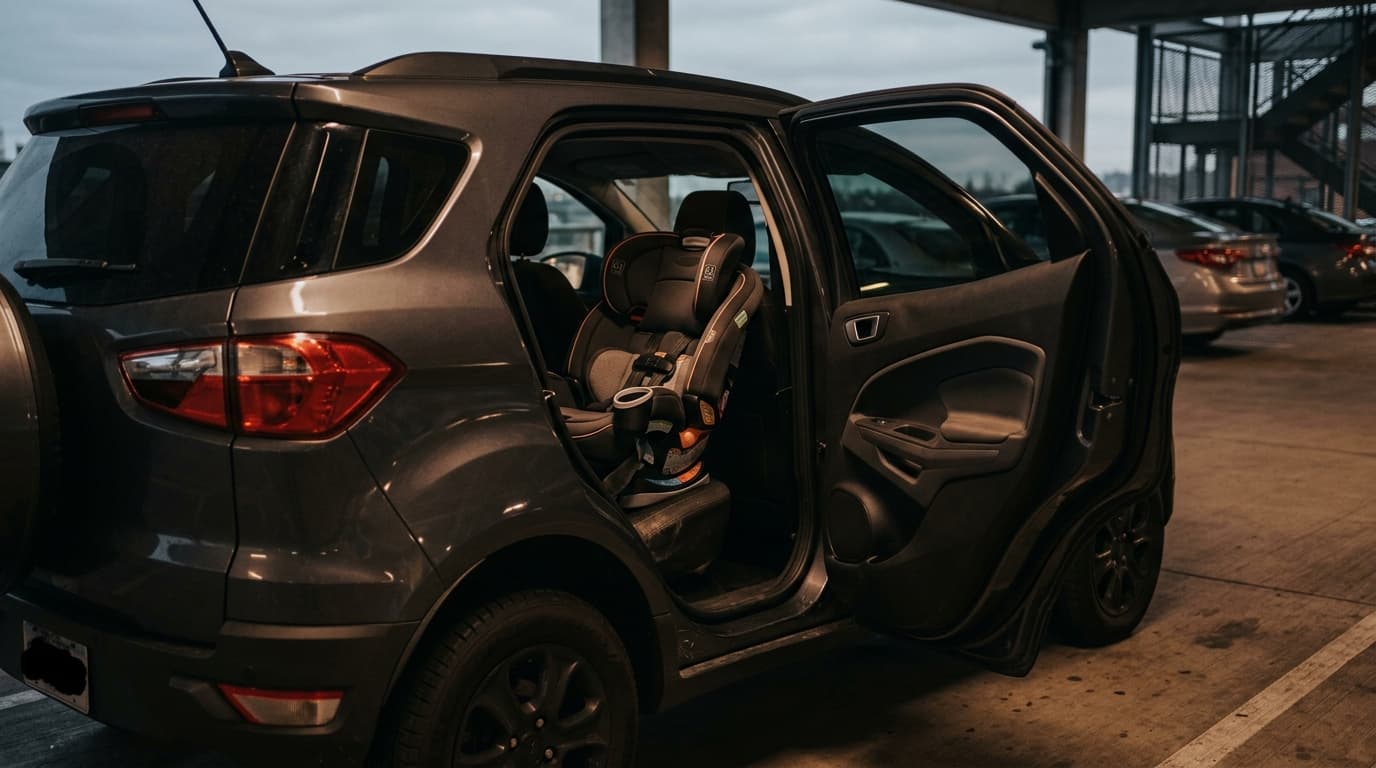
A child car seat is mandatory in Belgium up to 1.35 m and 18 years old, on pain of a 191 € fine. For a first baby, the best compact SUV is not the one with the largest boot, but the one that offers the most rear legroom and the widest doors. Our pick: the Skoda Karoq. Here is why, and the four alternatives by budget.
Which compact SUV should you choose for a first baby in Belgium?
The Skoda Karoq, for three measurable reasons: a wide bench, doors that open almost to a right angle, and the optional VarioFlex three independent sliding seats. From 28,340 € in Belgium, it is the compact that makes daily seat fitting the least painful.
On the Belgian market, the real question is not power or trim, it is rear geometry. A young parent clips and unclips a seat several times a day, often in a tight car park, with a child on one arm. The SUV that wins is the one where you bend the least and the seat drops straight into its anchors.
The number that matters: between the Duster at around 20,000 € and the Tucson at around 35,000 €, the price gap reaches 15,000 € for the same job. Here are the five compacts sold in Belgium, from cheapest to roomiest.
| Model | Length | Boot | Rear ISOFIX | Belgian price from |
|---|---|---|---|---|
| Dacia Duster | 4.34 m | 472–517 L | 2 seats | ~20,000 € |
| Toyota Yaris Cross | 4.18 m | 397 L | 2 seats | ~27,000 € |
| Skoda Karoq | 4.38 m | 521 L | 2 seats (3 VarioFlex seats optional) | 28,340 € |
| Nissan Qashqai | 4.43 m | ~479–504 L | 2 seats | ~32,000 € |
| Hyundai Tucson | 4.51 m | 577 L | 2 seats | ~35,000 € |
Why is the biggest boot not the best for a baby seat?
Because a rearward-facing infant seat sits in the cabin, not in the boot. Bulky, it takes up the rear seat and pushes the front passenger's backrest towards the dashboard. What decides is rear legroom and headroom, two dimensions the marketing sheets rarely highlight.
Manufacturer data shows that the Hyundai Tucson, 4.51 m long with 577 L of boot, leaves margin behind a rearward-facing seat. The Toyota Yaris Cross, at 4.18 m and 397 L, leaves much less: the front passenger struggles to slide back once the seat is fitted. Half a metre of overall length is exactly the space you miss when you load a pram on top.
In practice, this reverses the boot-first logic: litres serve holidays and the pram, the cabin serves the seat every day. A 4.18 m compact does not replace a 4.50 m compact the moment a rearward-facing seat comes into play.
What does Belgian law say about car seats and ISOFIX?
It is clear and recently tightened on safety. Any child under 1.35 m and under 18 must travel in a suitable restraint, seat or booster, according to AWSR (the Walloon road-safety agency). An unrestrained child exposes the driver to a 191 € fine. The child may be seated in the front or the rear.
Seats sold today follow the i-Size standard, or regulation R129. It classifies models by the child's height rather than weight, requires rearward facing until at least 15 months and adds a side-impact test the older R44 standard ignored, according to Moniteur Automobile.
On fixing, ISOFIX relies on two metal loops set between the seat base and the backrest. An i-Size seat always adds a third anchor: a support leg on the floor, or a top-tether strap behind the backrest. Most cars built after 2006 have these loops, but their accessibility varies widely from one SUV to another.
Until what age does the seat stay mandatory?
Longer than most people think. A backless booster is legal from 1.10 m, but a high-back model is advised up to 1.35 m, and side protection stays useful up to 1.50 m. In concrete terms, a seat or a booster occupies the bench for about ten years. Rear access is therefore not a newborn criterion: it is a criterion for the whole of primary school.
How do you check that an SUV takes a rearward-facing seat well?
At the test drive, four moves are enough. Slide the front passenger seat back to a normal driving position, then measure what is left behind: a rearward-facing infant seat needs margin. Check headroom, because these seats sit high. Open the rear door fully and look at the angle: the wider it opens, the less you bend.
The fourth move is the most overlooked: the support leg. It must rest on a flat, firm floor. What we would avoid is an SUV whose rear floor hides a storage bin: resting a support leg on a hollow lid cancels its role in a crash. Safety data shows that this point, invisible in the showroom, decides whether the fit is valid.
This is where the Skoda Karoq pulls ahead. Its VarioFlex bench, an option, is made of three independent seats that slide about fifteen centimetres and remove one by one. You fit a child seat in the centre, or slide the outer seat back to gain legroom. No rival in this comparison offers that modularity.
ISOFIX or belt: what should you check on the test drive?
First locate the ISOFIX anchors: on some SUVs they are buried in the fold of the bench and need plastic guides to find. Then check the i-Size marks, which indicate the approved positions. Finally, look for the top-tether point, often on the back of the backrest or in the boot. A centre seat without ISOFIX is fitted with the belt, which stays valid but takes longer to install.
What budget should you plan, and which to avoid?
From 20,000 to 35,000 € depending on the space you want. The Dacia Duster opens the range under 20,000 € in petrol and climbs to around 23,000 € as a Hybrid 155: for a young family on a tight budget, it is the best litres-per-euro, with 472 to 517 L of boot. The Skoda Karoq, at 28,340 €, justifies its premium with VarioFlex modularity and a higher finish.
What we would avoid is paying compact money for a family use it only half fulfils. The Toyota Yaris Cross, around 27,000 €, costs almost as much as a Karoq for 4.18 m and 397 L: its boot saturates the moment you add a pram to the seat. We would also avoid a bench limited to two real places, a hollow rear floor under which to seat a support leg, and a backless booster while the child has not reached 1.35 m.
The table below links the child's height to the seat type and the point to check in the SUV.
| Child's height | Seat type | Check in the SUV |
|---|---|---|
| 0–15 months (< ~75 cm) | Rearward-facing infant seat (i-Size) | headroom + support leg on a flat floor |
| ~1–4 years (76–105 cm) | Rearward then forward-facing seat | rear legroom, ISOFIX + top tether |
| 4–7 years (100–125 cm) | Forward-facing high-back seat | bench width for a second seat |
| Up to 1.35 m (12 years and over) | High-back booster | door opening angle + belt guide |
Verdict: which compact SUV for which young family?
No model wins on every count, but each has its profile. On a tight budget, the Dacia Duster does the job without argument. For town and a single child, the Toyota Yaris Cross is enough, provided you accept a boot that saturates quickly. For versatile use, our pick is the Skoda Karoq and its VarioFlex bench, the only one that truly simplifies a central seat.
For maximum rear space, the Hyundai Tucson and its 577 L stay unbeaten in this comparison; the Nissan Qashqai sits in between, more versatile than the Yaris Cross and cheaper than the Tucson. Our SUV boot ranking in litres and our family SUV under 35,000 € guide detail the trade-offs once the second child arrives. For strictly urban use, our best city SUV comparison completes the picture.
Frequently asked questions
The Skoda Karoq, for three concrete reasons: one of the widest benches in the class, rear doors that open almost to a right angle, and the optional VarioFlex three independent seats that let you place a child seat in the centre or slide it. From 28,340 € in Belgium. On a tight budget, the Dacia Duster (from around 20,000 €) does the job with 472 to 517 L of boot. If you want the maximum rear room for a rearward-facing seat, the Hyundai Tucson and its 577 L boot is the most welcoming.
Up to 1.35 m, whatever the age, as long as the child is under 18. A 12-year-old shorter than 1.35 m must still use a booster, according to AWSR (the Walloon road-safety agency). A backless booster is allowed from 1.10 m, but a high-back model is recommended up to 1.35 m, even 1.50 m for side protection. In practice the seat lives in the car for about ten years: rear access matters over that whole span, not just the first months.
No, and it is the most common misreading. A rearward-facing infant seat is bulky and sits behind the front passenger, whom it pushes forward. What matters then is rear legroom and headroom, not boot volume. A Hyundai Tucson at 577 L and a Toyota Yaris Cross at 397 L are not the same case: the first leaves margin, the second, only 4.18 m long, can trap the front passenger. The boot serves the pram; the cabin serves the seat.
i-Size is the common name for regulation R129, which classifies car seats by the child's height rather than weight. It requires rearward facing until at least 15 months and adds a side-impact test that the older R44 standard lacked, according to Moniteur Automobile. An i-Size seat always installs with ISOFIX plus a third anchor point: either a support leg on the floor, or a top-tether strap behind the backrest. It is that third point you must check in the SUV.
191 € for a badly or unrestrained child, according to AWSR. But the fine is not the real issue: a poorly fitted or unsuitable seat sharply raises the risk of serious injury in a crash. The amount is mainly a reminder; safety is the underlying reason.
Rarely useful for a first child. Almost all compact SUVs offer two ISOFIX anchors on the outer rear seats, which is enough for one or two seats. The centre seat is the narrowest and rarely has ISOFIX: you then fit it with the belt. The Skoda Karoq with its VarioFlex three independent seats is the exception that genuinely eases a central seat.
Yes for one child, with caveats. At 4.18 m and 397 L of boot, the Yaris Cross takes a rearward-facing seat, but legroom behind the front passenger becomes tight, and the boot fills quickly with a pram. It is a good urban choice for a one-child family that drives mostly in town; to leave on holiday fully loaded, a Karoq or a Tucson breathes more easily.
We dig through the Belgian market data — TÜV reliability, real-world ADAC consumption, company-car taxation, list prices — to call it straight. No brand pays us.