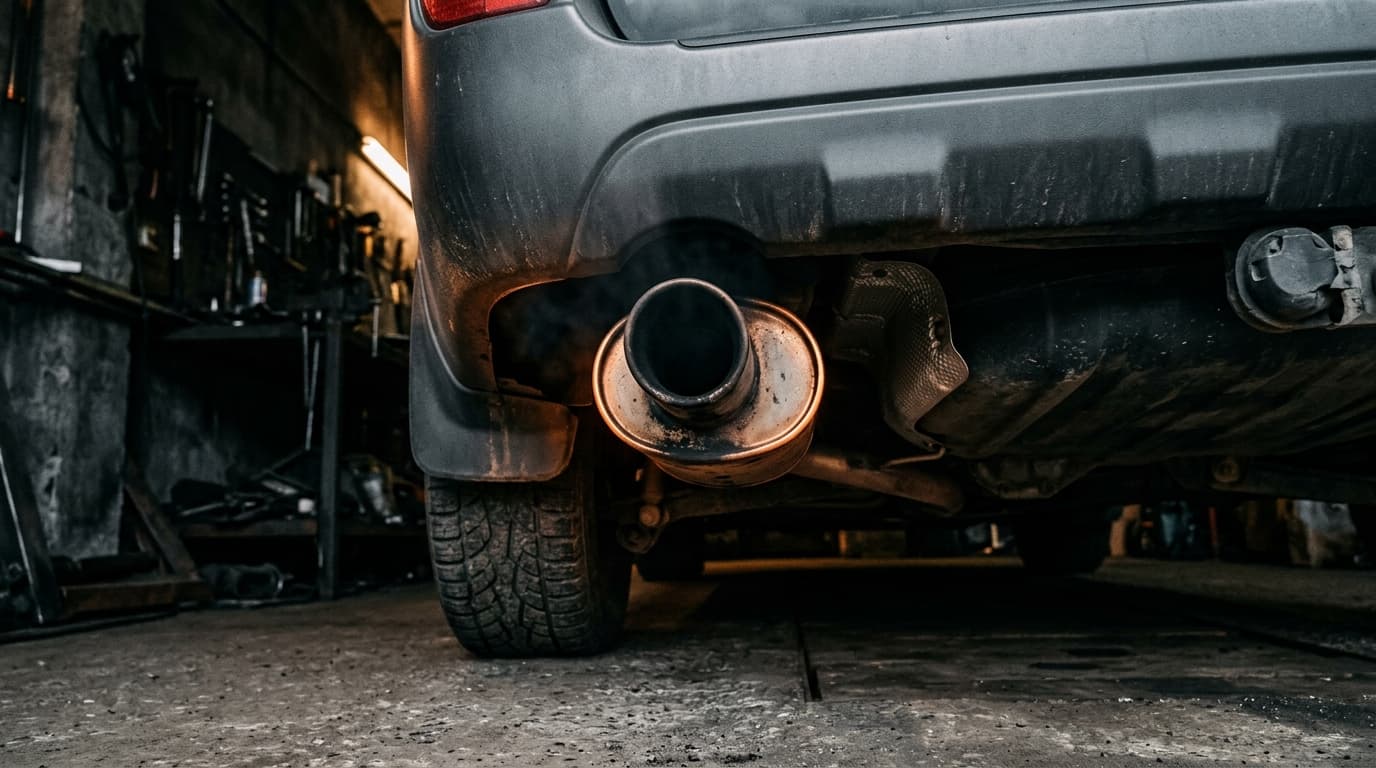
A clogged DPF announces itself through power loss, higher fuel consumption and a warning light. On a Belgian diesel SUV the stakes go beyond the breakdown. Since 1 July 2022 the roadworthiness test counts particles at the tailpipe, and above one million per cubic centimetre, it is a red card.
What are the symptoms of a clogged DPF?
They rarely arrive alone, and almost never in the order you expect.
- a loss of power under acceleration, as if the engine were choking;
- higher fuel consumption, because the engine offsets the back pressure;
- rough idling, jerking, sometimes a stall on starting;
- black smoke under hard acceleration;
- limp mode, which caps power to protect the engine;
- the DPF light or the engine light coming on.
The warning light is the best-known sign and the least early: by the time it comes on, the ECU has already attempted several regenerations without success. Power loss is felt weeks earlier, while the bill is still a three-figure one.
Why does an SUV clog its filter faster?
The DPF is a ceramic block drilled with channels that trap soot. To burn it off, the exhaust has to exceed 550 °C, which means holding a sustained engine speed for several minutes.
A compact diesel SUV used in town never gets there. Six-kilometre trips, a cold engine half the time, revs under 2,000: regeneration starts, aborts, and leaves a little more soot behind each time. Use matters more than weight.
The light came on: should you head for the motorway?
That depends on when you ask.
As prevention, yes. Touring recommends holding the engine around 3,000 rpm for a good quarter of an hour, meaning 100 to 120 km/h in fourth on a manual gearbox: a monthly Namur to Brussels round trip is enough.
Once the symptoms have set in, it is another matter. A clogged filter no longer regenerates on its own, and the diagnosis then runs through a reader tool, not through a motorway slip road.
Does a clogged DPF fail the Belgian roadworthiness test?
Yes, and Belgium was among the first countries in Europe to check it seriously, alongside the Netherlands.
Since 1 July 2022, Belgian test centres use a particle counter, the PN meter, which measures what the filter lets through. The old smoke opacity test saw nothing of fine particles.
| Particle counter reading | Certificate | Compliance deadline | What to do |
|---|---|---|---|
| Under 250,000 per cm³ | Green, no remark | None | Nothing |
| 250,000 to 1,000,000 per cm³ | Green with a non-compliance note | Two years announced | Clean before the next visit |
| Over 1,000,000 per cm³ | Red | 12 months since January 2023, 14 days originally | Repair or replace, then re-test |
| Pre-sale inspection, above the threshold | Fail | No reprieve | Repair before selling |
| DPF missing, holed or cut out | Red | Same as the red card | Restoration required |
One reservation applies to the deadline column. The grace-period calendar has moved four times in three years, from 14 days to 3 months then to 12 months, with a return to the original wording announced by Touring for 1 July 2024 and a Brussels derogation that ran until 31 December 2025. No region has published a consolidated version since. Call your test centre.
Is the test the same in Wallonia, Brussels and Flanders?
No. The gap is not about the thresholds, but about which vehicles are tested at all.
| Region | Test applies from | First registration | Specific point |
|---|---|---|---|
| Flanders | Euro 5a | 1 January 2011 | First region to extend the grace period to 12 months, on 1 December 2022 |
| Brussels | Euro 5a | 1 January 2011 | Compliance regime announced until 31 December 2025 |
| Wallonia | Euro 5b | 1 January 2013 | Euro 5a not tested; green card with a warning and 12 months since January 2023 |
A diesel SUV registered in 2012 is therefore counted in Antwerp and ignored in Namur, on the same exhaust and the same day.
The number that matters: across more than 141,000 vehicles tested in Flanders in July and August 2022, GOCA, the grouping of approved Belgian inspection companies, recorded 6.1 % failures, of which 12.7 % among Euro 5a cars, 8 % among Euro 5b and 1.9 % among Euro 6. That is close to seven times more red cards on a Euro 5a than on a Euro 6.
Testing in Wallonia commits the vehicle for good
The move is legal: the choice of region and of test centre is free, and Flemish drivers have been doing it since 2022.
It carries a catch the forums leave out. A vehicle presented at a Walloon centre will have to keep being tested in Wallonia. You do not escape the test: you choose the regime that will follow your SUV for the rest of its life. And the Walloon periodic test costs 59.60 € against 46.10 € in Brussels and Flanders, as we costed in our real cost per kilometre.
How much does fixing a DPF cost?
Three solutions, three orders of magnitude, recorded on 19 September 2026 at filtreaparticules.be. Forced regeneration through a diagnostic tool, with no removal, runs from 60 to 120 €. Cleaning, from an additive to a flow-bench rinse, runs from 80 to 250 €. Replacement starts at 400 € on a Peugeot or a Citroën and climbs to 1,200 € on a BMW, a Mercedes or an Audi. From the first line to the last, the ratio is one to twenty.
These figures come from a commercial provider, not a public tariff: none exists in Belgium. We have not tested this provider. The order of magnitude matches what Touring reported from a member as early as 2023, over 1,000 € for the part alone, on a well-maintained car with under 100,000 km.
A new filter needs roughly 150 kilometres of running in, and it will fail again if an internal engine leak contaminates it. Fitting a new DPF without looking for the cause means paying twice.
Deleting the DPF costs more than repairing it
DPF deletion is illegal, and the particle counter spots it within seconds. It also costs the resale, since the pre-sale inspection gets no reprieve. Our articles on the paperwork for selling and on the low-emission zones cover the rest. If the call tips towards a change of car, our comparison tool filters by powertrain.
Frequently asked questions
For a few dozen kilometres, yes. Beyond that, exhaust back pressure overloads the engine and can damage the turbo. The real risk is not the immediate breakdown but the growing bill: a filter you could have cleaned for 120 € ends up replaced for 700 €.
Between 80 and 250 € depending on the method, from a simple additive to removal and a flow-bench rinse. Forced regeneration through a diagnostic tool is cheaper, at 60 to 120 €. Prices recorded on 19 September 2026 on filtreaparticules.be. These are one provider's rates, not an official scale: none exists in Belgium for this work.
One million particles per cubic centimetre. Below 250,000 the car passes without a remark. In between, the certificate stays green but carries a non-compliance note. These three thresholds have been identical across the three regions since 1 July 2022.
No. Wallonia only applies particle counting from the Euro 5b standard, so to vehicles first registered from 1 January 2013. Flanders and Brussels test from Euro 5a, meaning from 1 January 2011. The AutoSécurité spokesman confirmed that difference in scope publicly.
Not always. According to the motor industry as relayed by Touring, a new filter needs roughly 150 kilometres of running in before it works fully. And if the engine has an internal leak, the new filter contaminates within weeks and goes back over the threshold.
No, and that is the nuance that costs the most. The transitional measure was deliberately excluded from the inspection carried out ahead of a sale, in the name of consumer protection. A diesel SUV presented for sale above the threshold is failed, and must return once repaired.
No. Removing an emissions device fitted as original equipment is prohibited, and the particle counter at the test centre spots a missing filter within seconds. A European study had established that most diesels were running with a faulty or removed filter: that is precisely what prompted the test.
We dig through the Belgian market data — TÜV reliability, real-world ADAC consumption, company-car taxation, list prices — to call it straight. No brand pays us.