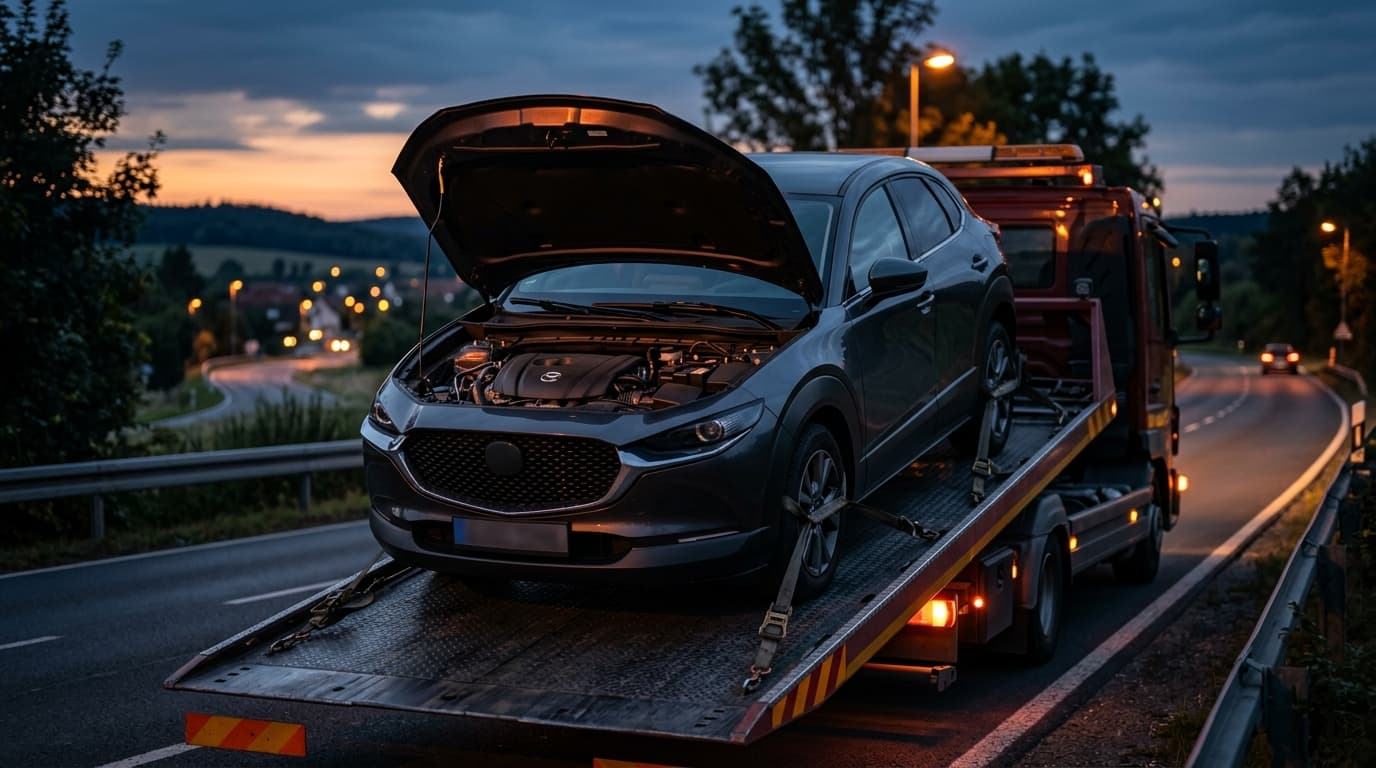
Yes, a car without a valid inspection can legally be sold in Belgium, but not to just anyone. A motor trade professional can buy it as it stands, with no pre-sale inspection and no Car-Pass. A private buyer will not be able to register it. And the Flemish reform of 1 January 2027 solves nothing for a car that has broken down.
Between private parties, the pre-sale inspection is still the rule
Wikifin (in French), the financial education site run by the FSMA (Belgium's financial markets regulator), puts it in one sentence: a car sold by a private individual to other private individuals must be taken through the technical inspection by the seller. That visit has a name, the contrôle occasion, or pre-sale inspection. It goes further than the periodic check, and the station hands over three things: a used-vehicle report, the Car-Pass (the official mileage certificate) and a pink registration application form, valid for two months at most.
That pink form is the real lock.
Without it, the buyer cannot put the car in their name. An SUV that no longer starts, or that would leave the station with a red certificate, therefore runs into an inability to register rather than a ban on selling. That distinction explains everything else: the workable routes all go through a buyer who does not need to drive tomorrow morning.
One admission, though. We looked for an official page stating in black and white whether the station hands over the pink form with a red certificate, and we did not find one: inspection companies describe the documents of a passed inspection, never those of a failed one. Ask at the counter before promising a buyer anything.
Who can you sell to without an inspection?
A motor trade professional, and your close family. Today, nobody else.
For the professional, Belfius (in French) sums up the rule in its seller's guide: the technical inspection is not mandatory when you sell your car to a dealer or a used-car professional. The Car-Pass is not owed in that case either. The bank advises writing "technical inspection at the buyer's expense" on the sales agreement, and that is the right reflex: the line proves you sold to someone whose trade it is.
For family, the exception covers three cases: between spouses, between legal cohabitants, and from a parent to a child. The car then keeps its old plates.
Cash-buying chains take cars that are broken down, accident-damaged or without a valid certificate, and it is their trade. The price reflects it. In every other case the plate does not leave with the car: in Belgium it is personal and stays with the seller.
A private buyer based abroad exempts you from nothing. The Car-Pass is still owed, as we explain in our guide to the mandatory Car-Pass at sale.

Flanders drops the pre-sale inspection on 1 January 2027
You can already read online that Flanders buried the pre-sale inspection on 1 September 2026. That is wrong, and the mistake has a precise origin.
The abolition was indeed part of the Flemish inspection reform, planned as one block for 1 September. In late May 2026 the sale component was split from the rest and pushed back four months, because the link with the federal IT systems would not be ready in time. The rest came into force on the planned date: a periodic inspection every two years for a car over four years old, and two months instead of fifteen days to repair a major defect, as Le Moniteur Automobile (in French) notes in its update of 31 August 2026.
| Date | Territory | Change for the seller |
|---|---|---|
| 1 March 2019 | Belgium | Motor assessors report serious accidents, the flag appears on the Car-Pass |
| 1 January 2026 | Three regions | Pre-sale inspection at 74.40 € in Brussels and Flanders, 89.40 € in Wallonia |
| Late May 2026 | Flanders | The end of the pre-sale inspection, planned for 1 September, is postponed |
| 1 September 2026 | Flanders | Periodic inspection every two years, two months to fix a major defect |
| 1 January 2027 | Flanders | End of the mandatory pre-sale inspection, under two conditions |
| After 1 January 2027 | Wallonia, Brussels | Nothing changes, the pre-sale inspection stays mandatory |
Sources: Touring (in Dutch), article of 1 September 2026 updated on 25 September; Le Moniteur Automobile; Car-Pass. Checked on 5 October 2026.
The two conditions change how the reform reads. According to Touring's file on the Flemish reform (in Dutch), dated 19 September 2026, the exemption only applies if the vehicle is registered in Belgium and still holds a valid inspection certificate on the day of sale. An imported vehicle is still inspected before its first Belgian registration. And a car that has been broken down since winter, whose periodic certificate has lapsed in the meantime, does not meet the second condition.
So the reform frees the seller of a car that is in order, the one who today pays for an inspection to confirm a certificate that is still valid. It does nothing for the seller of a car that would not pass.
The Flemish buyer, for their part, loses a piece of information. The Car-Pass records mileage, not the state of a brake disc, a rusty chassis rail or a shock absorber. GOCA Vlaanderen, the federation of inspection centres, and the sector's trade unions have voiced their concern for road safety. A serious seller keeps one card to play: taking an early periodic inspection on their own initiative and attaching the certificate to the advert. From January, that optional piece of paper will be a selling point.
The Car-Pass itself survives everywhere. Touring confirms it for 2027: it stays mandatory between private parties and cannot be more than two months old on the day of sale. A Flemish seller will still have to go to a counter to get one.
One case our sources do not settle: the seller from Aalst who sells to a buyer from Namur. The Walloon rule does not move, and the Walloon buyer will need their registration form. Until the administration publishes clear guidance, it is safer to assume the pre-sale inspection still has to be done as soon as one of the two parties lives outside Flanders.
A broken-down car: two years, not a day more
An immobilised car does not wait for its buyer forever. The Febelauto FAQ (in French), from the body that manages the take-back of end-of-life vehicles in Belgium, places in that category any vehicle whose most recent inspection certificate expired more than two years ago.
The switch is a legal one. Before the deadline you own a broken-down used car, which you can sell to a garage. After it you hold waste, and the only exit provided is delivery to an approved centre.
Brussels Environment applies the same test through the paperwork: a vehicle is end-of-life when it no longer has its full set of on-board documents, meaning a valid registration certificate and an inspection that is valid or expired for less than two years. Classic and collector cars are exempt.
The figure that matters: 24 months after the expiry date printed on your last certificate. Note it down before leaving the car at the back of the garage.
Febelauto also sets the pace for the clearer cases. An irreparable vehicle is handed in immediately. If documents are missing, you have one month at most.
Can an accident-damaged car still be sold?
Yes, but its past follows it. Since 1 March 2019, motor vehicle assessors have been legally obliged to report seriously damaged vehicles, and Car-Pass shows the post-accident inspection requirement on the document until that inspection has been passed.
The consequences are heavy. The car may no longer be driven on the road until it has passed this inspection, which covers the chassis, steering, suspension and braking system. The buyer cannot register it either. Reports made before March 2019 do not appear.
In practice, that gives two markets. An SUV that was damaged and repaired, post-accident inspection passed, resells to a private buyer like any used car. The same SUV unrepaired only interests a body shop or a trader, and it leaves on a flatbed.
Selling for parts: you may not strip a wreck at home
The idea comes up in every bar-counter conversation: strip it yourself and sell the parts one by one. For an end-of-life vehicle, Brussels Environment (in French) is categorical: you may no longer hold or dismantle end-of-life vehicles. The vehicle must go to a registered centre, which depollutes it before any dismantling, and only an approved centre issues a valid certificate of destruction.
The counterpart is that it costs nothing. Febelauto takes the vehicle back free of charge on two conditions: that it is complete and that none of its legal documents is missing. A car stripped of its engine or catalytic converter may therefore be charged to you.
The certificate of destruction deserves a place with your papers. It is the official proof that the car is no longer yours.
What does getting the car in order cost before selling?
Between 85.50 € and 117 €, repairs excluded. The sum applies to a car that runs but that you have doubts about.
| Item (rates of 1 January 2026) | Brussels | Wallonia | Flanders |
|---|---|---|---|
| Pre-sale inspection | 74.40 € | 89.40 € | 74.40 € |
| Car-Pass | 11.10 € | 11.10 € | 11.10 € |
| Total with a green certificate | 85.50 € | 100.50 € | 85.50 € |
| Re-test after a red certificate | 16.40 € | 16.50 € | 16.40 € |
| Total with one re-test | 101.90 € | 117.00 € | 101.90 € |
| Sale to a professional | 0 € | 0 € | 0 € |
Touring, for its part, quotes 90.70 € in Flanders and Brussels and 105.70 € in Wallonia, a package that adds the registration application to the inspection and the Car-Pass.
On the Belgian market, the trade-off is therefore decided elsewhere than in that hundred euros. It is decided in the repair bill, which you pay up front without knowing whether the private buyer will pay the difference. A diesel particulate filter to replace, recorded at between 400 € and 1,200 € in our file on the clogged DPF, is rarely recovered in full in the sale price of a ten-year-old diesel.
Take the least favourable Walloon case: 117 € of inspection, Car-Pass and re-test, plus 400 € for a filter at the bottom of the range. You put up 517 €. For the operation to hold, the private buyer must offer at least 517 € more than the trader, and must do so within the Car-Pass's two months of validity. If the professional's offer is already on the table, check first that this gap exists.
"Sold as seen" does not cover a fault you kept quiet
Between private parties, the hidden-defects warranty of article 1641 of the former Civil Code applies, and the buyer must act within a short period. The rule is not mandatory: a clause can set it aside, and that is the role of the words "sold as seen".
It has a limit. In principle, the clause does not protect a seller who knew of the defect and concealed it. Writing the fault into the agreement covers you better than any formula: a declared defect is no longer hidden.
Four checks before signing
- The expiry date of the last inspection certificate, to know how many months you have left before the two-year threshold.
- The buyer's status: ask for their company number and write it on the agreement, with the words "technical inspection at the buyer's expense".
- The Car-Pass, to consult before advertising, to spot a post-accident inspection flag you may have forgotten.
- The written description of the fault or the damage, signed by both parties.
To avoid: repairing blind in order to target a private buyer. To remember: a broken-down car goes to a professional, with neither inspection nor Car-Pass, and a car in order is worth its 85.50 € to 100.50 € of paperwork, because a private buyer generally pays more than a trader. Our guide to where used SUVs change hands covers those buyers, and our comparison tool places your model against its rivals.
Frequently asked questions
In principle, no. A private seller must take the car through the pre-sale inspection, and the station hands over the registration application form the buyer needs, valid for two months. The only exceptions are a sale to a motor trade professional and a transfer between spouses, legal cohabitants or from a parent to a child keeping the old plates. In Flanders the obligation ends on 1 January 2027, under conditions.
Yes. The Car-Pass is not owed when the buyer is a dealer or a used-car professional, and neither is the pre-sale inspection. Have the sales agreement state that the inspection is at the buyer's expense, add the garage's company number, and describe the fault in writing.
Hand it in to an approved centre. Febelauto, the Belgian body that manages end-of-life vehicles, treats any vehicle whose latest inspection certificate expired more than two years ago as end-of-life. Take-back is free if the vehicle is complete and no legal document is missing, and the centre issues a certificate of destruction.
We dig through the Belgian market data — TÜV reliability, real-world ADAC consumption, company-car taxation, list prices — to call it straight. No brand pays us.