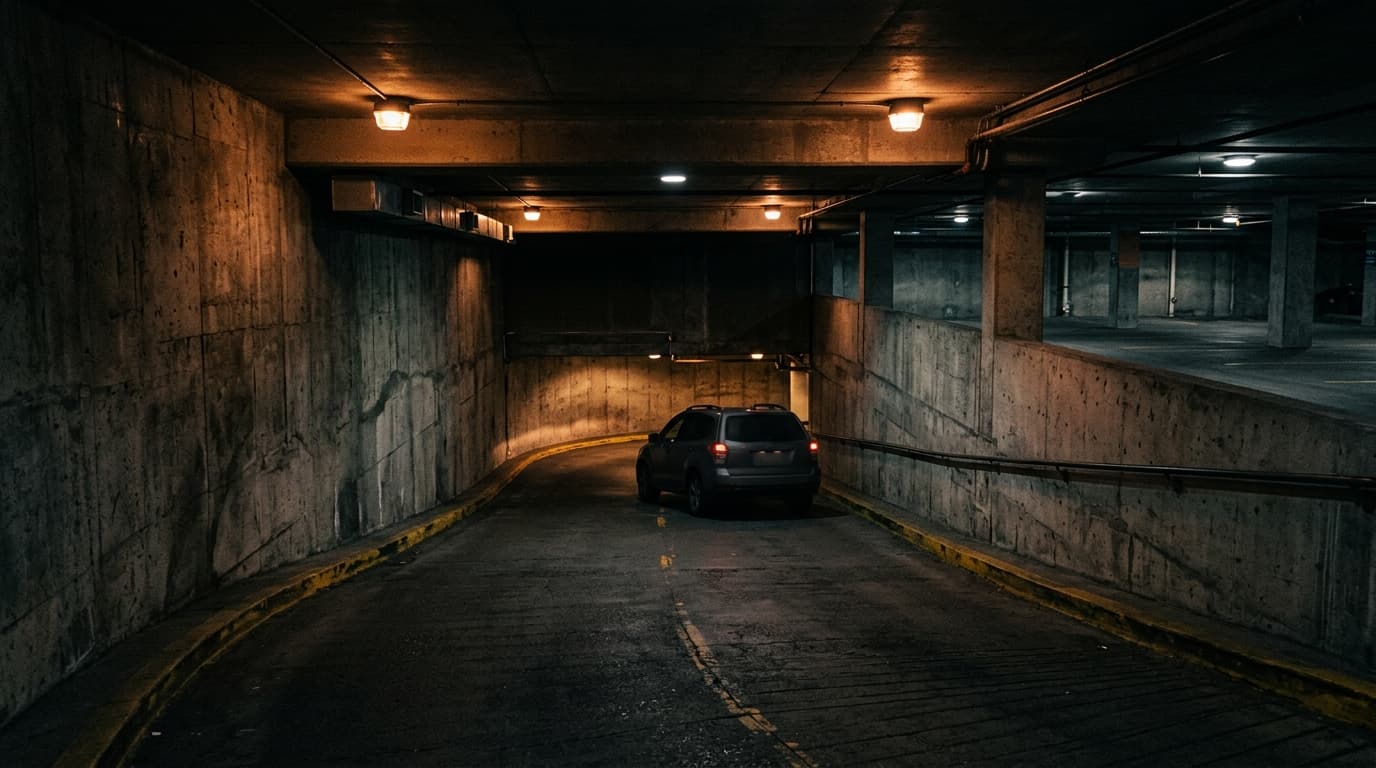
Yes, with a bare roof, in the vast majority of cases. Belgian car parks most often post 1.90 or 2.00 m of headroom, and a family SUV rarely exceeds 1.80 m. The trouble starts once you put something on top: bars, a roof box, a bike carrier.
What headroom do Belgian car parks actually post?
Six public car parks, four cities, three regions, and six figures written in black and white on the entrance gantry.
| Car park | City | Region | Posted headroom | Spaces |
|---|---|---|---|---|
| Hopland (above ground) | Antwerp | Flanders | 2.25 m | 222 |
| Grand Place | Brussels | Brussels-Capital | 2.00 m | 913 |
| Albertine-Square | Brussels | Brussels-Capital | 2.00 m | 698 |
| Oudaen | Antwerp | Flanders | 1.90 m | 365 |
| Center | Ghent | Flanders | 1.90 m | 532 |
| Saint-Georges | Liège | Wallonia | 1.90 m | 194 |
Recorded on 11 September 2026 from the public listings of Interparking Belgium, the operator of all six.
Three car parks out of six post 1.90 m. The figure turns up in Antwerp, in Ghent and in Liège, so in two regions and on structures that share neither size nor age. No text imposes it, and yet it imposes itself.
The one structure at 2.25 m is worth a pause. Hopland, in Antwerp, sits above ground. The most generous of the six is therefore the one without a ceiling in the strict sense.
Will my SUV fit under 1.90 m?
Get a tape measure out. The height that counts is not the one in the brochure, it is the one of your car with whatever is bolted on it today.
| Measured height, roof load included | Under 1.90 m | Under 2.00 m | Under 2.25 m | What to do |
|---|---|---|---|---|
| Below 1.80 m | fits | fits | fits | nothing, drive in |
| 1.80 to 1.85 m | fits, margin tight | fits | fits | slow down in the helical ramp |
| 1.85 to 1.90 m | marginal, avoid | fits | fits | take the bars off before entering |
| 1.90 to 2.00 m | does not fit | marginal, avoid | fits | aim for an above-ground car park |
| Above 2.00 m | does not fit | does not fit | fits up to 2.25 m | park-and-ride or on-street |
To place the top of the market, Volvo quotes between 1,767 and 1,771 mm for the XC90, and the brand states that the figure is taken at curb weight plus one person. Under the 1.90 m gantry at Oudaen, that leaves thirteen centimetres. Under the one in Ghent, the same.
A large seven-seater therefore fits everywhere. The question never really was about the car.
How much does a roof box add?
Thirty-eight centimetres above the bar, for a large model. And that is before the bar is counted.
The official data sheet for the Thule Motion 3 XL gives 15 inches of height above the roof bar, which is 38.1 cm. Put that box on an XC90 measured at 1,771 mm and you already stand 2.15 m tall, without adding a single millimetre for the bars themselves. Depending on the mounting type, integrated rails or raised rails, those add a few centimetres more that only the fitting instructions state precisely.
The sum is worth doing in order, because each layer sits on the one below and no carmaker does it for you. Start from the published body height, the catalogue figure. Add the roof rails where they stand proud of the panel, a dimension some brands fold into their official number and others leave out without saying so. Then come the crossbars, then the box, then the clamps holding it in place. The final total rarely resembles the figure you had in mind when you drove off the forecourt.
Go back to the survey. Of six car parks, one takes that combination, and it is the above-ground site in Antwerp. Grand Place turns it away. So do Ghent, Liège, Oudaen and the Albertine.
A roof-mounted bike carrier is worse, for a reason that catches people out: the carrier is not what decides, the bike is. A frame sitting wheels-down on crossbars rises higher than a closed box, and it rises by a variable amount depending on frame size and saddle height. Shifting the load to the rear settles that problem and the fuel problem at once, a trade-off we worked through in our file on the tow bar bike rack for an SUV.
The number that matters: between a bare SUV and the same SUV kitted out for the holidays, the difference eats more than all the margin you had.
No Belgian rule sets a minimum headroom in a car park
The only Brussels text that dimensions a parking space is Title IV of the Règlement régional d'urbanisme, the Brussels Regional Town Planning Regulation, adopted on 21 November 2006. Its article 7 requires a minimum width of 3.30 m for spaces reserved for people with reduced mobility, a length of 6.00 m where vehicles are parked one behind the other, a minimum number per block of fifty spaces, and a firm, level surface.
It says nothing about height.
The single time Title IV mentions 2.20 m, it is to exclude rooms offering less than that from a net floor area calculation. An accounting threshold, not a clearance requirement. On the operating side, a covered car park falls under the environmental permit regime of Bruxelles Environnement, the Brussels environment agency, whose conditions cover ventilation, fire and noise, never the distance to the ceiling.
French-language pages on this subject almost all quote the NF P91-100 and NF P91-120 standards, and draw from them a 2 m minimum or a 2.20 m urban recommendation. Those standards are French. They carry no weight here, and they explain why so many Belgian readers pull up at a 1.90 m gantry with the wrong number in their head.
Why does the ceiling drop after the entrance gantry?
Because the gantry flags the lowest point the operator knows about, not a guarantee of constant clearance on every level.
The five places where the ceiling drops below the posted value:
- ventilation ducts, which cross the aisles diagonally and often hang below the slab;
- transfer beams, visible at the head of each bay and never marked on the floor;
- sprinkler heads and light fittings, which eat five to ten centimetres of structural height;
- helical ramps, where the car tilts while the ceiling closes in;
- the lower levels of older structures, dug tighter the further down you go.
The curved ramp is the classic trap. The attitude of the car changes at the exact moment the margin narrows, the point of contact lands at the rear of the roof panel where the driver never looks, and a roof box touches there long before the roof itself does.
In practice that gives a short rule: at the first sign of doubt, crawl and send a passenger out to look. Thirty seconds against a roof panel repair.
What should you do if your SUV does not fit?
The best answer costs nothing: take the bars off when you are not using them.
A set of empty crossbars often stays up all year when it earns its keep for two weeks. It costs height, fuel and noise, for nothing. Removing it usually gives back more than ten centimetres and takes five minutes on a quick-fit system.
If the load is permanent, change the target rather than the hardware. An above-ground structure accepts dimensions no city-centre basement will ever take. Buying a flatter box is the most expensive answer, and the least often necessary one.
Should you give up on an SUV to park in town?
No, but watch the width rather than the height.
Volvo publishes two figures for the XC90: 1,923 mm for the bare body, and 2,140 mm with the door mirrors folded out. Two hundred and seventeen millimetres of difference, which exist only when the car is moving and you are closing in on a pillar. In a structure drawn for 1980s saloons, that is the dimension deciding whether you get out through the driver's door or the passenger's.
Length pulls the same way. The XC90 measures 4,953 mm overall, and in a standard city-centre bay a car that size overhangs the markings, nose or tail sticking out into the aisle. Title IV of the RRU does set 6.00 m of length for adapted spaces arranged one behind the other, which gives an idea of the room a large car genuinely needs to be manoeuvred without touching the next one.
None of this is a deal breaker. But the order of the constraints is not the one you would assume: height stops a loaded SUV twice a year, width gets in the way of an empty one every day. Our comparison of city SUVs ranks models on that criterion, and our article on ground clearance covers the opposite dimension, the one that counts underneath the car. Our comparison tool lets you filter on dimensions before making the trip.
Frequently asked questions
Most often 1.90 or 2.00 m of posted headroom. Across six car parks recorded on 11 September 2026 in four cities and three regions, three post 1.90 m, two post 2.00 m and one posts 2.25 m. That last one is above ground, not below it. No Belgian text imposes a minimum value: headroom depends on the structure and on the year it was built.
With a bare roof, almost certainly. The Volvo XC90, among the tallest SUVs sold here, is quoted by Volvo at 1,767 to 1,771 mm, which leaves thirteen centimetres under a 1.90 m gantry. Add roof bars, a box or a roof-mounted bike carrier and the sum changes completely, so measure it again with a tape.
Around 38 cm above the crossbar for a large box. The official data sheet for the Thule Motion 3 XL gives 15 inches of height above the roof bar, which is 38.1 cm. You then have to add the height of the bar itself, which depends on the mounting type and is given in the fitting instructions.
No. The entrance gantry gives the lowest point the operator knows about, not a guarantee of constant clearance on every level. Ventilation ducts, transfer beams, sprinkler heads and curved ramps often hang lower than the posted figure. At the first sign of doubt, crawl and send a passenger out to look.
No imposed value. Title IV of the RRU, the Brussels Regional Town Planning Regulation, sets the width of spaces reserved for people with reduced mobility at 3.30 m and their length at 6.00 m where vehicles are parked one behind the other, without a word about headroom. The NF P91-100 and NF P91-120 standards quoted all over the French-language web are French.
Take the bars off when you are not using them: it costs nothing and usually gives back more than ten centimetres. Failing that, aim for an above-ground structure, which posts more generous heights, or a park-and-ride site on the edge of town. Buying a flatter roof box is the most expensive answer and the least often necessary one.
Width causes trouble more often than height. Volvo quotes 2,140 mm for the XC90 with the door mirrors folded out, against 1,923 mm for the bare body. Those twenty-two centimetres come out of the door-opening space and the gap to the neighbouring pillar, not out of the painted markings.
We dig through the Belgian market data — TÜV reliability, real-world ADAC consumption, company-car taxation, list prices — to call it straight. No brand pays us.