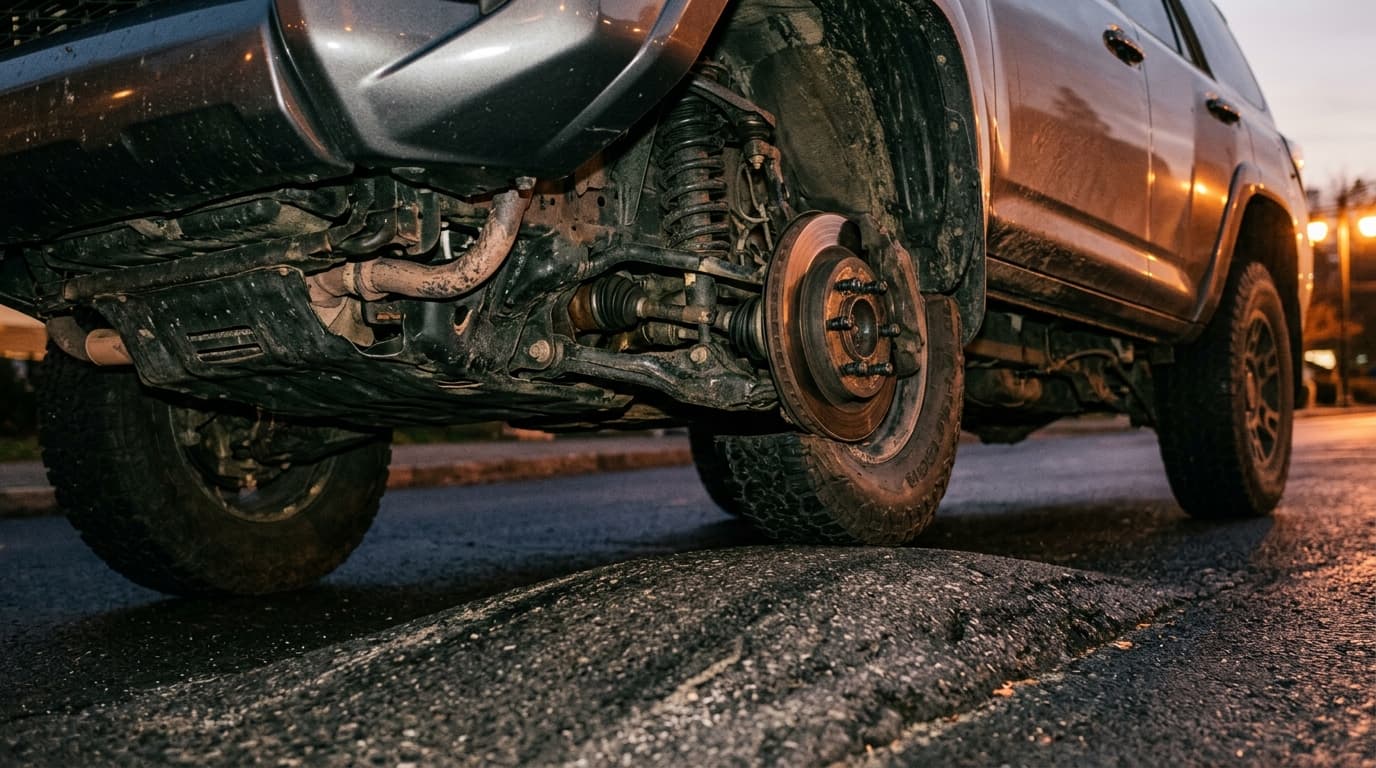
On SUVs sold in Belgium, published ground clearance runs from 161 mm on a Volkswagen T-Roc to 220 mm on a Subaru Forester. The 18 to 22 cm bracket you read everywhere therefore covers only the top of the field. And the tallest speed table Belgian law allows tops out at 15 cm.
Fifty-nine millimetres between the T-Roc and the Forester
Nine SUVs sold in Belgium, nine technical data sheets opened, a 59 mm gap between the lowest and the highest.
| Model | Published ground clearance | Detail given by the brand |
|---|---|---|
| Subaru Forester | 220 mm | no measuring condition stated |
| Jeep Renegade Trailhawk | 211 mm | suspension raised by 30 mm over the standard Renegade |
| Dacia Duster | 209 mm | under load, the only brand in the survey to say so |
| Suzuki Vitara | 185 mm | minimum, with an 18.2° approach angle and a 28.2° departure angle |
| Kia Sportage | 181 mm | no measuring condition stated |
| Renault Captur | 174 mm | no measuring condition stated |
| Tesla Model Y | 167 mm | up to 185 mm in high mode on air-sprung versions |
| Volkswagen T-Roc | 161 mm | no measuring condition stated |
| Peugeot 3008 | not found | line absent from the public technical data sheet |
Recorded on 9 September 2026 from carmakers' public data sheets and press material, including the Dacia specification comparator for the Duster.
Fifty-nine millimetres is almost six centimetres. On vehicles the same salesman will present to you using the same word.
The T-Roc brings up the rear at 161 mm, barely more than a modern hatchback. The Forester opens at 220 mm, and Subaru has been selling that number for three decades. In between, the bulk of the Belgian market settles around 170 to 185 mm, a long way from the 18 to 22 cm presented as the segment norm by most French-language pages on the subject.
The number that matters: out of nine models, only three clear 200 mm, and two of them are versions engineered specifically for it. The Jeep Renegade Trailhawk earns its 211 mm through a suspension raised by 30 mm over the ordinary Renegade, with the tyres and the angles that go with it. The Duster was simply born that way.
Dacia deserves a separate mention, and not for the reason you would expect. It is the only brand in the survey to state that its 209 mm are measured under load. Every other one publishes a bare number. An unladen ground clearance and a laden ground clearance do not describe the same vehicle: between the two, a compact SUV carrying five people and luggage routinely loses two to four centimetres. The harshest figure in the table is therefore probably the most honest one, and setting the Duster's 209 mm against the Forester's 220 mm means comparing two measurements that were not taken the same way.
Then there is the hole in the last row. On the public technical data sheet of the Peugeot 3008, the figure appears neither in the configurator nor in the brochure. The 3008 is among the country's best-selling SUVs, and its ground clearance circulates on a dozen aggregator sites, with diverging values and no source cited. Peugeot is far from alone: ground clearance remains, alongside towing capacity, one of the few dimensions a mainstream carmaker publishes only when it suits.
Why does the 18 to 22 cm bracket circulate everywhere?
Because it describes North American off-roaders, not European SUVs.
The pages that rank on this subject are written for France or for Canada, and they carry over a classification inherited from a market where the word SUV still often means a body-on-frame vehicle. A Jeep Wrangler fits the bracket. So does a Subaru Outback. A T-Roc does not, and the T-Roc is the one you meet on the E40 motorway.
The second reason lies in the measurement itself, which follows no single method. Some carmakers take the distance under the axle, others under the lowest fixed point of the body, others again under the skid plate where one is fitted. Add the question of load and the wheel diameter fitted to the test car, and the same vehicle comes out with three different figures depending on who measures it.
The Tesla Model Y illustrates this most sharply: 167 mm in standard configuration, up to 185 mm in high mode on versions fitted with air suspension. Same car, same documentation, 18 mm apart depending on which line you read.
For the Belgian market the consequence is direct. A ground clearance figure is only worth something next to another figure recorded under the same conditions. Next to a real obstacle, it is worth nothing until you know the height of the obstacle.
Which obstacle do you actually have to clear in Belgium?
A 15-centimetre speed table, worst case. That is the maximum federal regulation allows, and it is the only properly regulated number in this whole file.
The Royal Decree of 9 October 1998 sets the technical requirements for raised devices installed on public roads. It distinguishes two: the traffic hump, a sinusoidal rise, and the speed table, a flat rise with a trapezoidal longitudinal profile. For both, recommended heights are 10.0 or 12.0 cm. The height may be raised to kerb level, with a maximum of 15.0 cm and a minimum of 8.0 cm, where local circumstances demand it.
The speed cushion falls outside that text. Because it does not span the full width of the carriageway, it is governed by point 3 of the ministerial circular of 3 May 2002, which sets its geometry and forbids its installation anywhere other than on a road limited to 50 km/h. The Union des Villes et Communes de Wallonie, the Walloon association of towns and municipalities, sets out both regimes and their differing installation procedures.
The four measurable obstacles you will actually meet:
- the speed table and the traffic hump: 10 to 12 cm as a rule, 15 cm as an absolute maximum;
- the speed cushion: lower and narrower, but crossed by two wheels only, so it taxes body angles more than raw ground clearance;
- the kerb outside a dropped section: in the order of 12 to 18 cm, unclimbable head-on for essentially anything on wheels, SUVs included;
- the underground car park ramp: the constraint there is the posted headroom, often 1.90 or 2.00 m, and not ground clearance at all.
Do the arithmetic. The lowest SUV in the survey, the T-Roc at 161 mm, clears the tallest speed table Belgium allows with 11 mm to spare. The Forester clears it by 70 mm. Either way it goes over. What ride height changes is the speed at which you can do it without hearing an unpleasant noise under the floor, not whether you can do it at all.
Belgian law has defined ground clearance since 1968, without setting a floor
The Royal Decree of 15 March 1968 laying down general technical requirements for vehicles defines ground clearance between the axles as the smallest distance between the supporting plane and the lowest fixed point of the vehicle.
It defines it. It imposes no minimum value on a passenger car.
Modification is another matter. Raising or lowering a vehicle takes it outside the scope of its original type approval, which means a fitting certificate and a visit to an approved centre before it goes back on the road.
A 20-inch wheel, five passengers, and the figure melts away
The number printed on the data sheet describes an empty vehicle, on original wheels, on level ground. Your car is almost never in that state.
Load does most of the damage. Five adults plus luggage is roughly 400 kg resting on springs calibrated for far less, and the body drops accordingly. On a compact SUV, two to four centimetres go that way, with nothing broken and nothing badly set up. That is precisely the holiday departure scenario, the one where ground clearance matters, and it is the one the data sheet does not document.
Wheel diameter works against intuition. Going from 17 to 20 inches raises the car by exactly nothing: overall wheel diameter stays fixed by the carmaker, and it is the tyre sidewall that shrinks to compensate. You gain no height, you lose compliance, and every pothole lands straight on the rim.
A tow bar changes things at the rear. The ball often hangs lower than the bumper, and it is the ball that grounds first on a slipway or on a speed table taken at an angle. Our file on whether an all-wheel-drive SUV is worth it in Belgium returns to that case, which remains the one common local use where traction and ride height genuinely meet.
That leaves air suspension, reserved for the upper end of the market. It offers a temporary high setting, usually limited to low speed, and a low setting above a given threshold for aerodynamics. Useful on paper. Expensive to replace on an eight-year-old car.
Is three centimetres worth paying for?
No, unless you know exactly why.
Three extra centimetres of ride height never come on their own. They arrive with a higher centre of gravity, so more body roll, more frontal area that shows up in motorway fuel consumption, and often an all-wheel-drive system nobody needs in Flemish Brabant. The premium is sold as a capability. It is bought as a package.
Three profiles get a measurable return on height: the driver who reaches home along an unsurfaced, rutted lane, the one who lives above 400 metres and watches snow lie for days at a time, and the one who regularly launches a trailer at a slipway. For everybody else, height is a brochure argument paid for in litres.
On the Belgian market the price gap is almost never charged on ground clearance itself, either. It is charged on the rugged trim level that comes with it, on the bigger wheels, on the all-wheel drive, sometimes on all three at once.
In practice that gives you a short selection criterion. Open the technical data sheet for the model you are considering. If ground clearance is there with its measuring condition, the brand is playing straight. If it is not, take a tape measure out on the dealer's forecourt and measure it yourself, between the road and the lowest point under the body: two minutes, a reliable number, and the only measurement that matches the actual car you are about to sign for.
To place a model within its segment before you get that far, our article on what an SUV actually is works through the registration certificate boxes that carry legal weight, and our comparison of compact SUVs sold in Belgium ranks the remaining criteria. Our comparison tool lets you filter before making the trip.
Frequently asked questions
Between 161 and 220 mm across the nine models recorded in Belgium on 9 September 2026, with the bulk of the market sitting around 170 to 185 mm. The 18 to 22 cm bracket repeated by many French-language pages describes body-on-frame vehicles of North American tradition, not the compact SUVs actually sold here. Above 200 mm you have left the urban SUV behind for a Duster, a Forester or a specifically raised version.
Start with the carmaker's technical data sheet and check whether the measuring condition is stated. Many brands publish a bare number, and Peugeot publishes nothing at all for the 3008. Failing that, measure with a tape on level ground, between the road and the lowest fixed point under the body, first empty and then loaded. The two values often differ by two to four centimetres.
Yes, but not quietly. The Royal Decree of 15 March 1968 defines ground clearance without setting any minimum for a passenger car, but any suspension modification takes the vehicle outside the scope of its original type approval. A fitting certificate and a visit to an approved centre are required. A raised SUV that skips that step turns up at the contrôle technique, Belgium's periodic roadworthiness test, carrying an undeclared defect.
Fifteen centimetres. The Royal Decree of 9 October 1998 recommends a height of 10.0 or 12.0 cm for speed tables and traffic humps, and allows it to be raised to kerb height with a maximum of 15.0 cm and a minimum of 8.0 cm where local circumstances demand it. The speed cushion falls outside that text and is governed instead by the ministerial circular of 3 May 2002.
We dig through the Belgian market data — TÜV reliability, real-world ADAC consumption, company-car taxation, list prices — to call it straight. No brand pays us.