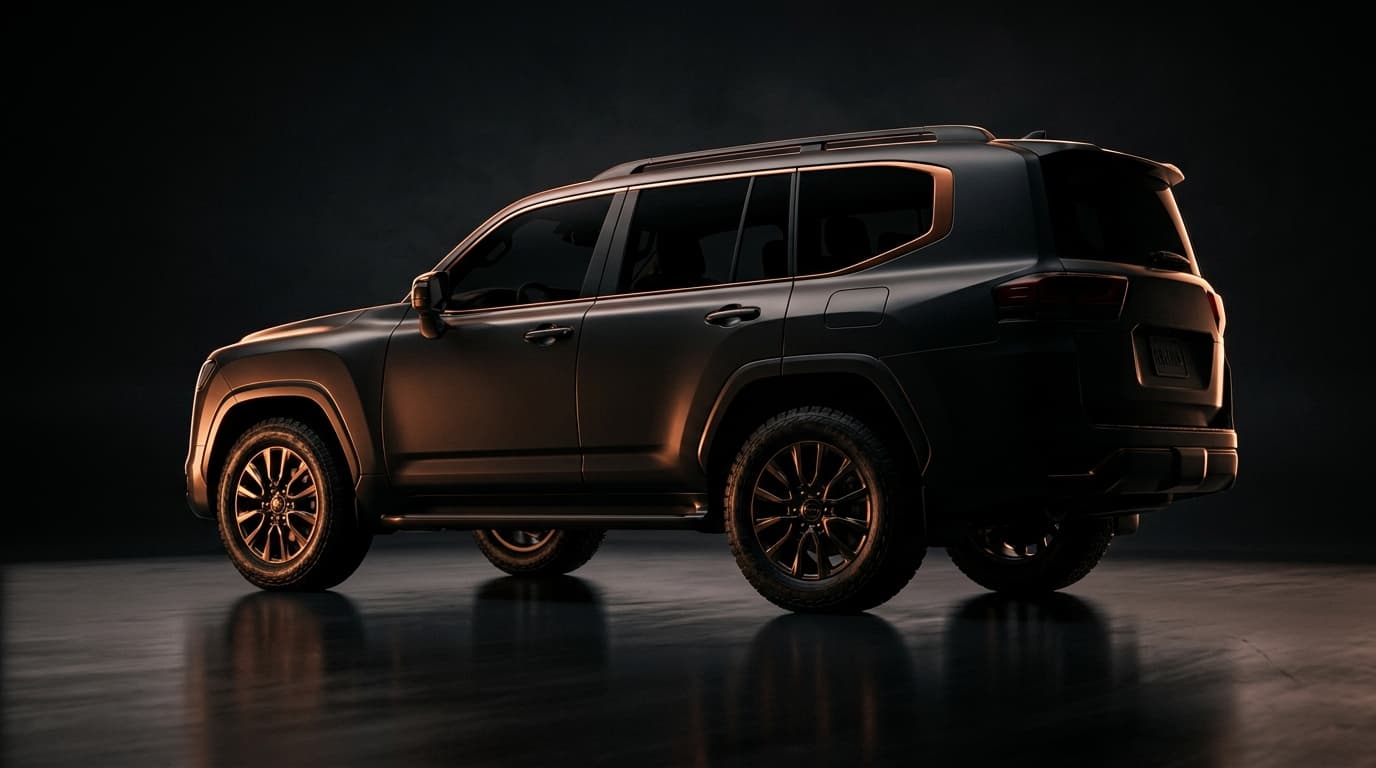
Sport utility vehicle. Three words imported from the United States, with no legal weight whatsoever: neither the European type-approval regulation, nor the Belgian registration certificate, nor a single tax schedule in this country knows the term. Your car is approved as M1, exactly like a city car. The only figure that costs you money is its mass.
Sport utility vehicle: three words, zero definition
The acronym comes from the United States and dates back to the 1980s. Back then it described leisure vehicles built on pick-up frames, able to tow a boat at the weekend and survive a forest track. Europe imported it in the 2000s, Belgium right behind.
Since then the label has been used to sell more or less anything: a raised four-metre city car, a five-metre lifted estate, a five-door coupé. No text sets a minimum ground clearance, a body height, a floor weight or a mandatory drivetrain. A manufacturer decides on its own that its model is an SUV, and nobody has standing to argue.
Hence a consequence that still surprises people: two cars wearing the same badge can be 700 kg apart and share nothing under the bodywork. Le Moniteur Automobile summed it up back in 2017: the SUV is a 4x4 for the road, and many make do with two driven wheels to keep fuel use down.
A Belgian buyer looking for a definition almost always lands on French pages. They talk about the carte grise, PTAC and the préfecture. None of that exists here.
What does the Belgian registration certificate say?
Nothing at all, and that is instructive.
Dig yours out. The document carries no commercial body-type line. It carries a European type-approval category, and for a passenger car that category is M1: a motor vehicle designed to carry people, with a maximum of eight seats besides the driver. A three-door city car is M1. A seven-seat large SUV is M1. The certificate does not separate them by a single line.
Five boxes, on the other hand, decide everything you will pay:
- J: the type-approval category. M1 for virtually every SUV sold in Belgium, M1G for the rare models approved as off-road vehicles.
- F.1: maximum authorised mass (MMA), in kilos. The box that weighs the most, literally and fiscally.
- P.2: power in kilowatts, the basis of the entry schedule for the registration tax (TMC, taxe de mise en circulation).
- V.7: CO2 emissions in grams per kilometre.
- V.9: the Euro standard, the one low emission zone cameras read.
A salesperson can talk SUV, crossover or rugged crossover at you for an hour. The administration will read only those five lines.
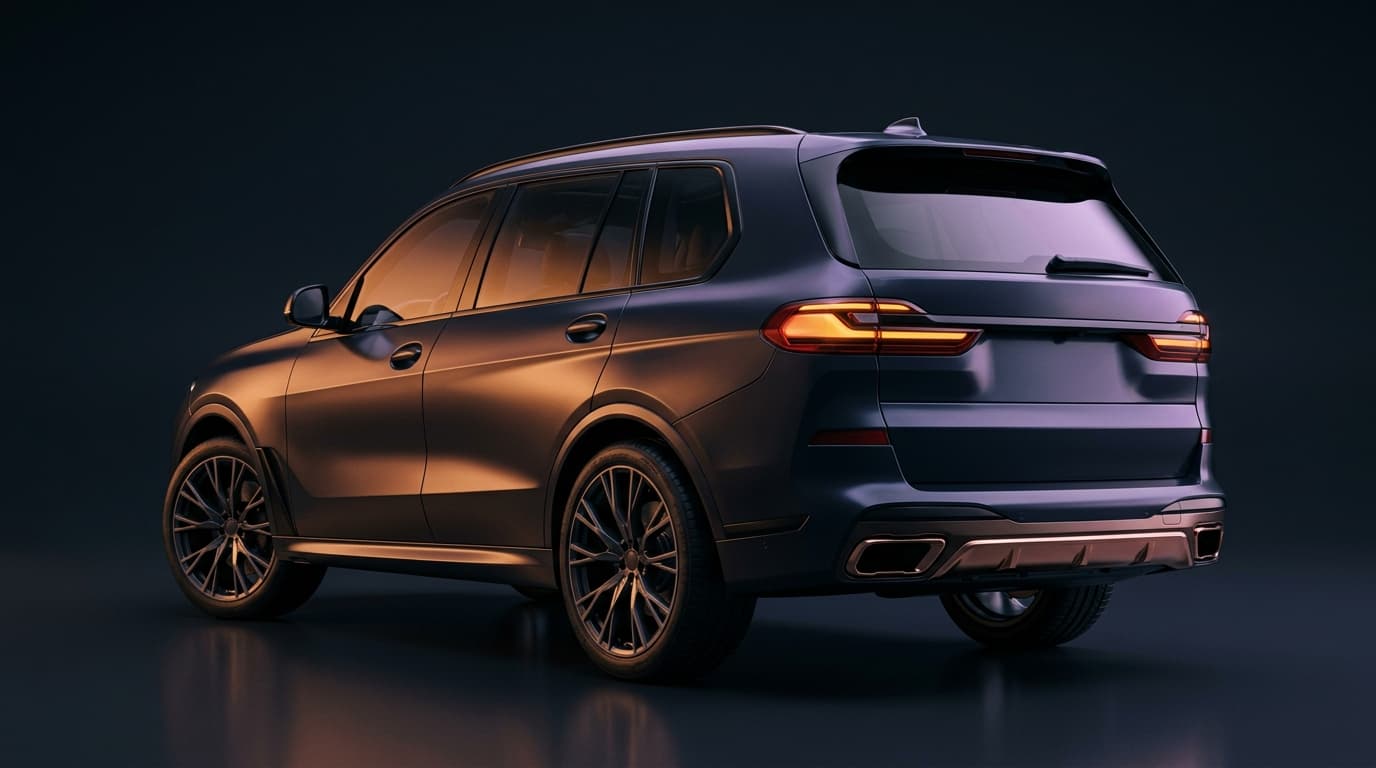
Off-road vehicle is the only term the regulation truly defines
Only one of the everyday labels has legal existence, and it is not the one you would expect.
European type-approval law recognises a category G, meaning off-road, which combines with category M1 to produce the code M1G. For a vehicle under two tonnes, the criteria compiled from European Union and UNECE texts stack up: a front axle and a rear axle driven simultaneously, a differential lock, the ability to climb a 30 % gradient, and numerical requirements on approach angle, departure angle, ramp angle or ground clearance.
A 30 % gradient is a slope of roughly 17 degrees. Most family SUVs climb it without complaint on dry tarmac, then stop dead the moment the surface gives way, for want of a differential lock and low-range gearing.
| Label | Official status | Architecture | Drivetrain | Example on the Belgian market |
|---|---|---|---|---|
| Off-road vehicle | Category G possible, code M1G | Ladder frame or reinforced body | Permanent four-wheel drive, low range | Toyota Land Cruiser, Jeep Wrangler |
| SUV | None | Unitary body | Front-wheel drive usually, AWD optional | Peugeot 3008, Skoda Kodiaq |
| Crossover | None | Unitary body of a saloon or estate | Front-wheel drive | Dacia Sandero Stepway, Audi A6 Allroad |
| Coupé SUV | None | Unitary body | Front-wheel drive or AWD | BMW X4, Renault Arkana |
| Pick-up | Often approved as N1 | Ladder frame | Selectable four-wheel drive | Ford Ranger, Toyota Hilux |
The second column is the one that matters. Three rows out of five have no status at all, and those are the rows filling Belgian showrooms.
In practice, an M1G code in box J buys you no tax break and no traffic exemption anywhere in the country. It certifies off-road ability, nothing more, and it is paid for in fuel, road noise and comfort. Few Belgian buyers have any use for it, and fewer still know that before they line up two quotes.
Crossover: an agency word, not a workshop one
The crossover never described a technique. It names a cross between a saloon or estate and an SUV, something the Belgian motoring press calls a pure marketing product without hedging. The term is fading from sales pitches too: a dealer will talk to you about a compact SUV today, hardly ever about a crossover.
Segment B, C or D: where does your SUV sit?
Again, no text. Segments come from the specialist press and marketing departments, and they are read with a tape measure rather than in an official journal. The grid European manufacturers use fits in four lines.
| Segment | Indicative length | Typical profile | Examples sold in Belgium |
|---|---|---|---|
| B | 4.00 to 4.35 m | Urban SUV, five seats, city-car boot | Ford Puma, Suzuki Vitara |
| C | 4.35 to 4.60 m | Compact SUV, the heart of the Belgian market | Audi Q3, Volkswagen T-Roc, Volkswagen Tiguan |
| D | 4.60 to 4.95 m | Family SUV, five or seven seats | Opel Grandland, Kia Sorento |
| E | beyond 4.95 m | Large SUV, people-carrier footprint | Volvo XC90 |
Those boundaries drift by a few centimetres depending on the source, and manufacturers play on it. A model marketed as compact can outgrow a family SUV from the previous generation.
The segment describes the room on board, never the weight. Two SUVs in the same segment can be 400 kg apart depending on their powertrain, and that gap is what shows up on your tax notice.
An SUV uses more fuel, and the extra weight explains most of it
Three causes, in this order.
Mass first. Every acceleration and every braking event is paid in proportion to the kilos being moved, and town driving is where the bill climbs. Frontal area second: a taller, wider body pushes more air, and that penalty becomes dominant on the motorway, where drag rises with the square of speed. Tyres last, wider and taller, whose rolling resistance adds to the rest.
On the Belgian market this arithmetic lands straight at the pump. According to Febiac, petrol accounted for 44.4 % of new registrations in the first quarter, and as much as 62.8 % among private buyers, against 2.3 % for diesel. In other words, most private buyers pay for every extra kilo at petrol prices.
Our survey of the most fuel-efficient SUVs gives the measured gaps between models, rather than the approval figures.
Wallonia has taxed mass since 1 July 2025
This is the one place in Belgian law where an SUV's footprint turns into euros.
Since 1 July 2025, the SPW Finances calculates the Walloon registration tax by multiplying four terms: a base amount set by power in kilowatts and tapering with vehicle age, the CO2 figure divided by 136 under the WLTP cycle, maximum authorised mass divided by 1,838 kg, and a fuel coefficient worth 1 for petrol and diesel, 0.8 for a hybrid and between 0.01 and 0.26 for an electric car depending on its power.
1,838 kg. That is the pivot, and nobody ever quotes it.
Below that mass, the coefficient lightens the bill. Above it, the coefficient inflates it. At strictly identical power, CO2 and fuel, a model showing 2,138 kg in box F.1 pays 16 % more than one at 1,838 kg. That is the closest thing to an SUV tax in Belgium, and it never says the word. The final figure can never fall below 50 € nor exceed 9,000 €.
A delicious detail, and a fully deliberate one: the Walloon 250 € large-family reduction is granted only if maximum authorised mass falls between 1,839 and 2,749 kg. So the Region taxes mass with one hand and refunds part of it with the other, on condition that you buy heavy.
Brussels and Flanders did not follow. The Brussels registration tax still rests on power, in fiscal horsepower and kilowatts, with a discount tied to vehicle age. The Flemish BIV combines power, CO2, Euro standard and fuel. Neither brings mass into its calculation, which means the same large SUV costs more to register in Namur than in Antwerp. Check the schedule in force with Bruxelles Fiscalité or the Vlaamse Belastingdienst before signing, as they are reindexed on different dates.
Low emission zones, for their part, ignore footprint completely. Brussels, Antwerp and Ghent filter on category, fuel and Euro standard, the one in box V.9. Since 1 January the Brussels LEZ has refused Euro 5 diesels and Euro 2 petrol cars, with a 350 € fine announced from 1 July. A 1,400 kg diesel estate is banned there while a 2,100 kg petrol SUV drives through freely.
Do you really need four-wheel drive in Belgium?
No, in the vast majority of cases. Belgian relief, winter road salting and the density of the road network make four-wheel drive useful to a minority of drivers, essentially in the Ardennes and above 400 m of altitude. We put numbers on that case in our feature on SUVs where AWD genuinely earns its keep here.
For everything else, forget the vocabulary. It will never cost you a euro, whereas three boxes on your registration certificate will, every single year. If you drive a company car, our guide to company-car SUV taxation covers the same boxes from the deductibility angle. And to compare two models on their real mass and power rather than their badge, use our comparison tool.
Frequently asked questions
What is the difference between an SUV and a 4x4? A 4x4 in the strict sense, an off-road vehicle, meets type-approval criteria: both axles driven simultaneously, a differential lock, a 30 % gradient it can climb, plus requirements on approach, departure and ramp angles and ground clearance. The SUV meets no criteria at all, and plenty of SUVs sold in Belgium drive only two wheels.
Are a crossover and an SUV the same thing? In everyday usage today, yes. Originally the crossover named a cross between a saloon or estate and an SUV, on a unitary body. Neither word carries any legal weight, and the term crossover has all but vanished from Belgian sales pitches.
How do I know which segment my SUV belongs to? With a tape measure, for want of any official text. Under 4.35 m, people talk about segment B. From 4.35 to 4.60 m, segment C, the heart of the Belgian market. From 4.60 to 4.95 m, segment D. Beyond that, large SUV. Two models in the same segment can be 400 kg apart.
Is an SUV taxed more heavily in Belgium? Not as an SUV, since no tax schedule uses the word. In Wallonia, maximum authorised mass has been part of the registration tax (TMC) calculation since 1 July 2025, which penalises heavy models in practice. In Brussels and Flanders, mass plays no part.
Frequently asked questions
A 4x4 in the strict sense, an off-road vehicle, meets type-approval criteria: both axles driven simultaneously, a differential lock, a 30 % gradient it can climb, plus requirements on approach, departure and ramp angles and ground clearance. The SUV meets no criteria at all, and plenty of SUVs sold in Belgium drive only two wheels.
In everyday usage today, yes. Originally the crossover named a cross between a saloon or estate and an SUV, on a unitary body. Neither word carries any legal weight, and the term crossover has all but vanished from Belgian sales pitches.
With a tape measure, for want of any official text. Under 4.35 m, people talk about segment B. From 4.35 to 4.60 m, segment C, the heart of the Belgian market. From 4.60 to 4.95 m, segment D. Beyond that, large SUV. Two models in the same segment can be 400 kg apart.
Not as an SUV, since no tax schedule uses the word. In Wallonia, maximum authorised mass has been part of the registration tax (TMC) calculation since 1 July 2025, which penalises heavy models in practice. In Brussels and Flanders, mass plays no part.
We dig through the Belgian market data — TÜV reliability, real-world ADAC consumption, company-car taxation, list prices — to call it straight. No brand pays us.