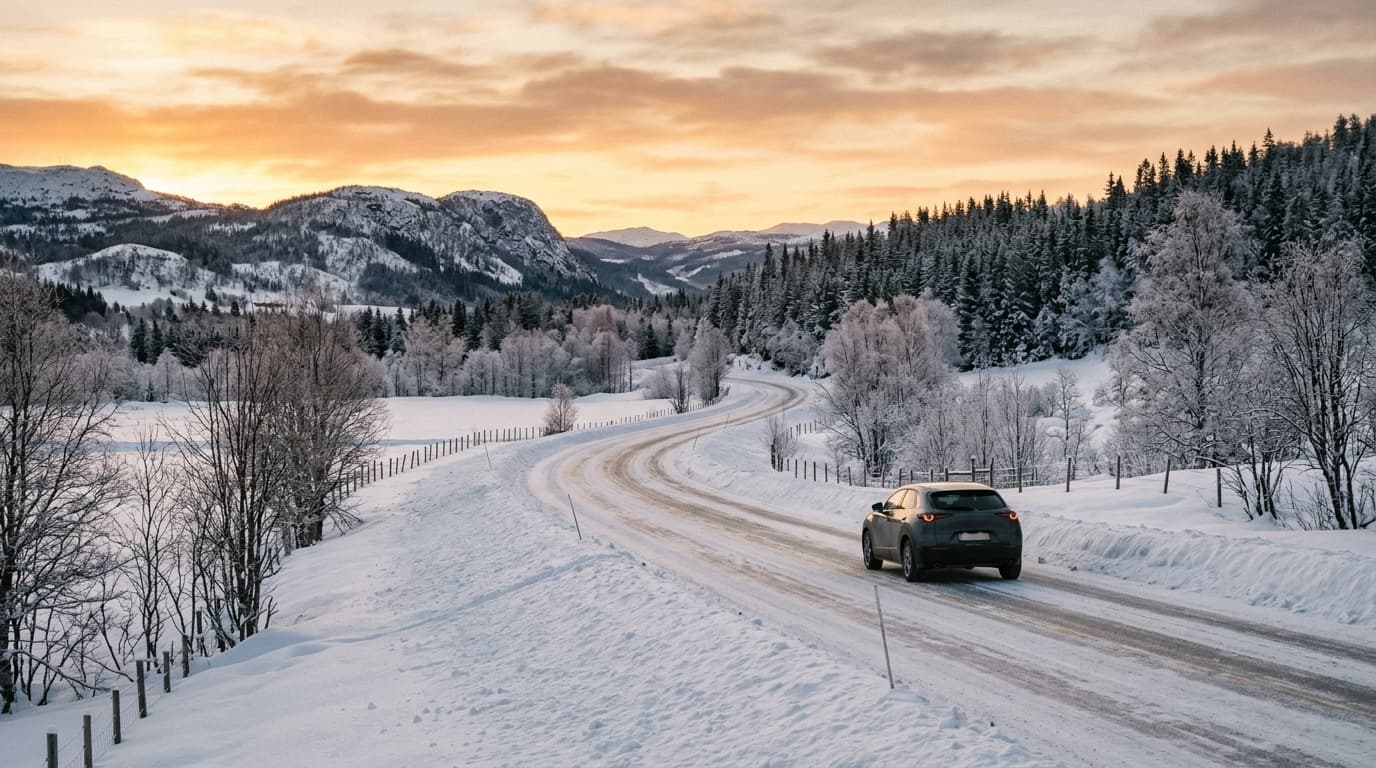
All-wheel drive earns its keep in Belgium above 400 metres, on a steeply sloping driveway, or for towing on soft ground. Everywhere else it costs 0.4 to 0.5 L/100 km and several thousand euros for 17 snow days a year in Uccle. Four winter tyres do more, for far less.
Is an AWD SUV really useful in Belgium?
For most Belgian drivers, no. Four-wheel drive acts only under acceleration: it splits torque across four wheels and delays wheelspin when pulling away. It improves neither braking nor cornering grip. On a salted road network at low altitude, that benefit adds up to a few minutes per winter.
The maths change as soon as you climb. On the Ardennes plateau, secondary roads are gritted last, 10 % gradients are routine and snow lies for days. Someone in Vielsalm or Bütgenbach who has to get a car up a sloping driveway every January morning has a real case. A commuter from Wavre taking the E411 does not.
The number that matters: on a Toyota RAV4 hybrid, AWD-i pushes WLTP fuel consumption from 4.9-5.2 to 5.3-5.7 L/100 km. You pay that gap 365 days a year for traction that helps on a handful of mornings.
How many snow days does Belgium actually get?
Seventeen a year in Uccle, thirty in the Ardennes. Those are the IRM averages for the 1991-2020 period. On the high Baraque Michel plateau the count approaches 40 days. The gap between low Belgium and high Belgium is therefore a factor of two.
The trend matters as much as the number. The Uccle average stood at 24 days over the 1981-2010 period: seven days lost in a single generation of climate normals. And a "snow day" means observed snowfall, not a snow-covered road. The share of days when snow actually settles in Brabant can be counted on one hand.
In practice that gives you a simple test: your altitude. Above 400 metres, all-wheel drive is worth a serious discussion. Below it, the benefit is psychological.
What does all-wheel drive cost on the same SUV?
Between €1,500 and €3,000 up front, then about €145 of fuel a year. The Toyota RAV4 hybrid lets us measure the penalty cleanly, since only the transmission changes between the two versions.
| RAV4 hybrid version | Power | WLTP consumption | WLTP CO₂ | Flemish BIV |
|---|---|---|---|---|
| Two-wheel drive | 183 hp | 4.9–5.2 L/100 | 112–118 g | ~€205 |
| AWD-i (all-wheel drive) | 191 hp | 5.3–5.7 L/100 | 121–129 g | ~€315 |
BIV calculated using the 2026 Flemish formula (technology coefficient q = 1.245, air constant €28.54 for Euro 6 petrol), at 115 and 125 g of CO₂.
Over 15,000 km a year, that extra 0.5 L/100 km amounts to 75 litres, or €145 at the official maximum price for 95 E10 petrol, set at €1.937/L on 17 July 2026 by the SPF Économie (the federal economy ministry). Over eight years of ownership, all-wheel drive therefore costs roughly €1,160 in fuel, plus €110 of BIV, plus the purchase premium. Against that, a set of four winter tyres on their own rims runs €600-900 and works every winter, everywhere.
Does AWD replace winter tyres?
No. This is the segment's most expensive misunderstanding. ADAC data show that an all-wheel-drive vehicle on summer tyres loses every advantage the moment it has to brake or turn: four-wheel drive only manages traction. Worse, an AWD SUV weighs 60 to 100 kg more than its two-wheel-drive equivalent, which mechanically lengthens its stopping distance on snow.
Summer rubber also loses its flexibility well before the first snowfall. Below 7 °C the compound hardens and grip drops, even on dry roads. That is where Belgian winter safety is decided: in the tyre compound, not in the driveshaft.
What we would avoid: buying the all-wheel-drive option and staying on cheap all-season tyres to balance the budget. The reverse order — 3PMSF winter tyres on a front-wheel-drive car — protects more, for less.
What does Belgian law say about winter tyres?
Nothing binding. Belgium has no legal winter tyre requirement, unlike most of its neighbours. They are recommended in snow, ice or low temperatures, and that is all. This absence of any rule partly explains why so many Belgian drivers buy mechanical traction rather than rubber.
Is a Belgian 4x4 exempt in France or Germany?
No, and it is spelled out. The French loi Montagne requires four 3PMSF-marked tyres or snow chains from 1 November to 31 March across 34 mountain-massif départements, and SUVs and 4x4s are explicitly covered. An M+S marking alone no longer qualifies. In Germany the obligation is situational but firm, and only tyres carrying the alpine symbol are accepted. Heading to the ski slopes in an AWD car on summer tyres is a guaranteed fine.
Which AWD SUVs still make sense in Belgium?
Four of them, for different reasons. The market has emptied out: most compact SUVs sold in Belgium now exist only in two-wheel drive, all-wheel drive having been sacrificed on the altar of CO₂.
| Model | AWD | BE price from | Profile |
|---|---|---|---|
| Dacia Duster 4x4 mild hybrid 130 | Option | €28,090 | Rural, tight budget |
| Suzuki S-Cross Hybrid AllGrip | Option | €28,299 | Compact all-rounder |
| Subaru Forester e-Boxer | Standard | ~€40,000 | Altitude, towing |
| Toyota RAV4 AWD-i | Option | €49,160 (2WD) | Family, reliability |
Belgian list prices taken from Le Moniteur Automobile, 2025-2026 ranges.
The Dacia Duster remains the only new SUV under €30,000 with genuine four-wheel drive, including a low-range reduction gear and a locked mode. Against the €22,690 of the two-wheel-drive petrol Duster, all-wheel drive costs roughly €5,400: expensive, but it is the market's entry ticket. The Subaru Forester sits at the other extreme — permanent symmetrical AWD as standard, but 7.4 L/100 km on the WLTP cycle and €40,000 minimum. If your real need is pulling a load, our comparison of the best SUV for towing a caravan ranks things differently.
When should you avoid AWD?
Three profiles, no nuance. The commuter first: if your journeys follow the E19, E40 or E411, you drive on roads that are gritted as an absolute priority, and all-wheel drive will never serve you. You will pay €145 of fuel a year and €110 of Flemish BIV for dormant hardware.
The urban driver next. In town, all-wheel drive adds nothing a good tyre does not do better, and the extra weight penalises consumption at every red light. Our ranking of the most fuel-efficient SUVs contains no AWD model at all, which is no accident.
The electric buyer last. On an electric SUV, all-wheel drive means a second motor, so more weight and less range — already a heavy handicap in winter, as our file on real electric SUV range in cold weather shows. Barring altitude or a trailer, take the rear-wheel-drive version and put the difference into winter tyres. For the rest of the decision, our comparison of the best compact SUV in Belgium remains the starting point.
Frequently asked questions
For the vast majority of drivers, no. The IRM records 17 snow days a year in Uccle on the 1991-2020 average, and snow settles on the ground for only a fraction of those days. For a Brussels-Antwerp-Ghent commute, a front-wheel-drive car on winter tyres covers everything. Four-wheel drive becomes defensible above 400 metres of altitude, where the average climbs to 30 snow days a year, on a steeply sloping driveway, or for regularly towing a trailer on soft ground.
A two-wheel-drive SUV sends torque to the front wheels only, more rarely the rear. An AWD SUV splits torque across all four wheels, permanently or on demand. The difference shows up under acceleration on slippery ground: AWD delays wheelspin when pulling away and on hills. It shows up neither under braking nor in corners, where only the tyres matter.
Expect two bills. Up front, AWD typically adds €1,500 to €3,000 on the same trim. In use, it adds weight and friction: on the Toyota RAV4 hybrid, the AWD-i version goes from 4.9-5.2 to 5.3-5.7 L/100 km on the WLTP cycle, or roughly €145 of fuel a year over 15,000 km at €1.937/L. Add the extra BIV registration tax tied to the 9 to 11 g of additional CO₂ in Flanders.
No, and the reverse is closer to the truth. The ADAC points out that four-wheel drive only intervenes under acceleration: it helps neither braking nor turning. An AWD SUV on summer tyres brakes worse on snow than a front-wheel-drive car on winter tyres, and its extra weight lengthens the stopping distance further. The right order of priorities: four 3PMSF-marked winter tyres first, all-wheel drive second, if at all.
No. No law requires winter tyres in Belgium; they are merely recommended in snow, ice or low temperatures. That is a Belgian quirk: Germany requires 3PMSF-marked tyres whenever conditions demand it, and France applies the loi Montagne from 1 November to 31 March across 34 départements. Driving an AWD car exempts you from none of these obligations.
The Dacia Duster remains the only new SUV offering four-wheel drive under €30,000: Le Moniteur Automobile lists the 4x4 mild hybrid 130 range between €28,090 and €29,590 in 2026, against €22,690 for the two-wheel-drive petrol Duster. The Suzuki S-Cross Hybrid AllGrip starts at €28,299. Beyond that you are looking at a Subaru Forester e-Boxer, around €40,000, with permanent symmetrical AWD as standard.
Not for driving, yes for manoeuvring. On dry roads a front-wheel-drive car tows without difficulty within its homologated towing limit. The trouble starts on a waterlogged campsite pitch or a slipway: the front wheel spins because weight transfers rearwards. It is the one common Belgian use case where all-wheel drive genuinely pays for itself.
We dig through the Belgian market data — TÜV reliability, real-world ADAC consumption, company-car taxation, list prices — to call it straight. No brand pays us.