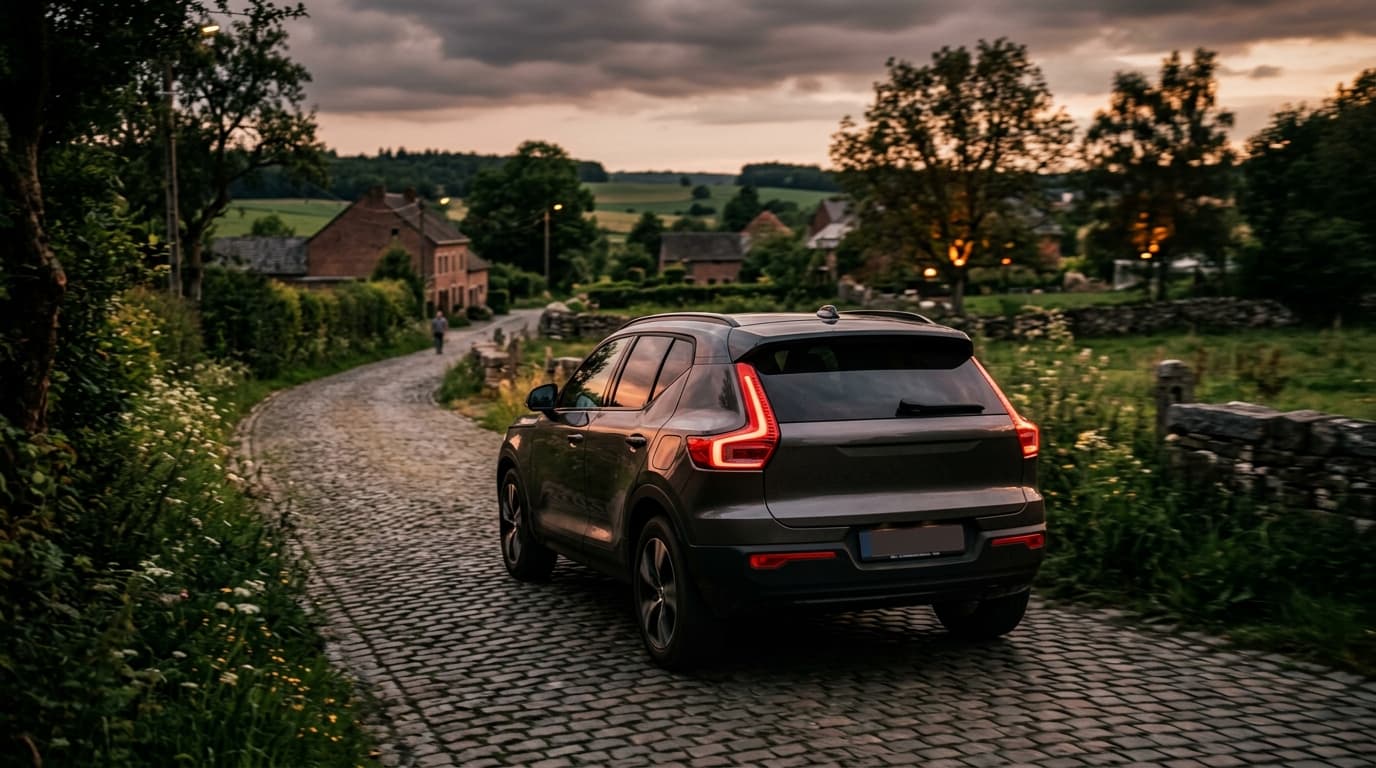
The most fuel-efficient SUV in Belgium is the Toyota Yaris Cross Hybrid 130, measured at 4.9 L/100 km in the ADAC Ecotest, including 3.6 L in town. Since 12 July 2026, 95 E10 petrol has been capped at €1.909/L: every half-litre saved per 100 km is now worth more than €140 a year. Here is the ranking based on real consumption, not on brochures.
Which SUV uses the least fuel in Belgium?
The Toyota Yaris Cross Hybrid 130 leads with 4.9 L/100 km measured by the ADAC Ecotest, the German protocol that drives cars on a rig and on the road instead of copying WLTP figures. The breakdown is worth reading: 3.6 L in town, 4.3 L on secondary roads, 6.7 L on the motorway. It is the only SUV on the Belgian market to drop below 5 L in real-world average.
Three models sit within 0.1 L of each other behind it. The Renault Symbioz E-Tech runs at about 5.1 L/100 km in real driving for a WLTP rating of 4.7 L. The Toyota C-HR Hybrid and the Dacia Duster Hybrid 155 both land at roughly 5.2 L. The Renault Captur E-Tech closes the group of serious hybrids at around 5.5 L in mixed conditions.
The figure that counts: no non-hybrid petrol SUV drops below 6 L/100 km in real driving. On the Belgian market, the question "which SUV uses the least fuel" has a short answer — a full hybrid, full stop. The rest is a matter of purchase price and size.
Why does real consumption differ from the WLTP figure?
Because WLTP is a standardised laboratory cycle, not a measurement of your commute. The gap between the homologated value and observed consumption runs between 10 and 20 % depending on the model, the payload and the driving style.
In practice: the Dacia Duster Hybrid 155 is rated at 4.6 L/100 km under WLTP (105 to 107 g CO₂/km) and measures around 5.2 L in real driving, a 13 % difference. The Toyota Yaris Cross, rated between 4.4 and 4.7 L, lands at 4.9 L in the ADAC test — a modest 7 % gap that says a lot about the maturity of Toyota's hybrid drivetrain. PHEVs, by contrast, advertise WLTP figures of 1.2 L/100 km that mean nothing once the battery is empty.
WLTP remains useful for one thing: comparing two models with each other, since they take the same test. To estimate your own bill, add 10 to 20 % and you will be close to reality.
How much does fuel really cost over a year?
Over 15,000 km a year, the gap between the most frugal SUV and a conventional petrol SUV exceeds €600. The calculation uses the official maximum prices on 12 July 2026: €1.909 per litre of 95 E10 petrol and €2.094 per litre of B10 diesel, according to the official tariff published by the SPF Économie (the Belgian federal economy department).
| Model | Real consumption | Motorway | Price BE from | Fuel / year |
|---|---|---|---|---|
| Toyota Yaris Cross Hybrid | 4.9 L/100 | 6.7 L/100 | €30,535 | ~€1,403 |
| Renault Symbioz E-Tech | 5.1 L/100 | 6.0 L/100 | ~€33,000 | ~€1,461 |
| Dacia Duster Hybrid 155 | 5.2 L/100 | 6.8 L/100 | €26,190 | ~€1,489 |
| Toyota C-HR Hybrid | 5.2 L/100 | 6.5 L/100 | ~€36,000 | ~€1,489 |
| Renault Captur E-Tech | 5.5 L/100 | 6.3 L/100 | €30,000 | ~€1,575 |
| Dacia Duster TCe petrol | 7.0 L/100 | 7.5 L/100 | ~€22,000 | ~€2,004 |
Basis: 15,000 km/year, 95 E10 petrol at €1.909/L (official maximum price, 12 July 2026).
The Dacia Duster Hybrid 155 pays for itself fastest. At €26,190 in Expression trim, according to Belgian pricing from Moniteur Automobile, it costs €4,345 less than a Yaris Cross for 0.3 L/100 km more. That consumption gap is worth about €86 a year: you would have to drive for fifty years to make up the purchase-price difference.
Does a hybrid stay frugal on the motorway?
No, and this is the costliest misunderstanding in the segment. A full hybrid draws its advantage from regenerative braking and electric running at low speed. At a steady 120 km/h on the E40, there is no braking to recover and no electric phase: the combustion engine runs continuously, often a small-displacement unit forced to hang on.
ADAC and TÜV data show the Toyota Yaris Cross going from 3.6 L in town to 6.7 L on the motorway — nearly double. The Dacia Duster Hybrid 155 climbs to 6.8 L at 130 km/h. The Renault Symbioz does slightly better at 6.0 L, but the ranking order changes completely as soon as you leave the city.
What we would avoid: buying a small hybrid to cover 30,000 km of motorway a year. For that profile, our comparison of the best hybrid SUV for high-mileage drivers produces a very different ranking, where efficiency at steady speed matters more than urban consumption.
Is diesel still the cheapest SUV to run?
On paper it uses little fuel: 4.5 to 5.5 L/100 km in real driving for a recent compact diesel, and a Peugeot 3008 BlueHDi 130 drops below 5 L on the motorway. Except that the fuel costs more: €2.094 per litre of B10 against €1.909 for 95 E10 petrol since 12 July 2026, a gap of nearly 10 % per litre.
Run the numbers over 15,000 km. A diesel at 5.2 L costs €1,633 in fuel per year, against €1,403 for the Yaris Cross Hybrid burning 4.9 L of petrol. Diesel loses on both counts, precisely where its historical advantage used to be.
Can a diesel still drive in Belgium's LEZ zones?
A new Euro 6d diesel remains allowed everywhere, including Brussels, Antwerp and Ghent. The problem is the trajectory: the Brussels LEZ (low-emission zone) has excluded Euro 5 diesels since 1 July 2026 and targets a diesel phase-out around 2030. Buying a new diesel SUV today means buying a scheduled depreciation.
What mileage still justifies a diesel?
Beyond 35,000 to 40,000 km a year, mostly on the motorway, the efficiency gap eventually offsets the price per litre. Below that, the hybrid wins. On the Belgian market, fewer than one driver in ten reaches that mileage.
Which SUVs should you avoid if fuel economy is your first criterion?
Three cases to rule out. The PHEV SUV first, if you have no home charger: with a flat battery you haul 250 to 300 kg of extra battery and electronics for nothing, and real consumption climbs above that of a plain hybrid. Belgian tax rules no longer help either, since company-car deductibility has been reserved for 0 g CO₂ vehicles from 2026.
The large non-hybrid petrol SUV next. A naturally aspirated or turbocharged petrol engine with no electric assistance in a 1.6-tonne vehicle exceeds 8 L/100 km in town, or nearly €2,300 of fuel a year over 15,000 km. It is the worst ratio on the market.
The new diesel last, unless you are a committed high-mileage driver. Between €2.094 per litre, accelerated depreciation and the tightening of Belgian low-emission zones, it no longer ticks a single box for mixed use. If your purchase budget is tight, look instead at our best compact SUV in Belgium comparison, and if you drive mostly in town, our city SUV guide narrows the choice street by street.
Frequently asked questions
The Toyota Yaris Cross Hybrid 130 is the most frugal SUV sold in Belgium: 4.9 L/100 km measured in the ADAC Ecotest, with 3.6 L in town. The Renault Symbioz E-Tech follows at around 5.1 L/100 km in real driving, then the Toyota C-HR and the Dacia Duster Hybrid 155 at about 5.2 L. Below 5 L/100 km in the real world, a non-hybrid petrol SUV simply does not exist.
The gap generally runs between 10 and 20 %. The Dacia Duster Hybrid 155 is rated 4.6 L/100 km under WLTP and measures around 5.2 L in real driving, a 13 % difference. WLTP is a standardised laboratory cycle: it accounts for neither wind, nor payload, nor your actual speed on the E411 motorway. It is still useful to compare two SUVs; to forecast your bill, add 10 to 20 %.
Over 15,000 km a year, a hybrid SUV at 4.9 L/100 km burns 735 litres, or about €1,403 at the official maximum price of 95 E10 petrol (€1.909/L on 12 July 2026). A conventional petrol SUV at 7 L/100 km burns 1,050 litres, or about €2,004. The yearly gap exceeds €600, and it widens if you drive mostly in town.
No, and this is the most misunderstood point. A hybrid draws its advantage from regenerative braking and electric running at low speed. At 120 km/h on the E40, the combustion engine works continuously: the Toyota Yaris Cross climbs back to 6.7 L/100 km on the motorway according to ADAC, against 3.6 L in town. For a motorway high-mileage driver, the hybrid advantage is halved.
Not really. A compact diesel uses little fuel (4.5 to 5.5 L/100 km in real driving), but a litre of B10 has been capped at €2.094 since 12 July 2026, against €1.909 for 95 E10 petrol. At equal consumption, diesel therefore costs about 10 % more per litre. Add the LEZ (low-emission zones) of Brussels, Antwerp and Ghent, which keep tightening, plus faster depreciation: the maths only works for very high-mileage drivers.
It offers the best purchase-price-to-consumption ratio on the Belgian market. It starts at €26,190 in Expression trim and measures around 5.2 L/100 km in real driving (4.6 L under WLTP), with 4.4 L in gentle town use and 6.8 L at 130 km/h. It uses 0.3 L more than a Yaris Cross, but costs more than €4,000 less to buy.
Three profiles to rule out. A PHEV SUV if you have no home charger: with a flat battery you carry 250 to 300 kg of extra weight for nothing. A large non-hybrid petrol SUV, which easily exceeds 8 L/100 km in town. And a new diesel, penalised both by the price per litre (€2.094) and by the tightening of Belgium's low-emission zones.
We dig through the Belgian market data — TÜV reliability, real-world ADAC consumption, company-car taxation, list prices — to call it straight. No brand pays us.