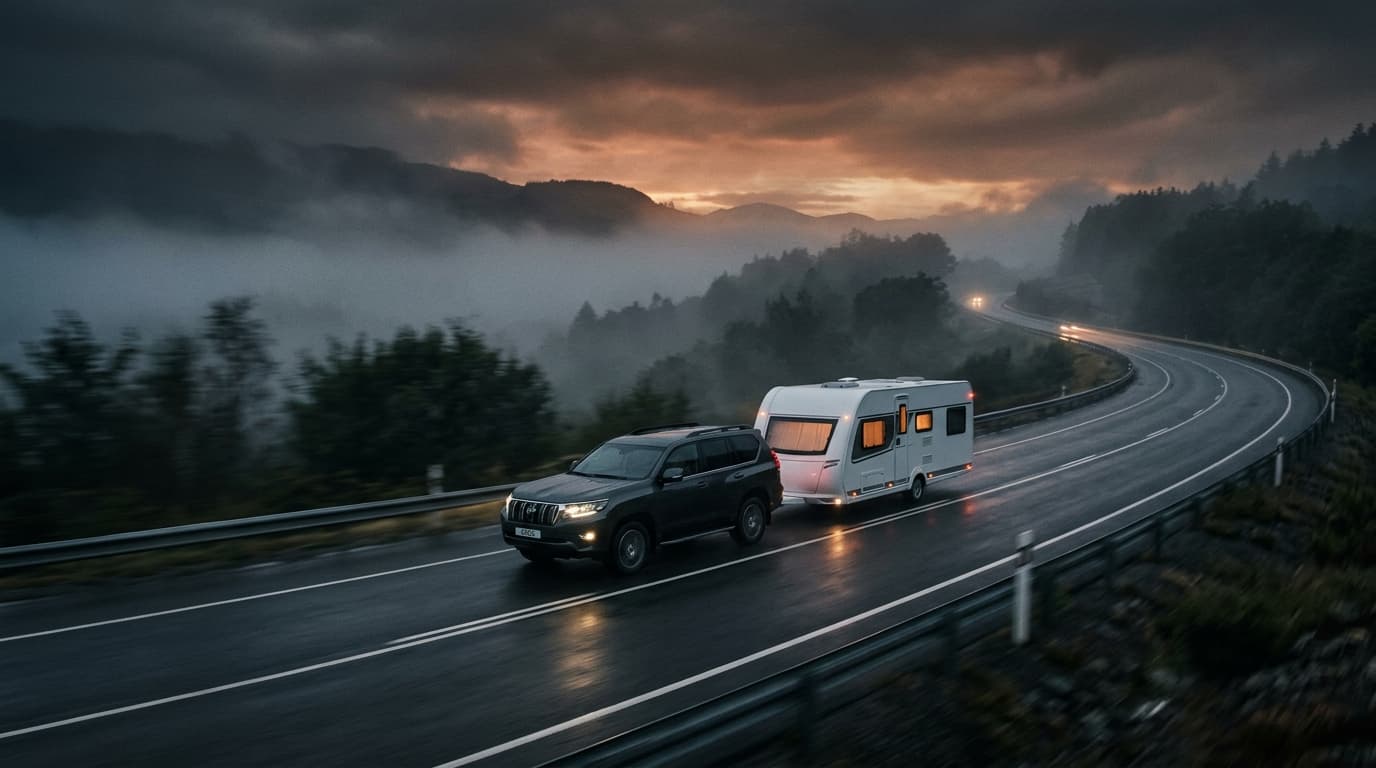
Choosing an SUV to tow a caravan in Belgium comes down to three numbers, not the looks: the braked towing capacity, the combined MMA that decides your licence, and the noseweight. The diesel Kia Sorento tows 2,500 kg, a RAV4 Hybrid is limited to 1,650 kg. Here is how to get it right.
Which SUV tows a caravan best in Belgium?
To tow a loaded family caravan, diesel keeps the edge. The Kia Sorento 2.2 CRDi is rated at 2,500 kg braked, and the Skoda Kodiaq 2.0 TDI 4x4 matches it: enough to pull a full twin-axle without straining. Above them, the Volkswagen Touareg V6 TDI climbs to 3,500 kg, the legal ceiling for a trailer.
Low-end torque explains this dominance. A diesel delivers its peak torque from 1,500 rpm, exactly where you pull away uphill with 1,500 kg hitched behind. On the Belgian market, these three models remain the safe bets for heavy towing, with available all-wheel drive that reassures on a soaked campsite pitch.
The number that counts: the braked towing capacity appears on the car's certificate of conformity (item O.1). That is what applies, not the brochure. The same model can show 2,000 or 2,500 kg depending on the engine and whether four-wheel drive is fitted, so check the exact line for your version before you sign.
How much towing capacity do you really need?
Start from the real loaded weight of your caravan, never its empty weight. A caravan quoted at 1,200 kg empty often weighs 1,400 to 1,600 kg once water, luggage, the bike rack and the furniture are on board. Field data shows it clearly: it is this ready-to-go weight that must stay under the towing capacity, with a margin of at least 15% for hills and crosswinds.
The second number, often forgotten, is the noseweight on the towball. It is usually between 75 and 100 kg depending on the car and the hitch, and a poorly distributed load exceeds it fast: too much weight at the front of the caravan and the ball sags; too much at the back and the outfit starts to snake at 110 km/h. What we would avoid: loading all the heavy bags behind the axle to "relieve" the car. That is exactly what triggers the notorious pendulum effect.
Do you need a special licence to tow in Belgium?
It depends on a single number: the MMA (maximum authorised mass) of the car-plus-caravan combination. As long as this total stays under 3,500 kg, the standard B licence is enough, even if the caravan exceeds 750 kg, according to the SPF Mobilité (the Belgian federal mobility authority). A Sorento loaded to 2,000 kg with a caravan of 1,500 kg MMA puts you right at the limit.
Beyond that, two options. Between 3,500 and 4,250 kg combined, the B licence with code 96 unlocks the situation: a training course of a few hours, no theory exam. For a trailer whose MMA exceeds 3,500 kg, or a combination up to 7,000 kg, you need the BE licence, with a practical exam this time, as the Moniteur Automobile points out.
In practice, most Belgian caravanners drive on a simple B licence. The trap appears when you move up to a big, heavy SUV: a Touareg already exceeds 2,300 kg empty, so with a caravan of 1,500 kg MMA the combination nudges 3,800 kg and tips into code 96 territory. Do the maths before buying, not in front of the inspector.
Diesel, hybrid or electric for towing?
The table settles it quickly. For heavy, regular towing, diesel stays the most versatile; the hybrid covers small and medium caravans; and the electric tows hard but drinks its battery.
| Model | Powertrain | Braked towing capacity | Typical licence* |
|---|---|---|---|
| VW Touareg V6 TDI | Diesel | 3,500 kg | B96 or BE |
| Kia Sorento CRDi | Diesel | 2,500 kg | B (mind the MMA) |
| Skoda Kodiaq TDI 4x4 | Diesel | 2,500 kg | B (mind the MMA) |
| Kia EV9 AWD | Electric | 2,500 kg | B (mind the MMA) |
| Toyota RAV4 Hybrid | Full hybrid | 1,650 kg | B |
| Toyota RAV4 PHEV | Plug-in hybrid | ~1,500 kg | B |
| Tesla Model Y | Electric | 1,600 kg | B |
*Depending on the real combined MMA: a combination under 3,500 kg stays on a B licence.
The electric SUV's weak point is not power but range. The ADAC measures a drop of up to 50% when towing a caravan, because the frontal area and the weight almost double consumption. A Kia EV9 that claims 500 km solo falls to around 250 km with the caravan: on a trip to the south of France, that multiplies the charging stops, often hard to make with a trailer hitched.
The full hybrid, for its part, works no miracle when towing. The Toyota RAV4 Hybrid pulls its 1,650 kg cleanly, but its petrol engine runs almost constantly to recharge the battery under load, and consumption climbs to 8 or 9 L/100 km. It is the right compromise for a small caravan and occasional use, not for crossing the Alps every summer.
Which SUVs should you avoid for towing a caravan?
First reflex to drop: the PHEV for a big caravan. Most plug-in hybrids cap around 1,500 kg, because the battery weight eats into the payload. A Toyota RAV4 PHEV or a plug-in Peugeot 5008 suits a light caravan, not a 1,800 kg twin-axle. What we would avoid: buying a PHEV expecting to tow heavy, then discovering the limit on the certificate of conformity.
Second trap, the electric SUV with no charging plan. Technically, an EV9 or a Model Y tows without issue, but the range halved turns a holiday trip into a headache, especially as few fast chargers are accessible without unhitching. For recurring long-distance towing, electric is not yet ready in Belgium.
Finally, be wary of small compact SUVs. A Yaris Cross or a T-Cross shows a derisory towing capacity, sometimes under 1,000 kg, or even nil on an entry-level hybrid version. The manufacturer data is clear: under 1,200 kg of capacity, you are no longer talking about a family caravan but a small trailer. Always check item O.1 before dreaming of a campsite holiday.
Which SUV should you choose for your caravan?
For a family caravan of 1,300 to 1,700 kg loaded, the diesel Kia Sorento is the rational choice: 2,500 kg of capacity, a real margin, and a B licence that is enough as long as the combination stays under 3,500 kg. The Skoda Kodiaq 2.0 TDI 4x4 plays in the same league, a little cheaper, with the same composure on hills.
For a couple with a small caravan under 1,500 kg and above all mixed use, the Toyota RAV4 Hybrid takes the lead: frugal day to day, reliable, and comfortably within limits for light towing. Keep the Volkswagen Touareg or the Land Rover Defender for very large caravans or vans, bearing in mind the likely move to code 96. Before you sign, the right reflex is to weigh your loaded caravan on a public weighbridge, then check item O.1 on the car you are eyeing. To go further, see our Skoda Kodiaq vs Peugeot 5008 comparison and, if you are unsure about the powertrain, our hybrid or electric SUV feature.
Frequently asked questions
Among the common models on the Belgian market, the Volkswagen Touareg V6 TDI and the Land Rover Defender tow up to 3,500 kg braked, the legal maximum for a trailer with a BE licence. Just behind, the diesel Kia Sorento and the Skoda Kodiaq 2.0 TDI 4x4 reach 2,500 kg, plenty for a loaded twin-axle caravan. These figures are the homologated braked towing weight, to be checked on the car's certificate of conformity.
It depends on the MMA (maximum authorised mass) of the combination. With a B licence, you can tow as long as the car + caravan total does not exceed 3,500 kg, according to the SPF Mobilité (the Belgian federal mobility authority). Between 3,500 and 4,250 kg of combined mass, you need the B licence with code 96 (a short training course, no theory exam). Beyond that, or for a trailer over 3,500 kg MMA, you need the BE licence, with a practical exam.
Yes, but with lower limits than a diesel. The Toyota RAV4 Hybrid is rated at 1,650 kg braked, its plug-in version around 1,500 kg. That is enough for a single-axle caravan for a couple or a small family, but short for a loaded twin-axle. A full hybrid also uses more fuel when towing, because the petrol engine runs almost constantly to recharge the battery.
Some can: the Kia EV9 is rated at 2,500 kg braked, the Tesla Model Y at 1,600 kg. The real limit is range: the ADAC measures a drop of up to 50% when towing a caravan, because the frontal area and the weight almost double consumption. On a 600 km holiday trip, that means many charging stops. Best kept for short distances or drivers who plan seriously.
Start from the real loaded weight of your caravan (luggage, water, bikes), not its empty weight, then add a margin of at least 15%. A loaded family caravan often weighs 1,300 to 1,700 kg: so aim for an SUV rated at 1,800 kg or more. Also check the maximum noseweight on the towball, usually 75 to 100 kg, which a poorly distributed load exceeds quickly.
Yes, up to 1,650 kg braked. It is the rational choice for a couple or small family with a light to medium caravan, with the bonus of reasonable consumption when not towing and Toyota hybrid reliability. For a large twin-axle caravan or frequent mountain use, however, a diesel like the Sorento or Kodiaq remains safer.
Not necessarily, but it is a real plus. On the wet grass of a campsite or a boat-launch slope, four-wheel drive prevents wheelspin when pulling away with the caravan hitched. For classic road use to the Belgian coast or France, two-wheel drive is enough, provided you respect the towing capacity and distribute the loads well.
We dig through the Belgian market data — TÜV reliability, real-world ADAC consumption, company-car taxation, list prices — to call it straight. No brand pays us.