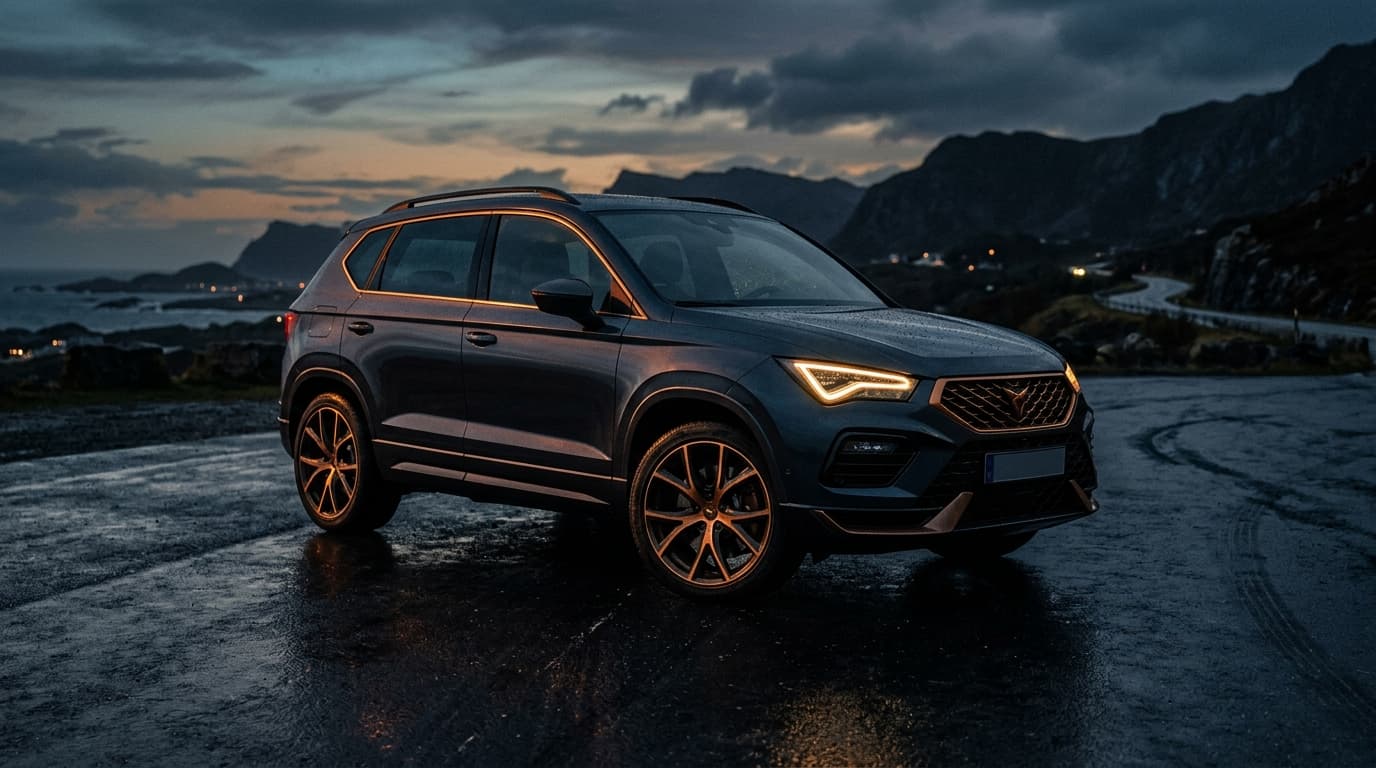
For a family of five, a people carrier still makes more sense than an SUV as soon as you need three child seats side by side. The catch: the people carrier has almost vanished from Belgian showrooms. Only the Dacia Jogger and pricey large vans remain. Here is how to decide, with the figures.
SUV or people carrier for a family of five in Belgium?
It depends on the children's age. Three little ones still in car seats fit better in a flat-floor people carrier; three older children fit in a wide five-seat family SUV. The seven-seater only earns its keep for an occasional sixth or seventh passenger.
On the Belgian market the shift is stark: the people carrier, long the ruler of the large family, has been swept aside by the SUV. Buyers now fall back on seven-seat SUVs whose third row is often a jump seat, or on the one affordable proper family car that survives, the Dacia Jogger.
The number that counts: between a seven-seat Jogger at €18,990 and a large passenger van above €55,000, the budget runs from one to three for the same job. Here are the options actually available, cheapest to roomiest.
| Model | Type | Seats | BE price from |
|---|---|---|---|
| Dacia Jogger | Raised estate | 5 or 7 | €18,990 |
| Skoda Kodiaq | SUV | 5 or 7 | ~€40,000 |
| Peugeot 5008 | SUV | 7 | ~€42,000 |
| Kia Sorento | SUV | 7 | ~€52,000 |
| Volkswagen Multivan | Passenger van | 5 to 7 | ~€55,000 |
Are there still people carriers for sale in Belgium?
Almost none. The classic MPV, the one with a flat floor and three independent rear seats, has nearly disappeared from new catalogues. Manufacturers shifted their budgets to the SUV, more profitable and more in demand.
The withdrawals piled up: the Ford S-Max and Ford Galaxy left the stage in 2023, the petrol Renault Grand Scénic and Citroën Grand C4 SpaceTourer were dropped, and the Volkswagen Touran is ending its run. What we would avoid is hunting for a brand-new 2015-style MPV: the supply barely exists any more.
Three vehicle families remain. The Dacia Jogger, a raised seven-seat estate, plays the role of the affordable MPV. The van-derived leisure vehicles (Citroën Berlingo, Peugeot Rifter, Volkswagen Caddy) offer huge volume on a contained budget. Finally, the large passenger vans (Volkswagen Multivan, Mercedes V-Class, Ford Tourneo) really do carry seven people, but from €55,000 upward.
Can you fit three child seats side by side?
This is the test that settles it, and the SUV often fails it. A family-SUV bench measures 1.30 to 1.45 m, with a centre position that is narrow, raised and rarely fitted with ISOFIX anchors. Three wide child seats almost never coexist there.
An i-Size infant carrier, under the R129 regulation, is 44 to 50 cm wide. Three side by side therefore need at least 1.35 m of usable bench and three workable fixing points. Manufacturer data show that most five-seat SUVs offer only two ISOFIX points, at the outer positions: the third then fits on the belt, slower and tighter on width.
In practice this hands a clear edge to the people carrier and van. Their flat floor and three independent rear seats let each child seat slide in without encroaching on its neighbour. The Dacia Jogger, with its three-part second row, takes two infant carriers without drama; a Multivan with three individual seats accepts three children across where a Kodiaq jams.
How much width does each child seat need?
Count 45 cm per infant carrier plus a little slack to fasten it. Three seats therefore need a bench of at least 1.35 m with no central obstacle. What we would avoid is trusting the number of approved seats: a car can show five belts and take only two child seats side by side. Measure before buying, seat in hand.
What does each option really cost in Belgium?
From €18,990 to over €55,000, to carry the same family. The seven-seat Dacia Jogger starts at €18,990 per Dacia Belgium's offers, and the Eco-G 120 Extreme seven-seat version is listed at €22,790 by Le Moniteur Automobile. It is by far the cheapest way into a new seven-seater.
On the SUV side, the ticket climbs fast. A seven-seat Skoda Kodiaq sits around €40,000, a Peugeot 5008 around €42,000, a Kia Sorento above €50,000. The large passenger vans pass €55,000 for a well-equipped Multivan or V-Class. Between the Jogger and the van, you mostly pay for trim and modularity, not extra seats.
On top of these prices comes Belgian taxation. A passenger van registered as a car (category M1) pays the registration tax (taxe de mise en circulation / belasting op de inverkeerstelling) and the road tax on the regional scales, exactly like an SUV. So there is no tax break in choosing a van for family use: it is taxed the same way.
Does the engine change the maths?
A little. The Dacia Jogger comes in petrol TCe and in Eco-G LPG, frugal in daily use; the seven-seat SUVs go mostly hybrid, pricier to buy but thriftier in town. A diesel van still makes sense for high mileage, but its registration penalty weighs more in Flanders, where the registration tax depends on emissions.
What boot is left with five people aboard?
Far less than the brochure claims. The advertised boot volume almost always refers to the five-seat setup with the last row folded. As soon as you raise the third row to seat seven, an SUV's boot melts.
The manufacturer figures are blunt: third row up, about 340 L remains on the Skoda Kodiaq, 259 L on the Peugeot 5008 and only 187 L on the Kia Sorento. Enough for two schoolbags, not the suitcases of five people. The Dacia Jogger keeps 160 L in seven-seat mode and climbs to 565 L as a five-seater; a Volkswagen Multivan tops 1,000 L even with people aboard.
In practice this gives a simple rule: a big boot and seven seats do not coexist in an SUV. You have to choose. The van is the only one to truly offer both at once, at a steep price.
| Model | Boot 7 seats | Boot 5 seats |
|---|---|---|
| Kia Sorento | 187 L | 813 L |
| Peugeot 5008 | 259 L | 916 L |
| Skoda Kodiaq | 340 L | 845 L |
| Dacia Jogger | 160 L | 565 L |
| Volkswagen Multivan | >1,000 L | >3,000 L |
Verdict: which choice for which family of five?
No vehicle wins everywhere, but each profile has its answer. For three children still in car seats and a measured budget, the Dacia Jogger is the rational pick: seven seats, three manageable child seats and an unbeatable price from €18,990. For five occupants daily with no extra passenger, a wide five-seat family SUV with a big boot is enough and costs less than an under-used seven-seater.
For those who really do carry seven people often, with luggage, only a large van such as the Multivan delivers, but you have to accept €55,000 and up. Our SUV boot-space ranking in litres and our best seven-seat SUV guide detail the models once the body style is chosen. And if only one child is involved, our compact SUV and baby car seat comparison targets the need more precisely.
Frequently asked questions
For three children to fit side by side, the people carrier or van still wins thanks to its flat floor and independent seats: three child seats fit across. But the segment has collapsed, leaving little more than the Dacia Jogger (from €18,990) and large vans above €55,000. If your children have outgrown infant carriers, a wide five-seat family SUV often does just as well for less than a seven-seater whose last row is a jump seat.
Very few. The classic MPVs are gone: the petrol Renault Grand Scénic, Ford S-Max and Galaxy, Citroën Grand C4 SpaceTourer, and the Volkswagen Touran is ending its run. What remains is the Dacia Jogger, the van-derived leisure vehicles (Citroën Berlingo, Peugeot Rifter, Volkswagen Caddy) and the large passenger vans (Volkswagen Multivan, Mercedes V-Class, Ford Tourneo). The seven-seat SUV has taken over.
Rarely. A family-SUV bench measures 1.30 to 1.45 m, and the centre position is narrow, raised and often without ISOFIX anchors. Three wide child seats almost never coexist. A people carrier or van with three independent seats and a flat floor allows it far more often. That is the real criterion when you have three children still in seats.
The gap is huge. The seven-seat Dacia Jogger starts at €18,990, the Eco-G 120 Extreme seven-seat version is €22,790 per Le Moniteur Automobile. A seven-seat Skoda Kodiaq sits around €40,000, a Peugeot 5008 around €42,000, a Kia Sorento above €50,000. Large passenger vans pass €55,000. Between the Jogger and a van, the price ratio runs from one to three.
No, and that is the trap. With the third row up, an SUV boot drops: around 340 L on the Kodiaq, 259 L on the 5008, 187 L on the Sorento, per manufacturer figures. Enough for two schoolbags, not the luggage of five people. The Dacia Jogger keeps 160 L in seven-seat mode and 565 L as a five-seater; a Volkswagen Multivan tops 1,000 L. Full boot volume only comes back by folding the last row, so by returning to five seats.
Not always. A family of five means five seats used daily, not seven. Paying for a seven-seater only makes sense if you regularly carry extra passengers, or want breathing room between rows. For three children and luggage, a wide five-genuine-seat estate or SUV with a big boot is often the most rational choice, and the cheapest.
Yes when it is registered as a passenger car (category M1), which is the case for a Multivan or V-Class configured to carry people. It then pays the registration tax (belasting op de inverkeerstelling / taxe de mise en circulation) and the annual road tax on the regional scales, like an SUV. Only some vans registered as light commercial vehicles (N1) fall under another regime, but they do not suit ordinary family use.
We dig through the Belgian market data — TÜV reliability, real-world ADAC consumption, company-car taxation, list prices — to call it straight. No brand pays us.