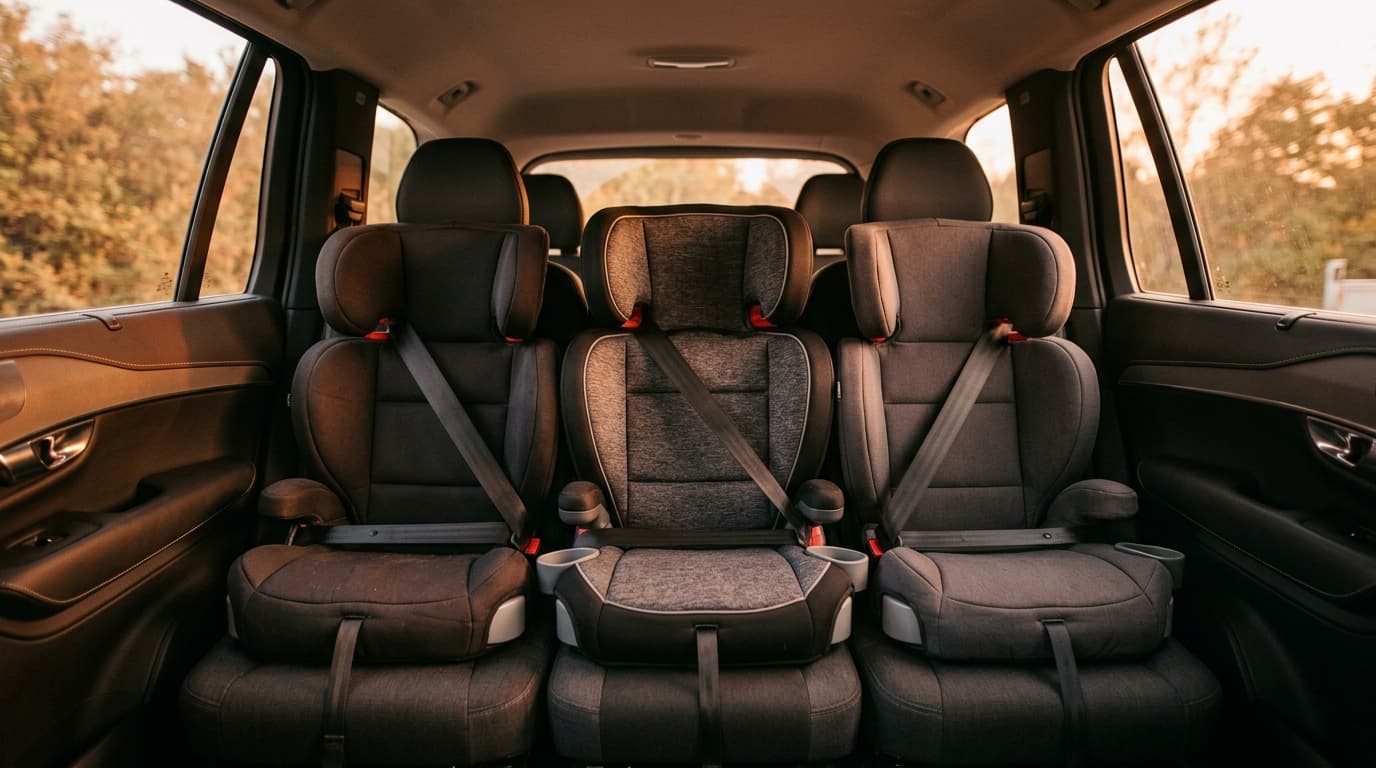
Yes, three child seats fit in a car, but rarely in an SUV. On the new car market, ADAC keeps only one. Belgian rules leave a way out for the third child, and a bench with 132 cm of usable width is enough for three narrow boosters. The method takes six steps.
Can you put 3 car seats in a car in Belgium?
Yes. The highway code forbids nothing as long as each child under 135 cm has their own seat, their own belt and a suitable restraint.
The difficulty is physical, not legal. The official table from Vias and the FPS Mobility (in French) sets only two limits in a car: a child under 3 may only sit on a seat fitted with a belt, and a rear facing restraint is allowed in front only with the frontal airbag switched off. Everything else is a matter of centimetres. If the third seat really will not fit, article 35.1.2 lets a child aged 3 or over travel with the belt alone, in the rear, provided the two other restraints are fitted and in use.
The rule is federal. It is the same in Namur, Brussels and Ghent. The new Code de la voie publique, which will split the subject between one federal code and three regional codes, has been postponed to 1 June 2027 (in French): until then, article 35 of the 1975 highway code remains the only text in force. For the age and height that end the obligation, our article on the Belgian 135 cm rule details the thresholds.
Only one new SUV passes the three seat test
On 31 July 2026 ADAC published its list of cars that take three child seats side by side (in German), drawn from its full road tests. Among new cars, twelve models are listed, and eleven of them are minibuses or leisure vans: Citroën Berlingo, Ford Tourneo Connect, Volkswagen Caddy, Renault Kangoo, Mercedes EQV. The only SUV is the Volvo XC90 plug-in hybrid, built since September 2024.
The reason lies in the shape of the seats. Carmakers sculpt the outer places for comfort and side impact protection, and the centre seat shrinks to a padded, domed perch, often higher than its neighbours. A bench advertised as wide between the doors may offer only a flat strip in the middle that is too narrow for the base of a child seat.
| SUV listed by ADAC | Production period | 3 seats across | 3 ISOFIX positions side by side |
|---|---|---|---|
| Volvo XC90 plug-in hybrid | since 09/2024 (new) | yes | no |
| Audi Q7 | 04/2024 to 04/2026 | yes | yes |
| Peugeot 5008 (2nd generation) | 03/2017 to 09/2020 | yes | yes |
| Citroën C5 Aircross (1st generation) | 02/2019 to 03/2022 | yes | no |
| Dacia Duster (1st generation) | 11/2013 to 12/2017 | yes | no |
Source: ADAC, list published on 31 July 2026, consulted on 27 September 2026.
Two absences matter as much as the entries. The current Peugeot 5008, launched in 2024, is not there, whereas its predecessor lined up three individual seats of equal width, each with its own anchor points. Nor is the second generation C5 Aircross. The ADAC list publishes no measured bench width: we do not invent one, and we have not measured it ourselves. Do not conclude that these recent models refuse three seats: they are simply not listed, and a trial at the dealership remains essential.
How do you fit 3 car seats in the back of an SUV?
Allow an hour the first time, with all three seats and all three children. A real world trial is the advice the Touring Club Suisse has repeated since its test of 13 models reported by Moniteur Automobile (in French), and it is the only one that never lies.
- Open the vehicle manual at the chapter on carrying children. It states seat by seat whether a child seat is allowed, in which category (universal, i-Size, ISOFIX) and whether the centre seat is excluded. Some are.
- Measure the bench at the buckles, not at the backrests nor between the doors. That is where the shells touch.
- Fit the widest seat first, usually an infant carrier or a harnessed seat, on an outer ISOFIX position.
- Then put the narrowest one in the centre, often the eldest child's booster, held by the three point belt. Check that the buckle stays reachable and does not end up trapped under the neighbouring shell.
- Finish with the second outer seat, and check that every seat sits flat against the backrest without overlapping its neighbour.
- Do the hands test: each child should be able to buckle up alone, or an adult should manage it without forcing. An unreachable buckle will be badly fastened one morning in two.
| Step | Equipment | Time | Cost |
|---|---|---|---|
| Read the manual | Vehicle manual or online version | 10 min | 0 € |
| Measure the bench | Tape measure | 5 min | 0 € |
| Fit both outer seats | Seats and instructions | 20 min | 0 € |
| Fit the centre seat | Narrow booster | 10 min | 0 € |
| Buckling test with the children | None | 15 min | 0 € |
| Replace a seat that is too wide | i-Size booster seat | 1 h in store | variable |
Which narrow car seat for the middle position?
A booster approved in the "i-Size booster seat" category. The R129 regulation gives that category a 44 cm wide envelope, which makes it the most reliable benchmark on the market. A booster classed as a "specific vehicle booster seat" may be wider: it guarantees nothing outside the vehicle list supplied by its maker.
The number that counts: three i-Size booster seats need 132 cm of usable bench. That is the best case. With two children still in harnessed seats the margin melts away, because an infant carrier or a harnessed seat is clearly wider than those 44 cm.
Before paying, check five points on the seat:
- the words i-Size booster seat on the orange label, not just the R129 mention;
- the height range, 100 to 150 cm for most, 125 cm minimum for a backless booster;
- the overall width stated by the maker, with side protection deployed;
- the path of the diagonal strap, which must not rub against the neighbouring seat;
- the optional ISOFIX connectors, useful on an outer seat and often unusable in the centre.
Britax Römer, Maxi-Cosi and Cybex all print the approval category in their instructions. We have tested none of these seats: the 44 cm criterion comes from the regulation, not from an in house bench test. To read the label line by line, our article on group 2/3 seats and i-Size sizes gives the conversion table.
The third seat does not fit: three legal ways out
One seat moves to the front, allowed at any age with the frontal airbag off if the seat faces backwards. Or article 35.1.2 covers a child aged 3 or over, belt only, provided the third restraint genuinely cannot be fitted. Or a third row settles the matter: a 7 seater SUV, provided the manual confirms that the rearmost seats accept a child seat.
Should you change SUV for a third child?
Not necessarily. First try the method above with narrow boosters: an eldest child of 6 or more on a 44 cm booster unlocks many benches judged too small. Buying a car for a problem two 44 cm boosters would have solved is the most avoidable expense on the list.
If a change is unavoidable, the used market offers the option new cars have nearly abandoned. Surveyed on 27 September 2026 on AutoScout24 Belgium, the Peugeot 5008 first registered in 2018 had 56 listings; the 18 on the first page ranged from 9,499 to 15,950 €, with a median around 11,200 € and mileages from 87,000 to 198,000 km. In practice, that means three ISOFIX seats in the second row for around 11,000 €, whereas the only new SUV on the ADAC list is a large premium plug-in hybrid.
One regional detail changes the sums. A 2018 diesel 5008 is often Euro 6b, and in Brussels that sub standard leaves it only about fifteen months of access to the LEZ (low emission zone); Antwerp and Ghent still accept every Euro 6 car, and Wallonia has no low emission zone. A Brussels household will take the petrol version. The comparison tool filters models by number of seats, and our guide to the ISOFIX base tells you whether the old one follows you into the new car.
Frequently asked questions
Yes, if the rear bench offers three belted seats and enough width for three restraints. In many compact SUVs the centre seat is too narrow, sometimes even banned for child seats by the carmaker: the vehicle manual decides, not the brochure.
Very few. ADAC lists six new cars, all leisure vans or minibuses such as the Citroën Berlingo or the Opel Zafira Life, and ten used ones. On the SUV side, only the Audi Q7 built between April 2024 and April 2026 and the Peugeot 5008 built from March 2017 to September 2020 appear.
Allow 132 cm of usable width at the very least for three i-Size booster seats, whose regulatory envelope is 44 cm each. A harnessed seat or an infant carrier needs more. Measure at the belt buckles, where the bench is sculpted.
Yes, at any age, provided the seat has a belt. A rear facing seat requires the front passenger airbag to be switched off. It is often the simplest answer when the third seat will not fit in the back.
The first generation, built from February 2019 to March 2022, appears in the ADAC list of used cars taking three child seats across. It is not among the models with three ISOFIX points, though: the centre seat is fixed with the belt. The following generation is not on the list.
174 € on the spot, unless the exception of article 35.1.2 applies: child aged 3 or over, rear seat, two restraints already fitted and in use, and a genuine impossibility of fitting a third. Below 3 years of age there is no exception.
We dig through the Belgian market data — TÜV reliability, real-world ADAC consumption, company-car taxation, list prices — to call it straight. No brand pays us.