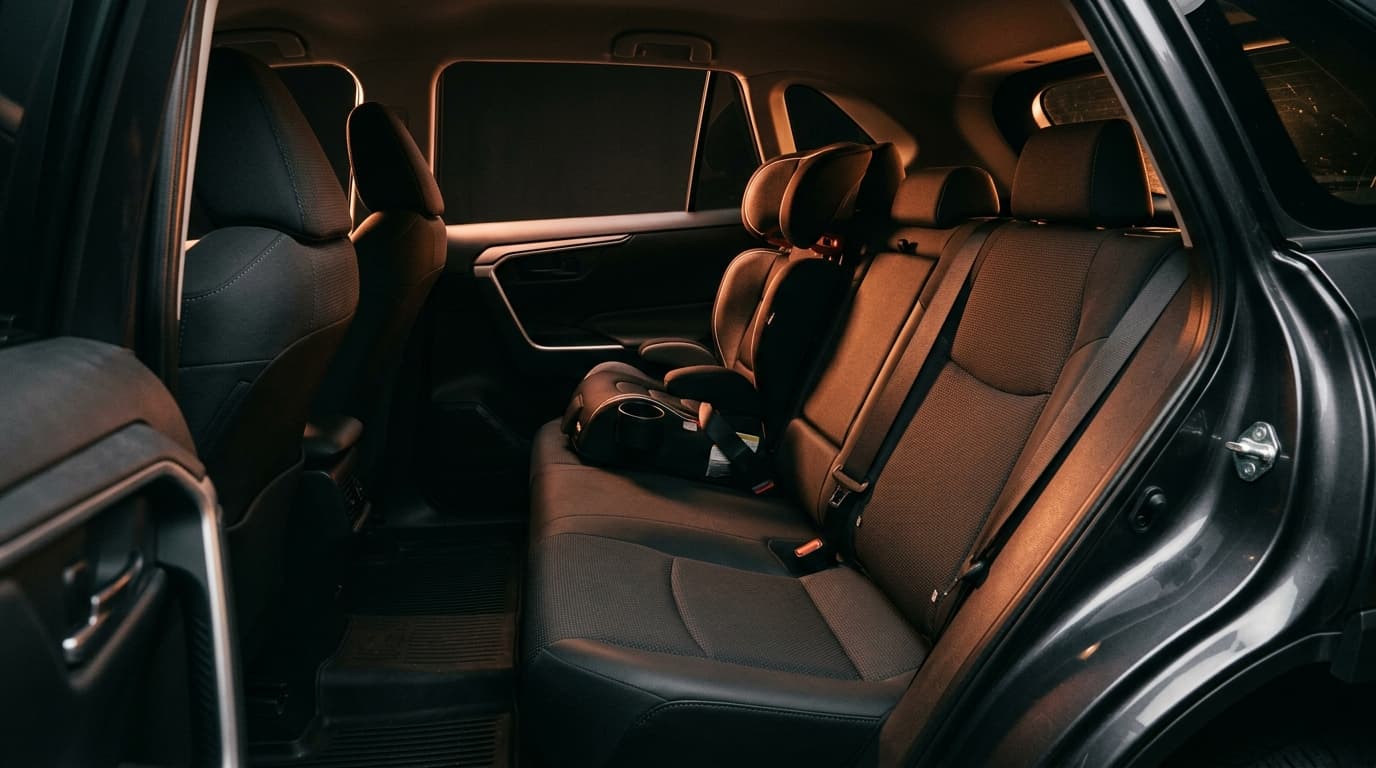
There is no age in the Belgian text. The rule runs on height: below 135 cm, a child under 18 travels in a suitable restraint. That threshold is rarely crossed before ten, and only two exceptions allow you to do without.
Until what age does Belgian law require a child seat?
Until 18, for as long as the child measures less than 135 cm.
The traffic regulation puts it plainly: every child under 18 whose height is below 135 cm must be carried in a restraint suited to them. No pivot age appears in the text. The figure of 12 that so many pages repeat comes from Germany, Italy or Switzerland, where the limit really is 12 years or 1.50 m, and it carries no weight here.
The table published by the Vias institute and the FPS Mobility and Transport (SPF Mobilité, the federal mobility department) still splits the obligation into three age brackets, and the nuance has very practical effects. Under 3, the child may only occupy a seat fitted with a belt, always in a restraint, with no tolerance whatsoever. From 3 to 8, then from 8 to 18, the restraint stays mandatory in a car, the front seat opens up as soon as a belt is present, and the exceptions in article 35.1.2 become available. Above 135 cm, the belt alone is enough, at any age. Classic cars without belts are simply off limits to children under 135 cm.
An adult of 1.30 m, by contrast, is bound by nothing.
135 cm arrives around ten, not around six
The WHO growth reference for ages 5 to 19 puts the median at 137.8 cm for boys and 138.6 cm for girls at exactly ten years of age. Half of all children therefore pass 135 cm just before their tenth birthday, the other half after it.
The booster, meanwhile, leaves the bench around six or seven. As soon as the child objects.
Three years of gap, sometimes four: that is precisely where the fines and the abdominal injuries cluster, caused by a lap belt riding up onto the stomach instead of bearing on the top of the thighs.
How do you check in ten minutes that your child is compliant?
Six steps, no special tools, no spending. Worth repeating once a year, at the start of the school year for instance, and every time you change car.
- Measure the child barefoot, heels and back against the wall, with a set square or a flat book on the crown of the head. One centimetre decides everything around 135 cm.
- Read the orange label stitched onto the seat. It carries the approval standard, R129 or R44, and the height or weight range covered.
- Check that this range still covers the child. Under R129 a backless booster is only approved from 125 cm; below that, a backrest is mandatory.
- Choose the seating position. The back remains the safest. The centre rear position only works if it has a three-point belt, never with a lap belt alone. The front is allowed at any age, with the front airbag switched off if the seat faces rearward.
- Redo the fixing. ISOFIX clicked in on both sides, support leg resting or top tether tensioned, one centimetre of slack at most under the harness, winter coat removed.
- Follow the belt path. Lap strap over the top of the thighs, diagonal across the middle of the shoulder, never under the arm or behind the back.
| Step | Equipment | Time | Cost |
|---|---|---|---|
| Measure the child | Tape measure, set square or book | 2 min | 0 € |
| Read the orange label | Phone torch | 3 min | 0 € |
| Check the approval range | Seat instruction manual | 2 min | 0 € |
| Choose the seating position | Vehicle handbook | 5 min | 0 € |
| Redo the fixing | None | 5 min | 0 € |
| Check the belt path | None | 2 min | 0 € |
| Replace a seat out of range or over ten years old | R129 approved seat | 1 h in store | variable |
Vias institute observed more than a thousand children on Belgian roads and published its findings on 20 February 2018. The mistakes always cluster in the same places:
- Forward-facing seats and high-back boosters account for the most incorrect use.
- The centre rear position is the worst served, for lack of width for a restraint.
- Regular trips under ten kilometres show the lowest rate of correct fastening.
- The error rate jumps as soon as someone other than the parents or grandparents drives the child.
- A driver who does not buckle up fastens their own children less well.
For the earlier stage, the rear-facing one, our guide to baby car seats in a compact SUV covers anchor access and the space behind the driver.
Three child seats side by side in an SUV: is it allowed?
Yes, conditionally. Article 35.1.2 of the code is the only text that permits it.
A third child aged 3 or over and under 135 cm may travel on the seat belt alone, in a rear seat, when it is impossible to install a third restraint after the first two are in place, and provided those two are actually being used. The vehicle must have eight seats at most in addition to the driver's. The exception never applies in the front, nor to a child under 3.
A second door exists: occasional carriage over a short distance, when no restraint is available or not enough of them. The code nowhere defines what a short distance is, and that vagueness makes it a fragile basis for a daily school run.
Two limits frame the rest. Each child takes up a full seat with its own belt, so four children on a three-seat bench remain illegal, SUV or not. And the width of a compact SUV bench almost never takes three shells: the third row of a seven-seat SUV solves the problem far better than swapping seats.
Is your R44 seat still legal?
For use, yes. For sale in a shop, no.
Since 1 September 2024, only R129 approved seats, known as i-Size, may be sold new in the European Union. R44-04 and R44-03 seats already in circulation remain perfectly usable, and private resale stays possible. R44-02 and R44-01 have been banned from use since 2008.
So do not replace anything out of reflex. An R44-04 in good condition, bought five years ago, matched to the child's height and correctly fixed, protects better than a brand-new R129 badly installed. The two genuine reasons to replace are the age of the plastic, ten years at most according to manufacturers, and a crash, even a minor one, which can leave invisible microcracks.
R129 brings two things R44 did not have: a mandatory side-impact test and a classification by height rather than by weight. It also requires rear-facing travel until at least 15 months, against 9 kg under the old standard, which is roughly nine months.
Is a child who is legal here also legal in Germany?
Not always. The gap plays out over a few dozen kilometres.
Belgium's 135 cm threshold is shared by the Netherlands, Denmark, Spain, Sweden and Luxembourg. Germany, Italy, Switzerland, Portugal and Poland require a restraint until 12 years or 1.50 m. Austria goes up to 14. France stops at 10 years or 1.35 m.
In practice, here is how it plays out. An eleven-year-old measuring 1.38 m legally travels from Namur to Ostend with no booster. That same child, on the road to Cologne, slips into an offence the moment the border is crossed, because Germany wants a restraint until 1.50 m. The country-by-country table published by Moniteur Automobile deserves a look before a holiday departure.
The advice that follows fits in one line: keep the high-back booster until 1.50 m. You are legal everywhere, and the belt runs where it should.
A 174 € fine, and compliance that varies from region to region
The offence has been third degree since January 2013. The on-the-spot fine is 174 €, and close to 5,000 tickets go out every year for that reason alone.
The rule itself is federal. It does not change in Wallonia, in Brussels or in Flanders. Compliance does: Vias recorded 26 % of children correctly fastened in Brussels, 24 % in Wallonia and 21 % in Flanders. The figure that matters: 13 % of the children observed were not fastened at all.
What is at stake goes well beyond the fine. A correctly used restraint cuts the risk of fatal injury by 70 % below one year old and by 55 % between one and four. At 50 km/h, an unrestrained 25 kg child represents a mass of close to one tonne at the moment of impact.
Before changing car to fit three seats, measure the bench: our ranking of the safest SUVs for children crosses Euro NCAP child occupant scores with the number of ISOFIX anchor points, and the comparison tool filters models by seat count.
Frequently asked questions
Until 18, but only while the child measures less than 135 cm. Height ends the obligation in almost every case, usually between nine and eleven years old. No pivot age of 10 or 12 appears anywhere in the Belgian traffic regulation.
Up to 135 cm in Belgium. Under the R129 standard a backless booster is only approved from 125 cm, so between 100 and 125 cm a backrest is mandatory. Keeping the backrest until 150 cm remains the safest choice and keeps you legal across Europe.
Yes, at any age, on two conditions. The child must sit in a suitable restraint below 135 cm, and the front airbag must be switched off if the seat faces rearward. Rear seats still remain the safest places.
If the bench allows it, yes. Otherwise article 35.1.2 lets a third child aged 3 or over and under 135 cm travel on the seat belt alone, in a rear seat, when a third restraint will not fit after the first two are installed. The exception never applies in the front, nor to a child under 3.
Yes for use, no for new sales. Since 1 September 2024 only R129 seats may be sold new in the European Union, but R44-04 and R44-03 seats already bought remain legal and can be resold privately. R44-02 and R44-01 have been banned since 2008.
174 € as an on-the-spot fine. Carrying a child under 135 cm without a suitable restraint has been a third-degree offence since January 2013, and close to 5,000 tickets are issued in Belgium every year for that single reason.
We dig through the Belgian market data — TÜV reliability, real-world ADAC consumption, company-car taxation, list prices — to call it straight. No brand pays us.