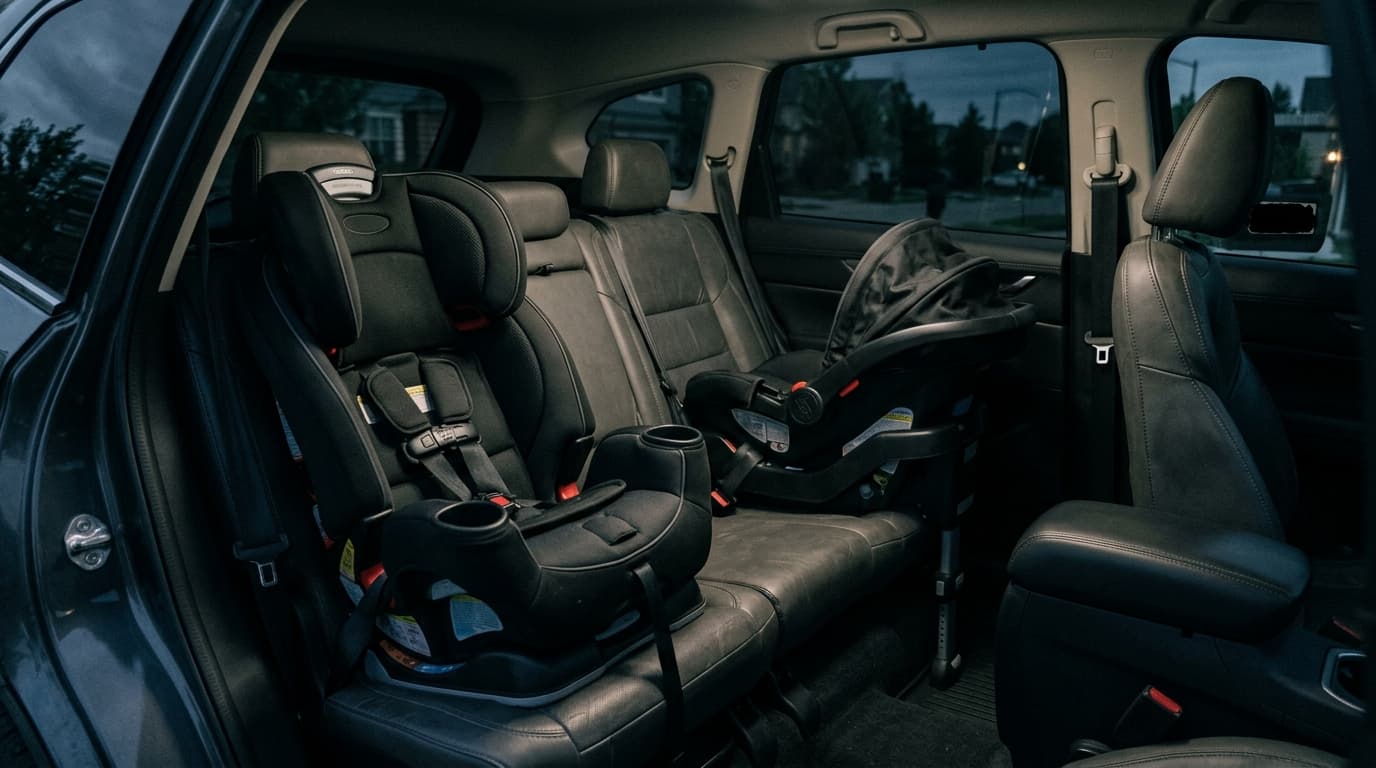
To carry children, a SUV is judged on its Euro NCAP child occupant score and its Isofix anchors, not on its looks. Four recently tested models stand out: Hyundai Santa Fe, Peugeot 5008, Skoda Kodiaq and Volvo XC60. Here is how to separate them, with the figures.
Which SUV is the safest for carrying children in Belgium?
No model wins everywhere, but four safe bets stand out: the Hyundai Santa Fe and Peugeot 5008, five Euro NCAP stars in 2024 with high child protection, the Skoda Kodiaq (83% child occupant, 2024) and the Volvo XC60 (87%, but tested in 2017). The right instinct: read the child occupant score, not just the stars.
On the Belgian market these four cover most family needs: two true seven-seaters (Santa Fe, 5008), one available in five or seven seats (Kodiaq) and a premium five-seater (XC60). All carry at least two rear Isofix anchors and passenger airbag deactivation, two items Euro NCAP scores.
The number that counts: between a Kodiaq near €40,000 and a Santa Fe around €55,000, the price gap reaches €15,000 for a measured safety level that is very close. Here are the figures from the latest known test for each.
| Model | Euro NCAP (year) | Child occupant | Seats | BE price from |
|---|---|---|---|---|
| Hyundai Santa Fe | ★★★★★ (2024) | among the best 2024 | 7 | ~€55,000 |
| Peugeot 5008 | ★★★★★ (2024) | high | 7 | ~€42,000 |
| Skoda Kodiaq | ★★★★★ (2024) | 83% | 5 or 7 | ~€40,000 |
| Volvo XC60 | ★★★★★ (2017) | 87% | 5 | ~€52,000 |
What is the Euro NCAP child occupant score really worth?
It is the most useful area for a parent, and it is a number. Euro NCAP rates each car on four areas; one of them, child occupant, measures as a percentage the protection of the 6- and 10-year-old dummies in frontal and side impacts, the ease of fitting seats and the presence of airbag cut-off.
A high score rewards three concrete things: a rear cabin that limits deceleration on the child, clear and accessible Isofix anchors, and cues that prevent misinstallation. The 2024 Skoda Kodiaq gets 83% on this area and 89% for adult protection, per Euro NCAP. The Volvo XC60 shows 87% for child occupant, a fine figure, but dated 2017.
In practice this gives a point of caution: that percentage means nothing without its year. A 2017 test used neither the same 6-year-old dummy nor today's requirements on driver assistance. Comparing an 87% from 2017 with an 83% from 2024 without saying so would be misleading.
Santa Fe, 5008, Kodiaq or XC60: which protects children best?
Each has its strength, and the ranking depends on the tested year. The Hyundai Santa Fe leads the child occupant scores among the SUVs crash-tested in 2024, with a seven-seat cabin built for the large family. The new Peugeot 5008, five stars the same year, protects child dummies well and adds seven seats on a more affordable base.
The Skoda Kodiaq plays the balance: 83% child occupant in 2024, available in five or seven seats, around €40,000. It is the best safety-to-price ratio of the four. The Volvo XC60 keeps the brand's safety aura and a solid 87% child occupant, but its test dates to 2017 and it is limited to five seats, at a premium price near €52,000.
What we would avoid is choosing on reputation alone. Volvo enjoys a deserved safety image, but the current XC60 has not re-run the recent tougher protocol. A Santa Fe or 5008 tested in 2024 rest on stricter requirements, notably on driver assistance and side-impact protection.
Does a front centre airbag change anything for children?
Yes, and Euro NCAP now scores it. The front centre airbag, fitted between driver and passenger, cuts the risk of the two front occupants clashing in a side impact. For a family the benefit is indirect but real: this device is among the equipment that lifts the score on recent models. SUVs tested from 2020 increasingly carry it, which older years ignored.
How many Isofix anchors does a family need?
Count the real number, not the number of seats. Most five-seat SUVs offer only two Isofix anchors, at the outer rear positions. The centre seat is narrow, raised and rarely compatible: a third seat then fits on the belt, slower and tighter on width.
An i-Size infant carrier, under the R129 regulation, is 44 to 50 cm wide. Three side by side therefore need at least 1.35 m of usable bench and three workable points. On a seven-seater like the Santa Fe or 5008, the sliding second row and the third row give more room to split two children in front and one behind.
In practice this gives a simple rule: measure before buying, seat in hand. What we would avoid is trusting the number of belts. According to VIAS and Test-Achats (Test-Aankoop), a large share of child seats are wrongly fitted in Belgium, often for lack of clear anchors or space. An accessible Isofix cuts that error risk far more than a manual.
Up to what age is a child seat mandatory in Belgium?
Up to 1.35 m. In Belgium, every child under 1.35 m must travel in a restraint suited to their size and weight, per the SPF Mobilité (FOD Mobiliteit) and VIAS. Above that, the adult belt is allowed. A rearward-facing seat is still advised until around age 4, well beyond the 15-month minimum set by the i-Size rule. And a rearward-facing seat up front requires switching off the passenger airbag.
Are five Euro NCAP stars enough to judge safety?
No, and it is the most common trap. Five stars say a car reached a very good level in its test, but they do not say when that test took place. Euro NCAP toughens its protocol every two to three years: new dummies, new impacts, higher requirements on driver assistance.
As a result, two "five-star" SUVs may have passed very different tests. The Volvo XC60, five stars in 2017, was rated against an older standard than the 2024 five-star Skoda Kodiaq. Neither is bad, but comparing them without looking at the year is like comparing two exams of different difficulty.
The right instinct stays free: on euroncap.com, open the exact model's page, note the test year and the child occupant percentage, then compare like for like. On the Belgian market, a model retested recently beats an old glory never re-run under the tougher protocol.
Verdict: which safe SUV to choose for your family?
Each profile has its costed answer. For three children in seats and room to spare, the Hyundai Santa Fe is the most reassuring: seven seats, a child occupant score at the top of the 2024 tests, around €55,000. The Peugeot 5008 offers nearly as much safety and versatility for about €42,000, a better entry ticket into the true seven-seater.
For the best safety-to-price ratio, the Skoda Kodiaq leads: 83% child occupant, five or seven seats, near €40,000. The Volvo XC60 stays relevant if the premium budget follows and five seats are enough, provided you accept a test dating from 2017. Our best seven-seat SUV guide details space and modularity, our SUV or people carrier for a family of five comparison settles the three-across question, and for a first child, our compact SUV and baby car seat article targets the need more precisely.
Frequently asked questions
There is no single winner, but four safe bets tested recently: the Hyundai Santa Fe and Peugeot 5008 (five Euro NCAP stars in 2024, high child protection), the Skoda Kodiaq (89% adult, 83% child occupant in 2024) and the Volvo XC60 (87% child occupant, but 2017 protocol). The real criterion is the child occupant score of the tested year, not the star count alone.
It is one of Euro NCAP's four assessed areas, expressed as a percentage. It combines the protection of the 6- and 10-year-old dummies in frontal and side impacts, the ease of fitting child seats (Isofix, i-Size) and features such as passenger airbag deactivation. The higher the percentage, the better the rear cabin protects a child.
No. The protocol tightens every two to three years: a five-star SUV rated in 2017 passed less severe tests than a 2024 five-star. At equal stars, always compare the child occupant percentage and the test year on euroncap.com before deciding.
Ideally three, but most five-seat SUVs offer only two, at the outer rear positions. The centre seat is often narrow, raised and without Isofix: the third seat then fits on the belt. For three children in seats, check the real number of usable anchors, seat in hand.
In Belgium, every child under 1.35 m must be secured in a restraint suited to their size and weight, per the SPF Mobilité (FOD Mobiliteit) and VIAS. Above 1.35 m, the adult belt is allowed. A rearward-facing seat is still advised until around age 4, well beyond the 15-month minimum of the i-Size R129 rule.
Yes, without exception. A rearward-facing seat placed in front of an active passenger airbag exposes the child to serious injury if the airbag deploys. Deactivate the passenger airbag before fitting such a seat up front, or better, place the child in the rear. Most recent SUVs have a dedicated deactivation switch.
Not automatically. Mass helps in a crash against a lighter vehicle, but the protection Euro NCAP measures depends mainly on structure, airbags and restraints, not size. A recent compact with a strong child occupant score protects better than an old large SUV. Trust the dated score, not the size.
We dig through the Belgian market data — TÜV reliability, real-world ADAC consumption, company-car taxation, list prices — to call it straight. No brand pays us.