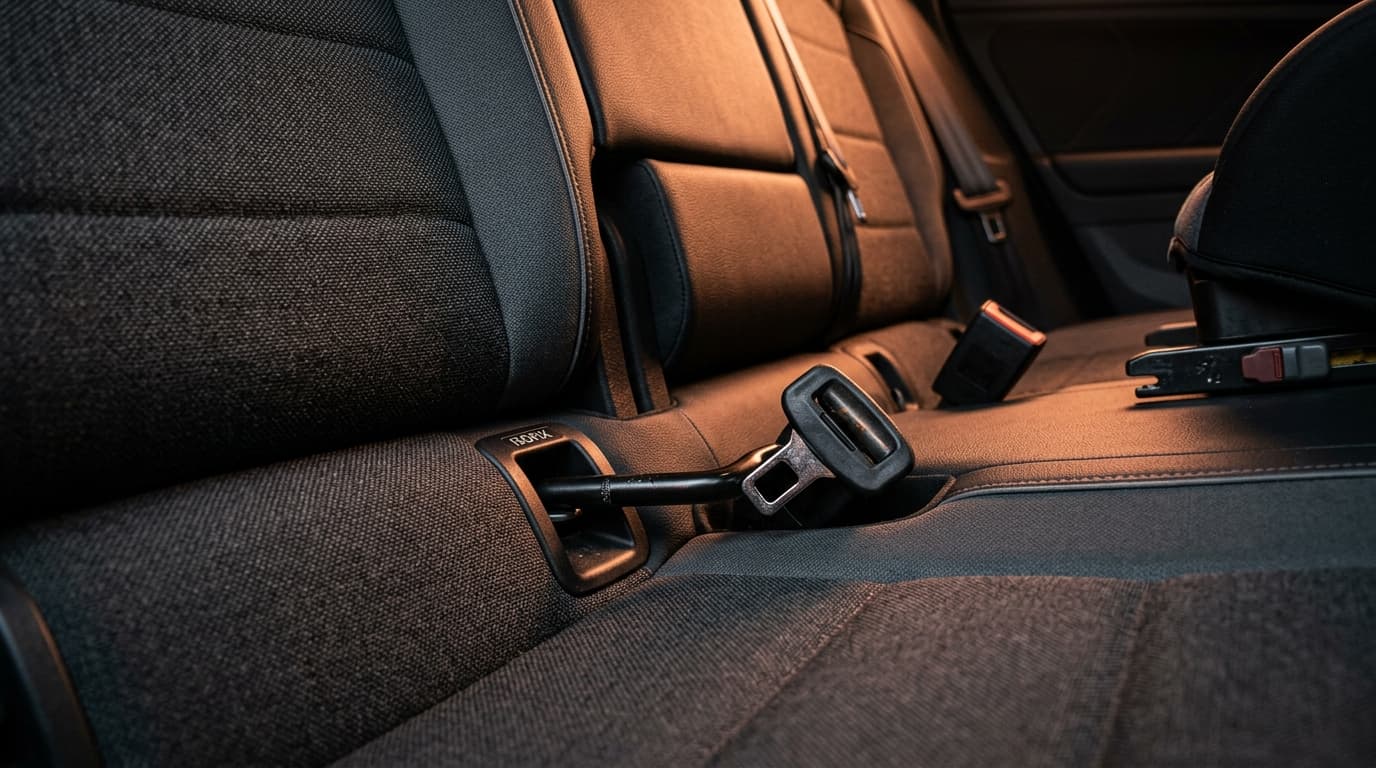
No ISOFIX base takes the shell of another brand. The word "universal" printed on the box says nothing about the seat: it describes the car, and the positions where the base holds. One word for two ideas, and a bill running from 82 to 230 € at the same Belgian retailer.
"Universal" describes the car position, not the shell
The orange label stitched onto a child restraint carries an installation category: universal, semi universal or vehicle specific. That wording answers one question only, namely which cars the object can be fitted in. It says nothing about the seat that will click on top. The link between a base and its shell is decided in the manufacturer's own catalogue, and it stops at the brand. Sometimes at a single generation of shells.
The word is not a lie, it simply answers beside the point.
The Belgian listing for the Cybex Q-fix base, consulted on 20 September 2026 at Orchestra, opens with the phrase "universal Q-fix base from birth", then closes three lines further down on a list of four compatible shells, Cloud Q, Aton Q, Aton 4 and Aton, all four badged Cybex. Nothing on that page is false. The reader, meanwhile, has understood the opposite of what was written.
Universal, semi universal, vehicle specific: what does the label say?
Four wordings circulate on the market, two inherited from the R44 standard and two alive under R129. Each of them concerns the seat and vehicle pairing.
| Wording on the label | Actual scope | Point to check |
|---|---|---|
| Universal ISOFIX (R44) | every ISOFIX position fitted with a top tether anchor | does a top tether anchor exist at that position |
| Semi universal ISOFIX (R44) | only the vehicles on the list supplied by the maker | is your model on it, model year included |
| i-Size (R129) | every position marked i-Size in the vehicle manual | does the manual mark that position i-Size |
| Vehicle specific (R44 or R129) | a closed list, sometimes a single trim level | the list, again the list |
None of the four lines mentions the shell. There lies the demonstration in a single image: approval vocabulary talks about the vehicle, catalogue vocabulary talks about the product, and both end up on the same box without anyone warning the buyer. Sécurange sums up the i-Size logic in the same terms on its page about the R129 regulation (in French): the label guarantees that an i-Size seat fits any i-Size position, and its scope ends there.
Is an ISOFIX base compulsory in Belgium?
No.
The highway code requires an approved restraint for every child under 135 cm and under 18, and the federal police reminder sheet (in French) says nothing about the fixing method. No roadworthiness test checks this point. The obligation is federal and does not change in Wallonia, Brussels or Flanders.
81.95 € against 229.99 € for the same job
On the Belgian market, the price of a base owes more to its features than to its compatibility scope. Surveyed on 20 September 2026 at Dreambaby, a retailer running twenty seven shops in Belgium.
| Base surveyed on 20 September 2026 | Displayed price | Compatible shells stated | Brand of those shells |
|---|---|---|---|
| Cybex Base One | 81.95 € (original price 110.00 €) | 1: Aton S2 | Cybex |
| Maxi-Cosi FamilyFix 360 | 229.99 € | 2: Pebble 360 and Pearl 360 | Maxi-Cosi |
The number that counts: a gap of 148.04 €, a ratio of 1 to 2.81. The dearer of the two does not accept more brands, it swivels through 360 degrees and covers two stages instead of one, the infant shell to fifteen months then the toddler seat to four years. The cheaper one retires with the shell, so after some fifteen months. Spread over service life, the 229.99 € object works out cheaper than the 81.95 € one, which is the exact opposite of what the price tag says.
We have tested neither of these two bases. The prices are the ones displayed that day, and the compatibility scope is the one the retailer writes under its own product sheet, in plain words: "suitable only for the Pebble 360 and Pearl 360 car seats from Maxi-Cosi".
Can you keep your base when you change SUV?
Most of the time, yes. A base follows its approval category, not your number plate. An i-Size base fitted yesterday to the i-Size position of an estate goes back on the i-Size position of an SUV tomorrow, with no formality beyond rereading the new vehicle manual.
Five points to check before refitting it:
- the manual page listing i-Size positions, usually in the chapter on carrying children;
- the top tether anchor, behind the backrest, on the boot floor or on the roof lining depending on the model;
- the manufacturer's compatibility list, model year by model year, if the base carries semi universal approval;
- the presence of a storage box under the feet of the chosen position, which sometimes rules out the support leg;
- the leg length available once extended, on a high SUV bench.
The support leg hits the floor storage box behind the front seats
Here is the one real obstacle to moving a base, and it turns up more often on a family SUV than on a hatchback. The foot that reaches down to the mat has to rest on a solid floor. Plenty of people carriers and SUVs hollow out a storage box at that very spot, and its lid was never calculated to take the thrust of a frontal impact.
Sécurange, which has documented this case for a decade on its page devoted to floor storage boxes (in French), states the most useful rule in the whole file: a position marked i-Size in the manual is necessarily compatible with a seat fitted with a support leg, since the carmaker validated that floor in order to obtain the label. If your manual marks the position i-Size, the argument is over.
If it does not, four ways out exist. Place the leg beside the hatch rather than on it, which many combinations allow. Use the centre rear position, which never has a box and happens to be the best protected seat on the bench. Order the carmaker's filler part, such as the spacer fitted as standard to some Ford C-Max, or the accessory referenced by Volkswagen for several Touran and Sharan. Run the leg down to the bottom of the box, a solution the Peugeot 3008 manual allows and that Citroën refuses on part of its range.
Home made fixes are out. Cybex states in writing that without filling material approved by the carmaker, the brand cannot confirm use of the seat in that configuration. Packing the hatch with books or a phone directory mainly creates a projectile weighing several kilos in a rollover.
A shell without a base stays approved, and is sometimes the better call
The best advice is sometimes to buy nothing, and this subject offers a good example. If the shell only goes into the car twice a week, if you juggle two vehicles of which only one has ISOFIX, if the rear floor rules out the support leg, then the three point belt does the job and costs nothing.
The real gain from a base is not in the crash test. It is in repeatability: one click, one green indicator, no strap to tension. Sécurange puts the share of children badly restrained in cars at 70 %, and most of those errors come from installation rather than from hardware. A base removes half the steps, therefore half the chances of getting it wrong. For a parent transferring the shell four times a day, that argument is worth 82 € several times over.
The objection stands the other way round, and it is financial. Buying the base means signing with one brand for the first four years: the shell, then the toddler seat, then nothing else. Changing your mind at eighteen months because a rival model protects better means writing off the initial outlay. Moniteur Automobile (in French) points out that a restraint is chosen first on the child's build, which is poorly known before birth.
So check the position before the base. Our guide on baby car seats in a compact SUV details access to the rear anchor points model by model, our piece on the approvals Belgium still accepts decodes the orange label line by line, and our ranking of the safest SUVs for children crosses Euro NCAP scores with the number of anchor points. The comparison tool filters directly on available seating positions.
Frequently asked questions
Not in the sense parents assume. A base only takes the shells planned by its own manufacturer, often one or two, and never those of a rival brand. The word universal printed on the approval label refers to compatible car seating positions, not to the seat itself.
Not in Belgium. The highway code requires an approved child restraint for every child under 135 cm and under 18, without prescribing how it is fixed. An infant shell strapped in with the three point belt, properly tensioned, is perfectly legal.
Yes, if the seat manual allows belt installation, and almost every shell on the market does. Allow a good extra minute per trip and a higher error rate: the diagonal strap has to run through the rear guides and the lap section through the side guides, with no slack at all.
Only if it carries i-Size approval and the position you want is marked i-Size in the vehicle manual. An older semi universal base comes with a closed vehicle list, model year included, and stepping outside that list voids the approval.
A semi universal base uses a support leg or an extra strap whose hold depends on the floor, so the manufacturer supplies a list of tested vehicles. The older universal category relied on the top tether, and today's i-Size relies on positions labelled in the manual.
We dig through the Belgian market data — TÜV reliability, real-world ADAC consumption, company-car taxation, list prices — to call it straight. No brand pays us.