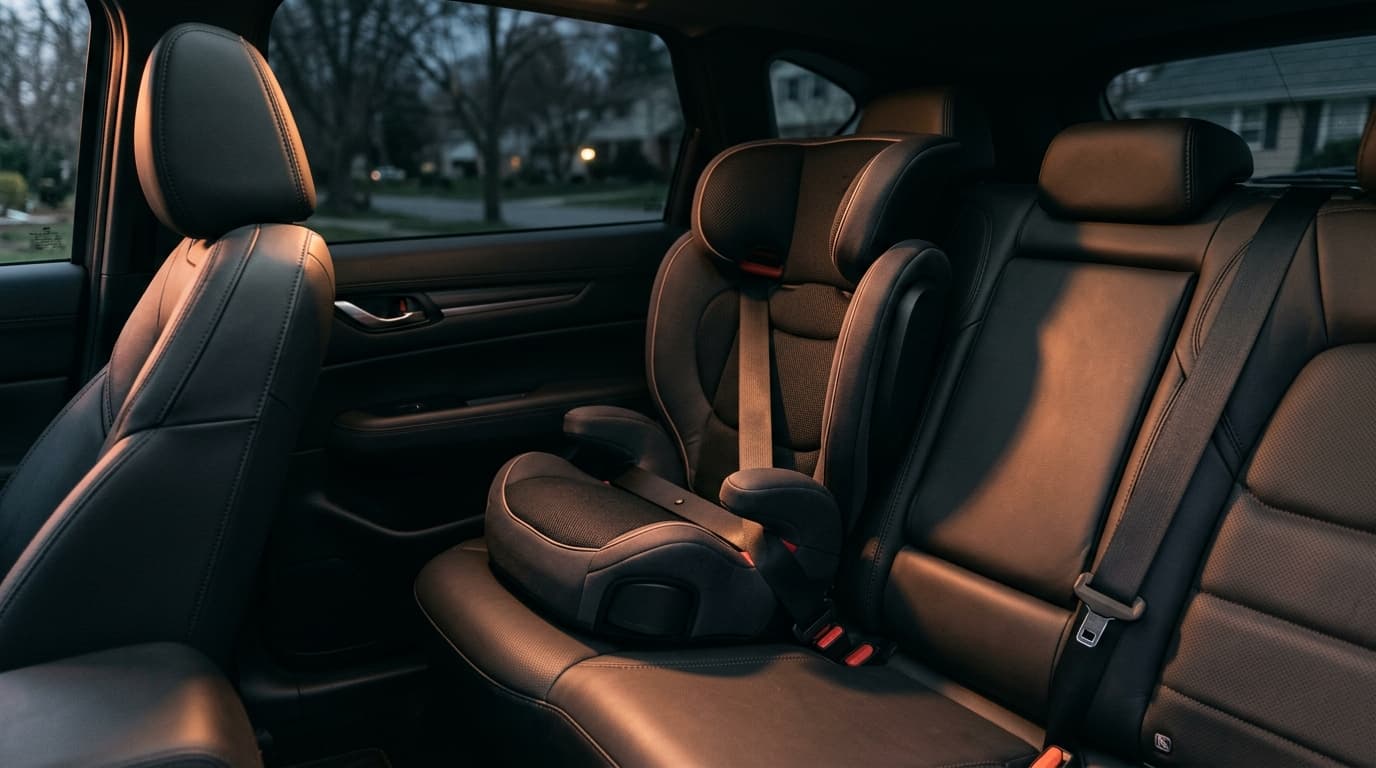
Group 2/3 is not an age bracket. It is a weight range, 15 to 36 kg, inherited from the R44 standard. Since 1 September 2024, no new seat carries that marking anywhere in the European Union. Yours remains legal. The label itself no longer helps you compare anything in a shop.
Group 2/3 covers 15 to 36 kg, and nothing else
The ECE R44 standard sorted child restraints by the mass of the child. Five boxes, no more: group 0 up to 10 kg, group 0+ up to 13 kg, group 1 from 9 to 18 kg, group 2 from 15 to 25 kg, group 3 from 22 to 36 kg. A seat sold as "group 2/3" simply merges the last two boxes and therefore covers 15 to 36 kg in one go.
No age appears anywhere in that split.
Translating it into years is a retail invention, later repeated by just about every page in the sector. It holds up on average and falls apart the moment you look at a real child: at six, a 19 kg child still belongs in group 1 while the classmate weighing 26 kg is already in group 3. Same age, two different seats, two different fixing methods. Weigh, do not guess. The federal police says as much in its note on choosing a child restraint (in French): under R44, weight is the selection criterion, and it is read off a scale.
Why did this marking vanish from the shelves on 1 September 2024?
Because R44 was replaced, not amended.
The ECE R129 regulation, better known under its commercial name i-Size, sorts seats by height and imposes three things the older standard ignored: a mandatory side impact test, a new generation of measurement dummies, and rearward facing until fifteen months at the earliest. New R44 approvals stopped being issued in September 2023. Retailers were given twelve months to clear their stock, and since 1 September 2024, selling an R44 seat is banned in the European Union, Belgium included.
The shops, though, kept the word. Norauto still titles its category «Car seat 100 to 150 cm (former group 2-3)», which sums the situation up better than any explanation: the vocabulary outlives the standard because parents keep typing it. Behind the shelf label, the product changed its logic.

R44 group against R129 height: the conversion, line by line
No official text publishes a conversion table between the two regulations, and that is precisely why nobody can find their way. The one below is rebuilt by cross-reading the ranges actually approved on either side, then laying the Belgian legal threshold across it.
| R44 marking | R44 range (weight) | Matching R129 offer (height) | Indicative age | Belgian obligation |
|---|---|---|---|---|
| Group 0+ | 0 to 13 kg | 40 to 87 cm | 0 to 15 months | restraint mandatory |
| Group 1 | 9 to 18 kg | up to 105 cm | 9 months to 4 years | restraint mandatory |
| Group 2 | 15 to 25 kg | 100 to 125 cm | 3.5 to 7 years | restraint mandatory |
| Group 3 | 22 to 36 kg | 125 to 150 cm | 6 to 12 years | mandatory up to 135 cm |
| Group 2/3 | 15 to 36 kg | 100 to 150 cm | 3.5 to 12 years | mandatory up to 135 cm |
Two columns do not speak the same language, and that is the whole problem: the second measures a mass, the third measures a stature. An R129 approval is declared in centimetres, the manufacturer remaining free to add a maximum mass on the label. So read the range printed on your own seat rather than the category printed on the box, which binds nobody.
The fourth column, finally, is indicative and nothing more. It describes an average child, and the average child exists no more here than anywhere else.
At both ends of the range, the conversion breaks down
In the middle, the equivalence roughly holds. A child weighing 20 kg and measuring 115 cm is properly served by a group 2/3 as well as by an i-Size 100 to 150 cm. At the extremes, the two standards diverge sharply, and in both cases R129 is the stricter one.
At the bottom of the range, first. A backless booster could be approved from 15 kg under R44, meaning around three and a half years old. Under R129, that same bare booster can only be approved from 125 cm, a height reached around seven or eight. Almost four years of growth separate the two bars. Between 100 and 125 cm the backrest is no longer optional: it carries the side protection for the head and guides the diagonal belt across the middle of the shoulder.
At the top of the range, next, and the blind spot is sneakier. Group 3 stops at a weight, 36 kg. The Belgian obligation stops at a height, 135 cm. Nothing guarantees those two thresholds arrive in that order, and for a heavy child who passes 36 kg while still measuring 130 cm, the R44 catalogue offers nothing at all, while the highway code still demands a suitable restraint. An R129 approval declared up to 150 cm keeps covering that child.
Is your group 2/3 seat still legal in Belgium?
Yes, and the Belgian answer is even broader than elsewhere. The federal police states that three approvals are accepted in use in this country: R44/04, R44/03 and R129. The 03 series of R44 dates from the mid 1990s. A booster approved under that series can therefore legally travel on a Belgian motorway in 2026, thirty years after reaching the market, even though no European retailer has been allowed to sell it for two years.
That police page, consulted on 14 September 2026, still advises weighing your child precisely "at least for a model complying with the UNECE R44/04 standard" and presents R129 as a standard that "is not compulsory yet". It runs two years behind the market it describes. The underlying advice remains sound for the seat you already own; it no longer is for the one you would go and buy on Saturday.
The orange approval label stitched onto the shell settles the matter better than any manual. Five lines to read on it:
- The standard itself: ECE R44/04, ECE R44/03 or R129. All three are legal in use in Belgium, neither of the first two can be resold in a shop.
- The approved range: a weight in kilos under R44, a height in centimetres under R129. Never both at once.
- The circled E and the number following it: the country that granted the approval. E1 for Germany, E4 for the Netherlands, E6 for Belgium.
- The installation category: universal, semi universal or vehicle specific. A semi universal seat is only valid on the car list supplied by the manufacturer.
- The manufacturing date, moulded into the plastic under the seat pan. Most manufacturers quote a ten year service life for the shell.
The obligation itself is federal. It does not vary in Wallonia, Brussels or Flanders, and only the prevention campaigns change operator from one region to the next, between the AWSR (Walloon road safety agency) in the south and Vias at national level.
135 cm, not 36 kg
The number that counts on a Belgian number plate is neither the group 3 figure nor the i-Size one.
The table published by Vias and the SPF Mobilité (the federal public service for mobility) leaves no room for doubt: below 135 cm and under 18, a child restraint is mandatory. Above it, the seat belt is enough. Our article on how long a car seat is required covers the exceptions and the fine.
Is replacing a seat that still works worth it?
No, in most cases.
A group 2/3 R44/04 bought four years ago, whose range still covers the child's weight, whose plastic is under ten years old and which has never taken an impact, protects better than a brand new i-Size fitted badly. Installation quality weighs more than the vintage of the standard, and always has. Replacing on reflex costs money and gains nothing.
The serious objection deserves a hearing, though. R129 adds a side impact test that R44 never required, and on a booster, head protection is exactly the area concerned. If your seat is a bare backless booster used below 125 cm, replacement is justified even though it remains perfectly legal here.
The nuance therefore fits into one rule. Keep a group 2/3 with a backrest in good condition until its weight limit. Replace without arguing a backless booster used too early, a seat over ten years old, or any model that has been through a crash. For the earlier stage, rearward facing and access to the anchor points, our guide on baby car seats in a compact SUV takes over.
If your constraint is bench width rather than the standard, our ranking of the safest SUVs for children crosses Euro NCAP child occupant scores with the number of ISOFIX anchor points, and the comparison tool filters directly on seat count.
Frequently asked questions
For no specific age. Group 2/3 covers 15 to 36 kg, which on average spans roughly three and a half to twelve years, but two children of the same age can belong to two different groups. Weight decides under R44, height decides under R129.
The 100 to 150 cm range. Group 2 alone maps in practice to 100 to 125 cm and group 3 alone to 125 to 150 cm. No official text publishes this conversion: it has to be rebuilt by cross-reading the approved ranges of both regulations.
No. Since 1 September 2024, selling an R44 approved seat is banned across the European Union, Belgium included. Retailers often keep the words group 2/3 on their shelves, but the product behind the label carries an R129 approval expressed in centimetres.
Only from 125 cm upwards. Under R44, a bare booster could be approved from 15 kg, roughly three and a half years old. R129 raised that bar by almost four years of growth, and the backrest version stays mandatory between 100 and 125 cm.
In principle yes, as long as the child weighs under 36 kg. The R44 range ends at a weight and the Belgian obligation ends at a height: if your child passes 36 kg before 135 cm, the seat leaves its approved range while the law still requires a restraint. Move to an R129 model declared up to 150 cm.
We dig through the Belgian market data — TÜV reliability, real-world ADAC consumption, company-car taxation, list prices — to call it straight. No brand pays us.