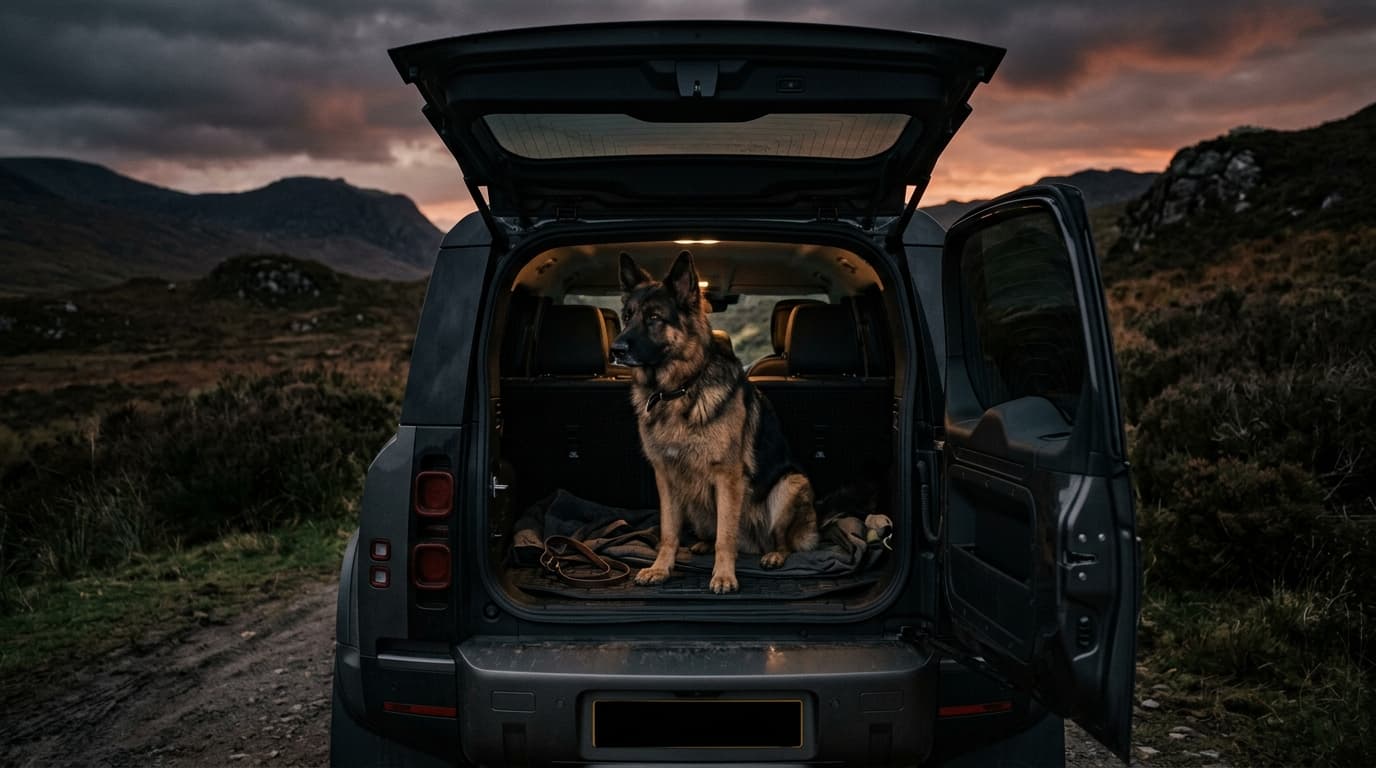
To carry a dog in Belgium, the best SUV combines a big boot, a low loading sill and a real separation from the cabin. The Skoda Kodiaq (910 litres) and the Dacia Bigster (667 litres, low sill, from about €24,000) stand out. But safety beats litres: an unrestrained dog becomes a projectile.
Which SUV should you choose to carry a dog?
Three measurable criteria come first: a boot of at least 600 litres, a low loading sill to spare the joints of an older dog, and a clean separation between the boot and the cabin. On the Belgian market, the Skoda Kodiaq and the Kia Sorento tick all three boxes. The Dacia Bigster, for its part, offers the best space-for-money.
Raw litres do not tell the whole story. A 900-litre boot with a high sill and a sloping rear window fits a German shepherd worse than a square 650-litre boot with a flat floor. What matters for a dog is floor area and usable height under the roofline, not the figure measured to the ceiling. The Kodiaq quotes 910 litres in five-seat mode, but its real strength lies elsewhere: flat floor, low sill and side bins that wedge a transport crate in place.
The figure that counts: a loading sill under 70 cm changes life for a ten-year-old labrador that no longer jumps. The Dacia Bigster and the Kodiaq are the best placed here, whereas a jacked-up off-roader forces you to lift the dog.
Do you have to restrain your dog in a car in Belgium?
No, Belgian law does not require you to strap in or crate a dog. The Highway Code (article 8.3) only demands that the driver keep permanent control of the vehicle and its animals. But in the event of an accident caused by a loose dog, the driver is liable.
In practice, an officer can issue a fine if a dog left loose is a visible hazard, for example an animal that hampers driving or climbs onto your lap. The penalty is at their discretion; there is no specific fixed fine. That is a clear difference with France, where the Highway Code explicitly bans anything that hampers the driver's field of vision or movements. In Belgium, the rule boils down to one principle: you must stay in control of the vehicle, full stop.
On the Belgian market, insurers go further than the law. AXA Belgium and the Moniteur Automobile recommend a crate in the boot or a two-anchor harness, less to avoid a fine than to avoid a tragedy. A loose dog that crosses the cabin is as dangerous for you as for itself.
Crate, harness or boot: what do the crash tests say?
ADAC and TCS crash tests are clear: a rigid crate, solidly anchored, is the safest option, and the harness the weakest. At 50 km/h, an unrestrained 20 kg dog develops a force of over 500 kg. At 30 kg, it exceeds one tonne.
Germany's ADAC club runs these configurations with a dummy husky named Waldi. Its verdict has held for years: the harness stretches on impact, letting the dog be thrown against the front seats, where it injures the occupants as much as itself. The rigid transport crate, wedged in the boot against the folded rear seat and set crosswise, best absorbs the deceleration. That is what the TCS dog-transport test confirms.
What we would avoid: the single-anchor harness, which leaves too much slack and turns the belt into a sling. If you drive without a crate, an approved divider grille between the boot and the seat is the minimum. A family SUV almost always offers one as a genuine accessory, with fixing points designed in from the start.
Which boot for which size of dog?
The right volume depends first on the dog's size and the number of animals. For a dog under 10 kg, a compact SUV with a crate is enough. For a large dog or two dogs, aim for 600 litres and up, with a flat floor. Here are the measured figures on the best-selling SUVs in Belgium.
| Model | Boot 5 seats | Low sill | Dog strength |
|---|---|---|---|
| Skoda Kodiaq | 910 L | yes | flat floor, bins |
| Peugeot 5008 | ~780 L | medium | large volume |
| Kia Sorento | 632 L (902 max) | medium | 7-seat flexibility |
| Dacia Bigster | 667 L (546 hybrid) | yes | price, low sill |
| VW Tiguan | 615 L | medium | factory grille |
| Toyota RAV4 | ~580 L | medium | reliability |
In practice this gives a simple hierarchy. For a shepherd, a retriever or a hunting dog, the Kodiaq and the Sorento are the most comfortable, especially with the seats down where they top 2,000 litres. On a tight budget, the Dacia Bigster is unbeatable: 667 litres in petrol form, a low loading sill and an entry price under €25,000. Watch the hybrid version, whose battery drops the boot to 546 litres, per the Bigster boot measurement guide.
To compare more widely, our SUV boot ranking in litres details the measurement traps, and our best 7-seater SUV guide covers families travelling with several dogs.
Which SUVs should you avoid for a dog?
Steer clear of coupe-SUVs with a sloping boot. The falling tailgate cuts usable height, and a large dog cannot stand under the roofline. A coupe-SUV easily loses 100 to 150 usable litres against its regular version, while costing more.
Be wary too of plug-in hybrid versions whose boot floor is sometimes raised to house the battery. The volume drops, but above all the step to clear grows, which penalises an older dog. The Bigster hybrid case (546 litres against 667 in petrol) illustrates this powertrain tax well. For pure dog use, with no home charger, petrol or diesel often stay more practical.
What we would avoid, to sum up: the sloping boot, the high loading sill for an old dog, the single-anchor harness, and the dog left loose on the back seat. None of these choices is illegal in Belgium, but all raise the risk under emergency braking.
Which SUV for a dog by profile?
For an active family with a large dog, heading off to walk in the Ardennes or at the coast, the Skoda Kodiaq is the rational choice: flat floor, low sill, side bins and a factory grille, for a 910-litre boot that swallows an XL crate. The Kia Sorento is the alternative if you carry two dogs or combine dog and children, thanks to its genuine seven-seat flexibility.
On a tight budget, the Dacia Bigster is the best buy on the Belgian market: it delivers the essentials, a big square boot and a low sill, without the premium bill. And for a small dog in town, no need to aim for the biggest SUV: a well-chosen compact with a wedged transport crate protects just as well. Before signing, run the test with the crate and the dog, not just the tape measure: it is the only test that counts.
Frequently asked questions
For a large dog, the Skoda Kodiaq (910 litres in five-seat mode, flat floor, low sill) and the Kia Sorento are the benchmarks. The Dacia Bigster offers the best space-for-money: 667 litres and a low loading sill from about €24,000. The deciding factor is not raw litres but floor area, usable height and the presence of a boot divider.
No. The Belgian Highway Code does not require you to strap in or crate a dog. Article 8.3 only demands that the driver keep permanent control of the vehicle and its animals. A fine remains possible if the officer judges a loose dog to be a danger, and the driver is liable for any accident the animal causes.
A rigid crate, solidly anchored, is the safest option according to ADAC and TCS crash tests. The harness is the weak link: on impact the strap stretches and the dog can be thrown onto the front seats. A crate placed in the boot, wedged against the folded rear seat, protects both the dog and the passengers.
The Skoda Kodiaq leads with 910 litres in five-seat mode, a flat floor and a low sill. The Kia Sorento follows (632 litres level with the parcel shelf, up to 902 litres to the roof), with a seven-seat flexibility useful for two large dogs. The Peugeot 5008 (~780 litres) and the Dacia Bigster (667 litres) round out the picture.
The entry point is the Dacia Bigster, from about €24,000 in petrol form, with a genuinely big boot and a low sill. Expect rather €40,000 to €50,000 for a well-equipped Skoda Kodiaq or Kia Sorento. At those prices, a boot divider and a made-to-measure boot mat cost €150 to €400 in genuine accessories.
It is strongly recommended whenever a dog travels in the boot without a crate. The grille stops the animal moving into the cabin under emergency braking and, in a crash, limits its projection towards the passengers. Most family SUVs offer one as a genuine accessory; the VW Tiguan and Skoda Kodiaq have anchor points designed for it.
Avoid coupe-SUVs with a sloping tailgate (angled boot): usable height collapses and a large dog cannot stand up. Be wary too of plug-in hybrid versions whose boot floor is sometimes raised by the battery, cutting the volume and making a crate harder to fit. Finally, rule out the single-anchor harness.
We dig through the Belgian market data — TÜV reliability, real-world ADAC consumption, company-car taxation, list prices — to call it straight. No brand pays us.