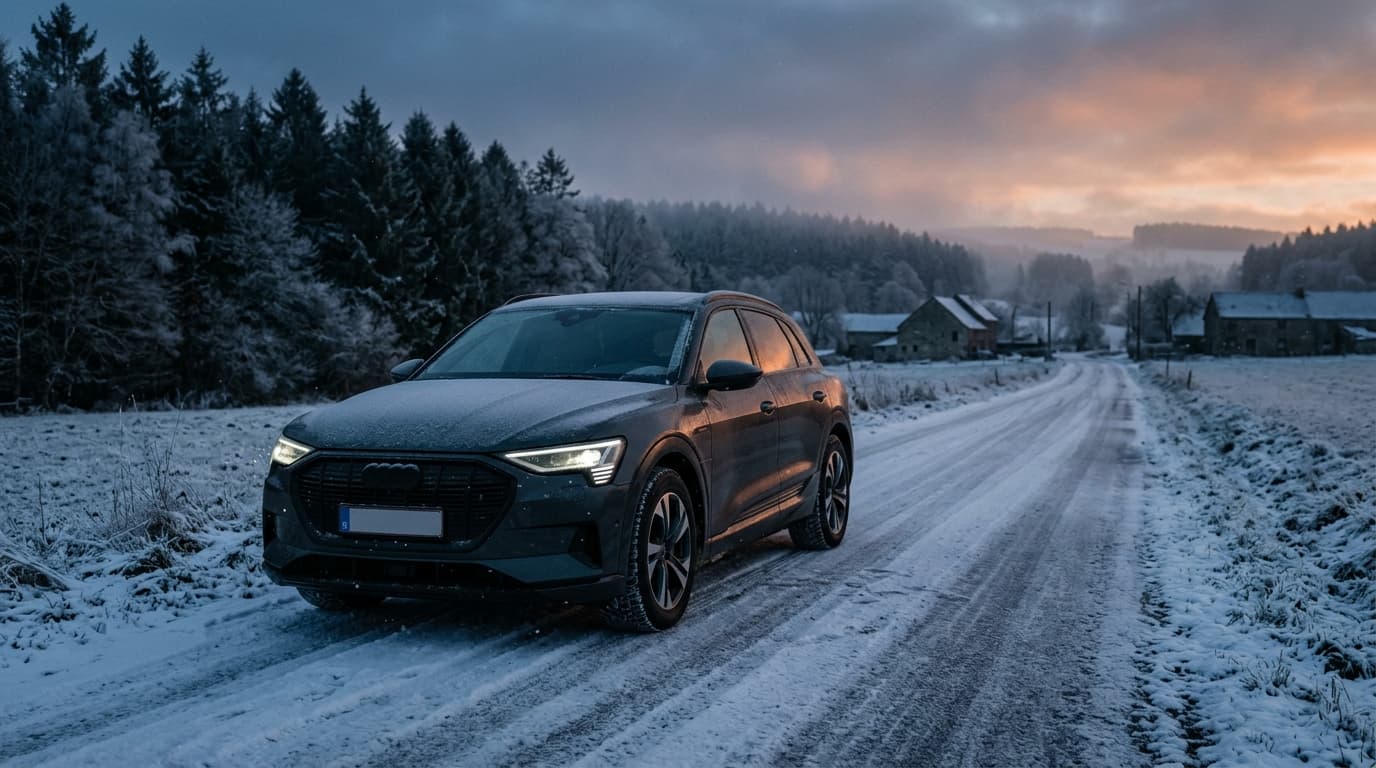
An electric SUV does lose range in winter, but not in the proportions the Scandinavian tests suggest. In Belgium, where the thermometer hovers around 0 to 5 °C, the real-world loss is around 15 to 25%. Heating and a cold battery explain most of it, and a heat pump limits the damage.
How much range does an electric SUV lose in winter?
In a typical Belgian winter, count on 15 to 25% less range than the headline figure. The loss climbs above 30% during a cold snap below -5 °C, especially on the motorway with the heating on full.
The extreme figures doing the rounds come from elsewhere. During the 2026 winter test run between -7 and -32 °C, measurements revealed an average gap of -38% versus WLTP range, according to Automobile Propre. Between the WLTP standard and a real-world mixed cycle at 0 °C with a cold car, the average measured loss is 31%, or nearly 160 km gone on a large battery.
What we'd avoid: transposing those Nordic -38% to Belgium. In Uccle, the average January temperature is around 3 to 4 °C, and spells below -10 °C are rare and brief. On the Belgian market, winter does cut range, but we are talking 15 to 25% most of the time, not a halving.
Why does cold melt away range?
Three causes stack up: the cold battery, cabin heating and rolling resistance. Heating is the first culprit, since on its own it can add 10 to 20% to consumption.
A lithium-ion battery works optimally between 20 and 25 °C, a band rarely reached in winter. Below it, its chemistry slows: it delivers less power and regenerates less well under braking, depriving the car of some of the energy normally recovered when slowing down. On top of that, cabin heating draws continuously on the battery, and winter tyres on cold roads slightly increase rolling resistance.
The number that matters: in winter, consumption rises by an average of 10 to 30% versus the warm season, according to measurements relayed by Touring. It is this rise in consumption, more than the battery itself, that explains the drop in range shown on the dash.
Does the heat pump really change things?
Yes, it is the equipment that makes the biggest difference in winter. A heat pump reaches a COP of 2.5 to 3: it produces 2.5 to 3 kW of heat for 1 kW consumed, where a classic electric resistance heater caps out at 1 to 1.
In practice, over a Belgian winter, a heat pump easily saves 5 to 10% of range versus the same model heated by resistance. It is now standard on many SUVs, but not all, and sometimes optional on entry-level trims. Checking for it before buying is a habit that pays off from the first winter.
Its blind spot remains extreme cold. Below -15 °C, the heat pump's efficiency collapses, because the system can no longer extract enough heat from the outside air, as tests by FLEET.be point out. In Belgium, that threshold is crossed only a few days a year: the heat pump keeps its full value for almost the entire winter.
Which electric SUVs cope best with the cold?
The most efficient and best thermally managed models fare best. The Tesla Model Y regularly comes out as the most efficient of the tested panels, with 22.2 kWh/100 km on the motorway in deep cold and 406 km covered.
The 800-volt platforms play a different card: charging. The Hyundai Ioniq 5 and the Kia EV9 keep much of their real-world capacity thanks to advanced thermal management and, above all, charge so fast that they recover the range loss with a shorter stop. In one cited test, the Kia EV6 GT lost only 17% of its range in cold weather, one of the best scores recorded.
| Model | Winter strength | Cold loss / consumption |
|---|---|---|
| Tesla Model Y | Record efficiency | 22.2 kWh/100 km, 406 km |
| Kia EV6 GT | Low loss | -17% recorded |
| Hyundai Ioniq 5 | 800 V + heat pump | Very fast charging |
| Kia EV9 | 800 V, large 7-seat SUV | ~239 km recovered in 15 min |
What we'd avoid: a heavy SUV, without a heat pump, chosen on its WLTP range alone. That is the combination that disappoints most in winter, because it stacks mass to heat with an energy-hungry heater. To compare models across the full year, see our guide to the best electric SUVs in Belgium.
How can you limit winter range loss?
The most cost-effective habit is preheating on mains power. Preheating the cabin and battery while the car is still plugged in draws energy from the grid, not the battery: you set off at temperature, at full regeneration power.
The second lever is preconditioning before a fast charger: warming the battery en route so it accepts full charging power on arrival. Without it, a fast stop in mid-winter can take twice as long, for lack of a warm enough battery. Most recent SUVs trigger it automatically when you set a charger in the sat-nav. Add heated seats and a heated steering wheel, less greedy than cabin heating, and a smooth driving style that maximises regeneration.
In practice, this makes for a far calmer winter. A Belgian driver who systematically preheats, preconditions before charging and runs winter tyres recovers a good part of the 15 to 25% lost. To choose between powertrains by your mileage, our hybrid vs electric SUV comparison spells out the thresholds.
Which electric SUV to choose if you dread winter?
For a Belgian driver who drives year-round, the right strategy is not to flee electric but to choose a model with a standard heat pump, measured consumption and, ideally, an 800-volt platform that turns charging into a formality. The Tesla Model Y for efficiency, the Hyundai Ioniq 5 or the Kia EV9 for charging speed, are safe bets at our latitudes.
The real trap is not winter itself, but the gap between the WLTP promise and real-world use. A buyer who sizes their range on the catalogue figure will be disappointed at the first frost; one who subtracts 20 to 25% upfront and checks for a heat pump will drive stress-free from December to February. Before signing, ask for the real consumption measured in winter, not the WLTP sheet, and take a test drive on a cold morning. To go wider, our piece on the real-world range of electric SUVs rounds out the approach.
Frequently asked questions
Expect an average loss of 15 to 25% versus the headline range during a typical Belgian winter, when the thermometer hovers around 0 to 5 °C. The loss climbs to 30% or more during a cold snap below -5 °C, especially on the motorway with the heating on full. The -38% recorded in Nordic tests at -30 °C does not apply to our maritime climate.
It is not essential but strongly recommended if you drive a lot between December and February. A heat pump has a COP of 2.5 to 3, meaning it produces 2.5 to 3 kW of heat for 1 kW consumed, versus 1 to 1 on a classic resistance heater. Over a Belgian winter, it easily saves you 5 to 10% of range. Its only blind spot: below -15 °C its efficiency drops, a rare case here.
The most efficient models and those with good thermal management fare best. The Tesla Model Y regularly comes out as the most efficient (22.2 kWh/100 km on the motorway in deep cold), and 800 V platforms like the Hyundai Ioniq 5 or the Kia EV9 offset the loss with very fast charging. Conversely, a heavy SUV without a heat pump pays a higher price in the cold.
Yes, it is the most cost-effective habit. Preheating the cabin and the battery while the car is still plugged in draws energy from the grid, not the battery. You set off with a battery at temperature, so at full regeneration power, and an already warm cabin. On a daily commute, this simple reflex recovers a good part of the winter loss.
Yes, a cold battery charges noticeably more slowly, because the system limits power to protect it. That is why preconditioning the battery before reaching a fast charger is decisive: it warms the battery en route so it accepts full power on arrival. Without preconditioning, a fast stop in mid-winter can take twice as long.
Slightly, yes. Winter tyres and, above all, cold, wet or snowy roads increase rolling resistance, which costs a few percent of range. It is marginal compared with cabin heating and a cold battery, and it is no reason to run summer tyres: safety far outweighs those few kilometres.
Yes, provided you plan. On a Brussels-to-the-Alps run in mid-winter, count on a real-world range cut by 20 to 30% and slower charging in the cold. An 800 V model that recovers 200 km and more in a quarter of an hour turns these constraints into simple coffee breaks. Plan your stops ahead and precondition the battery before each charger.
We dig through the Belgian market data — TÜV reliability, real-world ADAC consumption, company-car taxation, list prices — to call it straight. No brand pays us.