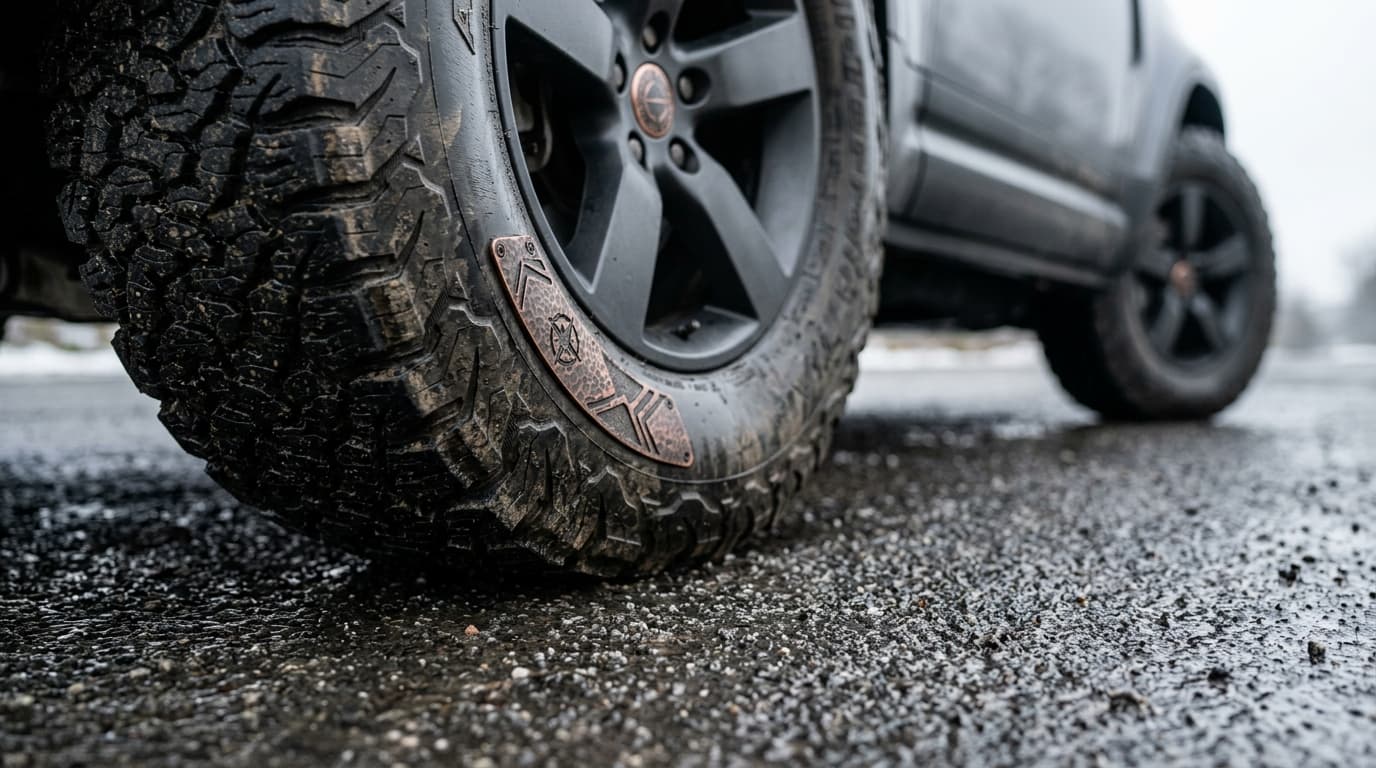
An all-season tyre is only winter-approved if it carries the 3PMSF symbol, the small three-peak mountain with a snowflake inside. The M+S marking is no longer enough. Nothing in Belgium forces you to fit them, but on an SUV the real question is not the season: it is the diameter of your wheels.
The snowflake in the mountain, and nothing else
3PMSF stands for Three Peak Mountain Snowflake. The symbol is moulded into the sidewall, next to the size, and it cannot be had on request: the tyre must pass a standardised European snow traction test and beat a reference tyre. It is the only marking with legal standing when a country imposes winter equipment.
The M+S marking is worth nothing. No test, no inspection, no third-party verification: the manufacturer applies it if it considers the tread pattern clears mud and snow. A tyre can therefore display M+S in large letters on the sidewall and behave like a summer tyre on an icy slope outside Gembloux in January.
Many all-season tyres carry both markings, some carry only M+S, and the difference shows up neither in the price nor in the tread pattern. It shows up on the sidewall.
Are winter tyres required in Belgium?
No.
No Belgian rule imposes winter or all-season tyres, whatever the weather. The obligation was considered, it was never introduced, and Test Achats confirms as much in its file on tyre legislation. Fitting winter tyres remains a driver's decision, not a legal constraint.
The vehicle technical regulation, the Royal Decree of 15 March 1968, requires something else. The list is short, and it binds harder than most SUV owners assume:
- a tread depth of at least 1.6 mm across three quarters of the contact patch, on pain of rejection at the contrôle technique, Belgium's periodic roadworthiness test;
- strictly identical tyres on the same axle: brand, size, load and speed ratings, tread pattern and degree of wear;
- identical construction on both axles, and no tyre protruding beyond the bodywork;
- load and speed ratings matching the carmaker's specification, readable on the sidewall and on the door-pillar label.
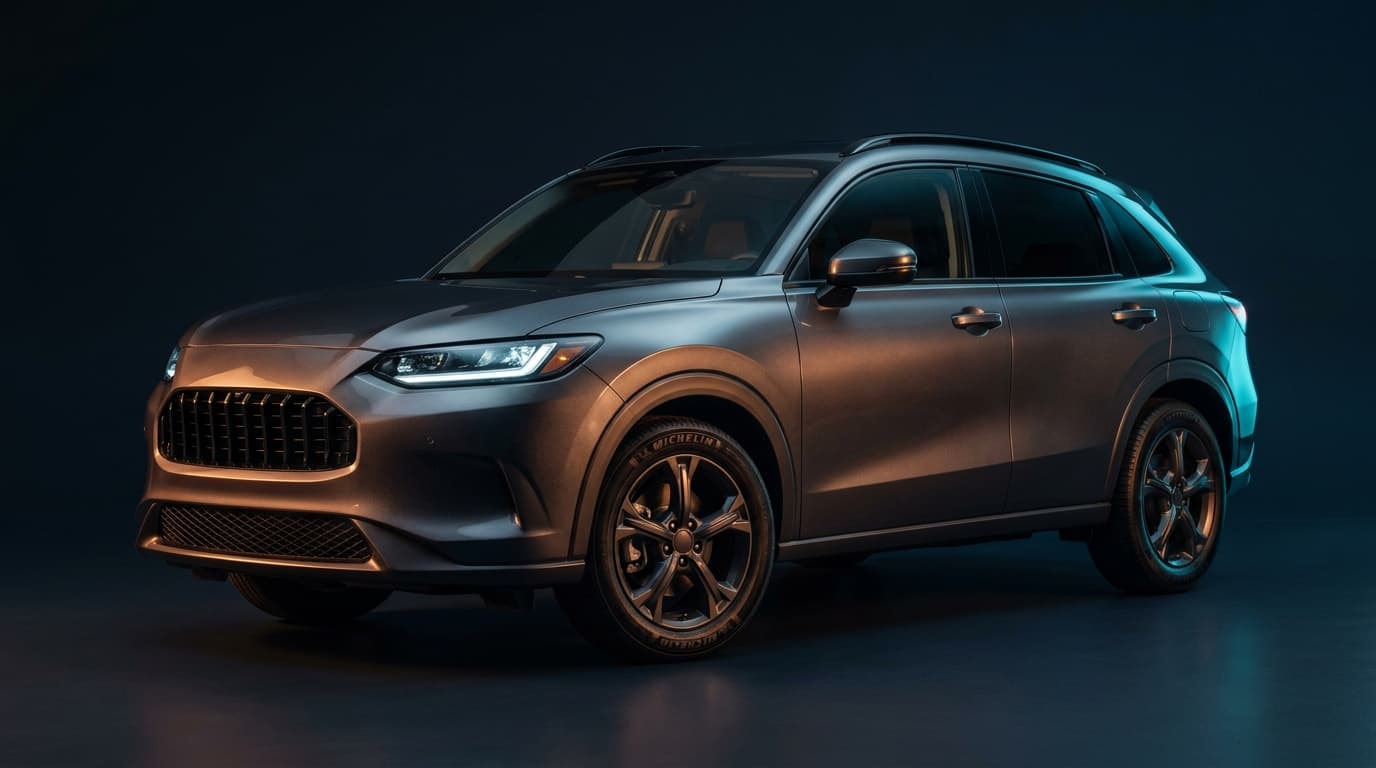
The second line deserves a pause, because it is expensive on an SUV. A tyre punctured at 20,000 km cannot be replaced on its own: its twin must show the same degree of wear, so a pair goes in the skip. On a set billed at 250 € per tyre, one sidewall puncture ends up costing 500 €.
One quiet exception exists, and it is dated: fitting winter tyres with a speed rating lower than the carmaker's specification is tolerated from 1 October to 30 April. Outside that window, the same tyres put you in breach. None of the pages that rank on this subject mention it, because they are written for France.
These rules are federal. Unlike road tax or low-emission zones, they do not change between Wallonia, Brussels and Flanders.
142.28 € in 17 inches, 372.49 € in 21
The number that matters: on the Belgian market, the same all-season tyre, same brand and same model, costs two and a half times more depending on the wheel it mounts to.
Recorded on 3 September 2026 on centralepneus.be across the Michelin CrossClimate 2 SUV range, unit price by diameter:
| Diameter | Size recorded | Unit price | Set of four |
|---|---|---|---|
| 17 inches | 225/65 R17 106V XL | 142.28 € | 569.12 € |
| 18 inches | 235/60 R18 103V | 155.39 € | 621.56 € |
| 19 inches | 235/55 R19 101V | 151.49 € | 605.96 € |
| 20 inches | 255/45 R20 105V XL | 248.69 € | 994.76 € |
| 21 inches | 285/45 R21 113W XL | 372.49 € | 1,489.96 € |
Between 17 and 19 inches the gap is trivial: 37 € across a full set. From 20 inches it explodes, at 426 € more per set than in 17 inches, and 921 € more in 21. The wheel that pleased you in the configurator comes back to you every four years, quietly, on the fitter's invoice.
The trap on a family SUV: ticking the 20-inch wheel option without asking the price of the matching tyre set. It is often a 1,000 € upgrade at purchase that adds 400 € at every replacement, for the whole life of the vehicle.
Competitors soften the bill without changing the logic. The Goodyear Vector 4Seasons SUV G3 in 235/55 R18 104V XL is listed at 122.39 € by the same Belgian retailer on the same day, against 140.49 € for the EVR version of the same tyre. Continental, Bridgestone, Vredestein and Nokian all field 3PMSF-approved SUV ranges in this segment, and the spread between brands rarely exceeds 40 € per tyre where diameter accounts for 230 €.
One last line is worth reading in the catalogues: the DOT 2022 mention. In 215/50 R18, the CrossClimate 2 SUV drops from 327.29 € to 156.99 € for that reason alone. The tyre is new, it has never rolled, but its rubber is three years older than that of its shelf neighbour.
Does a single set of tyres really save money?
Yes, but the saving does not come from where you expect.
Two full sets cost the price of two sets, which seems obvious, except each one only runs six months a year. At identical mileage, the total rubber consumed is the same in both scenarios. All-season tyres do not make the compound last longer; they remove half of the operations around it.
In practice, that means two fewer changeovers a year. Belgian fitters bill removal, refitting and balancing at 15 to 27 € per wheel depending on the centre and the diameter, according to tariffs published by professionals such as Corbais Pneus. A full seasonal changeover therefore costs 60 to 108 €, and two are needed each year. Over four years that adds up to 480 to 864 € the single set spares you, before counting off-season storage and a second set of alloy wheels, rarely below 400 €.
The maths tips towards all-season tyres as soon as annual mileage stays under 20,000 km and the car sleeps outdoors, with nowhere to store eight wheels. It tips towards two sets when the garage is large, the mileage high and winter driving frequent. In both cases, tyres cannot be judged in isolation. Our comparisons of the most fuel-efficient SUVs, of real electric SUV range in a Belgian winter and of hybrid SUV maintenance costs put figures on the other lines of the annual bill. Our comparison tool lets you filter models before choosing the wheel size that will follow you for eight years.
Where do all-season tyres genuinely lose?
On packed snow and on ice, and the gap is not marginal.
The Touring Club Suisse put 16 all-season tyres through 19 criteria for its 2026 test, on snow-covered and iced tracks. One came out highly recommended, seven recommended, three recommended with reservations and five not recommended. Close to one model in three on the market fails a test run by a motoring club, on a supermini size, with a Skoda Fabia as the test car.
That is the point retailer pages leave out. These tests run in 185/65 R15 or 225/45 R17, not on the 1,900 kg of a family SUV carrying five people and two suitcases. Mass stretches distances, and a tyre scoring decently under a Fabia does not mechanically repeat that under a Kodiaq.
The TCS separately advises against entering winter on all-season tyres below 4 mm of remaining tread, and recommends replacing them at 3 mm in spring. The Belgian legal minimum sits at 1.6 mm. Between the two lies the thickness of a crash: at 1.6 mm, wet braking distance is double that of a new tyre. An SUV that passes the roadworthiness test is not thereby a well-shod SUV.
What happens once you cross the border?
The rule changes, and it is enforced.
Germany tightened its regulation on 1 October 2024: since that date, only tyres carrying 3PMSF satisfy the situational winter obligation, and M+S alone no longer passes. Moniteur Automobile puts the fine at 60 € minimum, rising to 120 € where traffic is obstructed. A Belgian driver heading down to Cologne in February on all-season tyres marked M+S only is in breach from the first patch of slush.
Luxembourg has required winter or all-weather tyres on all four wheels in wintry conditions since October 2012, and Guichet.lu notes the on-the-spot fine at 74 €, regardless of country of registration. For the tens of thousands of Belgian cross-border commuters driving Arlon to Luxembourg every morning, that is not a tourist hypothesis: it is a daily trip from November to March.
Austria, France and Switzerland each apply their own logic, seasonal or situational. 3PMSF is the common denominator that covers you everywhere.
The SUV that should not run on all-season tyres
It exists, and it is easy to spot: heavy, often loaded, regularly above 400 metres of altitude, sometimes towing.
On that profile a second winter set stays justified, and all-season tyres become a compromise paid for under braking. For everyone else, the driver doing Namur to Brussels five days a week who sees snow three mornings a year, 3PMSF approval is plenty. What remains is to read the sidewall before paying.
Frequently asked questions
No. Only the ones carrying the 3PMSF symbol on the sidewall are. That marking is earned through a standardised snow traction test against a reference tyre. The M+S marking, by contrast, is self-declared: the manufacturer applies it without any test. An entry-level all-season tyre may well carry M+S alone, in which case it has no legal standing in countries that impose winter equipment.
A 3PMSF-approved all-season tyre covers the vast majority of Belgian conditions: flat terrain, temperatures around freezing, cold rain, a handful of frosty mornings. Dedicated winter tyres keep a clear edge on packed snow and ice, where the braking gap stays wide. If you regularly drive up into the Ardennes in winter, load the SUV to its limit or tow, proper winter tyres remain the safe call.
Between 569 € and 1,490 € for four Michelin CrossClimate 2 SUV tyres depending on wheel diameter, prices recorded on centralepneus.be on 3 September 2026. Add fitting, billed at 15 to 27 € per wheel depending on the centre and the diameter, balancing included, according to published Belgian fitter tariffs. Diameter weighs far more than brand in that total.
Yes. Below 1.6 mm of tread depth across three quarters of the contact patch, rejection is automatic. Two different tyres on the same axle also fail the vehicle, even if both are new. The TCS separately recommends 4 mm of remaining tread before heading into winter on all-season tyres, more than double the Belgian legal minimum.
We dig through the Belgian market data — TÜV reliability, real-world ADAC consumption, company-car taxation, list prices — to call it straight. No brand pays us.