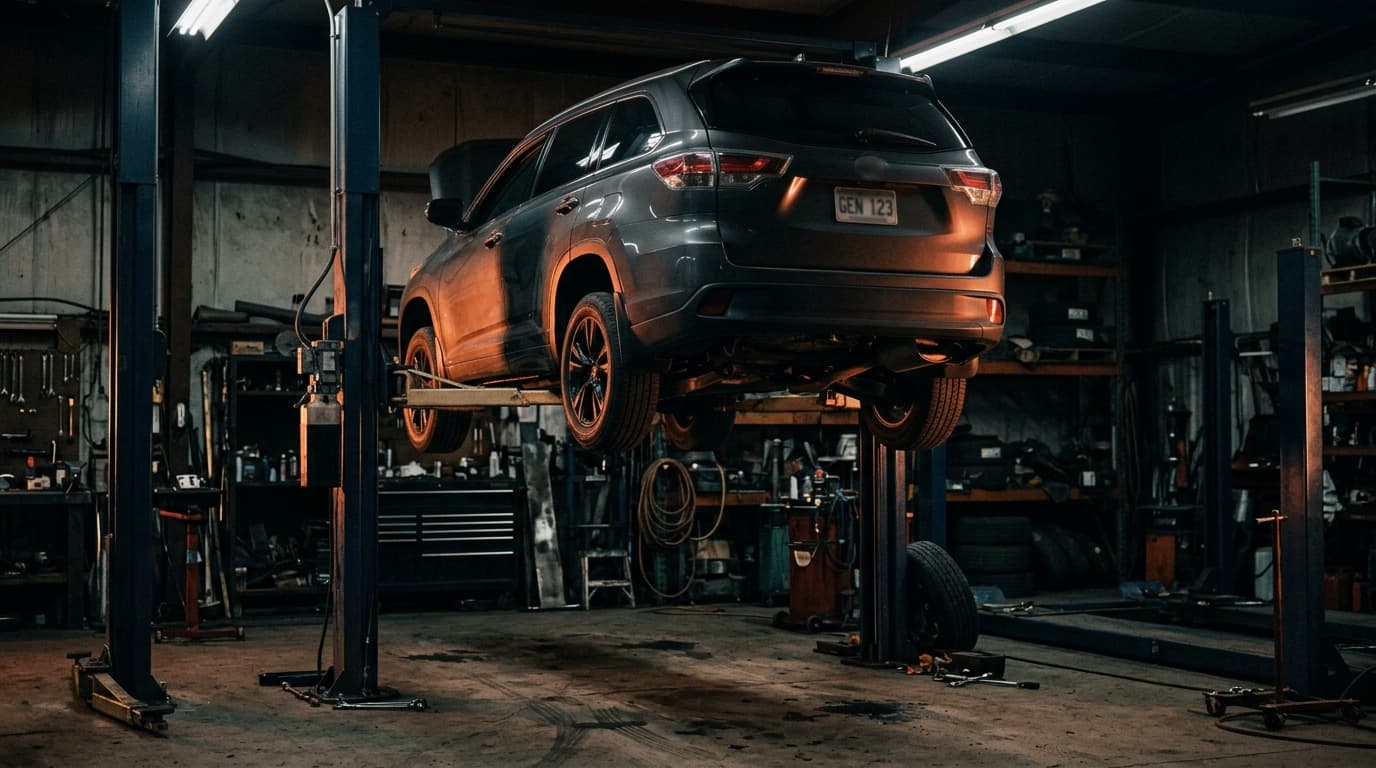
Maintaining a hybrid SUV costs between €250 and €650 a year in Belgium, 20 to 40% less than an equivalent petrol car. The real financial risk is not the service: it is the high-voltage battery, billed at €1,500 to €4,000 once the warranty has run out. Here is what each brand actually covers, and what it does not.
How much does hybrid SUV maintenance cost in Belgium?
Between €250 and €650 a year, all in. A minor service (oil, filters, brake fluid, checks) is billed at €150 to €250. A major service climbs to €300 to €500 depending on the brand, according to the cost surveys published by Test-Achats and Touring.
Most hybrid SUVs sold in Belgium — Toyota RAV4, Kia Sportage HEV, Hyundai Tucson Hybrid, Renault Austral E-Tech — require a visit every 15,000 km or once a year, whichever comes first. The average Belgian household drives 15,000 km a year: in practice, that means a single visit per year, alternating minor and major services.
The number that matters: against a total Belgian car budget of €6,240 to €10,200 a year across all items (credit, insurance, fuel, taxes, servicing), a hybrid's service accounts for under 8%. It is the least worrying line of the file. Depreciation and fuel cost ten times more.
Why is a hybrid cheaper to maintain than a petrol car?
Because half of the mechanical work is done by the electric motor, which does not wear out. The difference concentrates on three items: brakes, combustion engine and transmission.
ADAC and TÜV data show that pads and discs on a full hybrid often last twice as long as on an equivalent petrol car. The reason is mechanical: at every deceleration, the electric motor switches to generator mode and recovers energy. The friction surfaces only bite under hard braking. In mostly urban use, exceeding 120,000 km on the original front set is not unusual.
Second item: the combustion engine. It cold-starts less often, does not idle at a standstill and works in a gentler efficiency band. Third item: the transmission. A Toyota e-CVT has no clutch, no torque converter and no dual-clutch gearbox, meaning three wear parts fewer.
In practice, that gives a 20 to 40% gap on the maintenance bill. Watch the flip side: a hybrid SUV weighs 100 to 150 kg more than its petrol equivalent, and tyres wear accordingly faster. Budget a set every 35,000 to 45,000 km rather than 50,000.
How much does replacing a hybrid battery cost?
Between €1,500 and €4,000 fitted for a full hybrid. The NiMH batteries Toyota uses across part of its range sit at the lower end, around €2,000 to €3,000 including labour. Larger lithium architectures climb towards the top. On a plug-in hybrid SUV, whose battery is five to ten times bigger, the bill passes €5,000.
This is the figure that makes buyers back off. It deserves to be put in perspective: a full hybrid battery lasts 8 to 10 years or 150,000 to 200,000 km on average. On the Belgian market, a household keeps its SUV for 6 to 8 years. Statistically, most owners will never see that bill.
Why does a full hybrid battery age so slowly?
Because it never drops to zero and never climbs to 100%. The control unit keeps it inside a narrow charge window, often between 40 and 80%, precisely the zone that wears cells the least. It is the opposite of an electric vehicle battery, charged to the brim then drained on the motorway.
Can a hybrid battery be repaired rather than replaced?
Yes, and it is the first avenue to explore out of warranty. A battery almost never dies at once: one or two modules out of the twenty or so in the pack drop out. Specialist workshops recondition the faulty module for €600 to €1,200, two to three times less than a new pack. The dealer, by contrast, replaces the whole pack.
Which brand best covers your hybrid SUV battery?
None wins on every count. Toyota goes furthest in time but imposes its network. Kia offers the cover that is easiest to claim. Hyundai protects the high-mileage driver best.
| Model | Vehicle warranty | High-voltage battery | Extension |
|---|---|---|---|
| Toyota RAV4 Hybrid | 3 years / 100,000 km | 5 years / 100,000 km | Relax: +1 year per network service, max 10 years / 185,000 km |
| Kia Sportage HEV | 7 years / 150,000 km | 7 years / 150,000 km | None needed |
| Hyundai Tucson Hybrid | 5 years / unlimited km | 8 years / 160,000 km | None |
| Renault Austral E-Tech | 3 years / 100,000 km | 8 years / 160,000 km | Paid service contract |
| Dacia Duster Hybrid 155 | 3 years / 100,000 km | 8 years / 160,000 km | Paid extension |
Toyota is the only manufacturer in Belgium advertising up to 10 years of warranty. The Toyota Relax mechanism is simple: every service carried out in the official network renews the warranty by one year, up to 10 years or 185,000 km. It is free, and the cover follows the car when it is sold — a genuine argument at resale.
What we would avoid: assuming Relax covers everything. The terms and conditions exclude, beyond 100,000 km, the battery control module, the hybrid ECU and the inverter. In other words, the three most expensive hybrid parts leave the cover at exactly the moment they start to fail. Add the network constraint: one service at an independent garage and the year is not renewed.
Against that, Kia covers 7 years / 150,000 km with no network condition, high-voltage battery included. Hyundai advertises 5 years with unlimited mileage and 8 years / 160,000 km on the high-voltage battery: for a driver covering 30,000 km a year, it is the only offer that goes the distance. Our Toyota RAV4 vs Kia Sportage comparison breaks down that duel model by model.
What does the roadworthiness test cost for a hybrid SUV in Belgium?
€59.60 in Wallonia for a petrol or hybrid vehicle. In Flanders and Brussels the periodic test is billed at €40.90, plus a €5.20 emissions check for a petrol engine, so for any full hybrid. The 2026 rates put the regional gap at almost €14 per visit.
A hybrid SUV gets no special treatment: first test four years after first registration, then every two years until eight years or 160,000 km, annually after that. Only fully electric vehicles pay less in Wallonia (€53.40), the emissions check not applying.
On the Belgian market, one change matters on the Flemish side: from 1 September 2026, passenger cars there will go through every two years instead of every year. Over ten years of ownership, that removes two to three visits from the bill.
Which mistakes send the maintenance bill through the roof?
Three, and each costs more than the service it claims to avoid.
Skipping a service to save €300 is the first. On a Toyota, it cancels the Relax renewal for that year: you save €300 and lose cover worth several thousand euros on a hybrid transmission. Worse, if a fault is found on the day you come back, it is not covered: you have to fix it at your own expense before reactivating the warranty.
Buying a plug-in hybrid SUV without a charger at home is the second. With an empty battery you maintain two drivetrains to use only one, with a pack five to ten times more expensive to replace. Our article on choosing between full hybrid and mild hybrid settles the powertrain question upstream.
Neglecting the service history at resale is the third. An incomplete book on a hybrid SUV means €1,000 to €2,000 less at trade-in, because the next buyer prices in the battery risk. Our comparisons of the best hybrid SUV in Belgium and of the SUVs that hold their value show how much more that item weighs than servicing itself.
Frequently asked questions
Budget between €250 and €650 a year depending on the model and the type of hybrid system. A minor service (oil, filters, brake fluid, checks) runs around €150 to €250, a major service between €300 and €500 depending on the brand, according to the cost surveys published by Test-Achats and Touring. On a hybrid SUV serviced every 15,000 km, a household covering 15,000 km a year therefore pays for one visit only.
Yes, by 20 to 40% depending on the item. The electric motor handles part of the braking through energy recovery: pads and discs on a hybrid SUV often last twice as long as on an equivalent petrol car. The combustion engine runs less, cold-starts less often and works in a gentler efficiency band. A Toyota e-CVT transmission has neither a clutch nor a dual-clutch gearbox. Tyres, on the other hand, wear faster: a hybrid carries 100 to 150 kg more.
Between €1,500 and €4,000 fitted for a full hybrid (HEV) pack. The NiMH batteries used by Toyota often sit at the lower end, around €2,000 to €3,000. Larger lithium packs climb higher. On a plug-in hybrid SUV (PHEV), whose battery is five to ten times bigger, the bill easily passes €5,000.
Eight to ten years on average, or 150,000 to 200,000 km. That is longer than most buyers assume, and longer than the average ownership period of an SUV in Belgium. A full hybrid battery is never fully drained nor fully charged: it works inside a narrow charge window, which limits ageing. A failure before 150,000 km is the exception, not the rule.
Toyota Relax is a free extension that renews the warranty by one year at every service carried out in the official Toyota network, until the car reaches 10 years or 185,000 km. There are two catches. First, it ties you to the network: one service at an independent garage and the year is not renewed. Second, the terms and conditions exclude, beyond 100,000 km, the battery control module, the hybrid ECU and the inverter, precisely the expensive hybrid parts.
It depends on your servicing discipline. Toyota goes furthest in time (up to 10 years / 185,000 km with Relax) but imposes its network and excludes three hybrid components after 100,000 km. Kia covers 7 years / 150,000 km with no network condition, high-voltage battery included: it is the easiest cover to claim. Hyundai offers 5 years with unlimited mileage and 8 years / 160,000 km on the high-voltage battery, which suits high-mileage drivers.
€59.60 in Wallonia for a petrol or hybrid vehicle. In Flanders and Brussels the periodic test costs €40.90, plus a €5.20 emissions check for a petrol engine (so for any full hybrid). The first test happens four years after first registration, then every two years until eight years or 160,000 km. From 1 September 2026, Flanders also moves to a two-yearly rhythm for passenger cars.
We dig through the Belgian market data — TÜV reliability, real-world ADAC consumption, company-car taxation, list prices — to call it straight. No brand pays us.