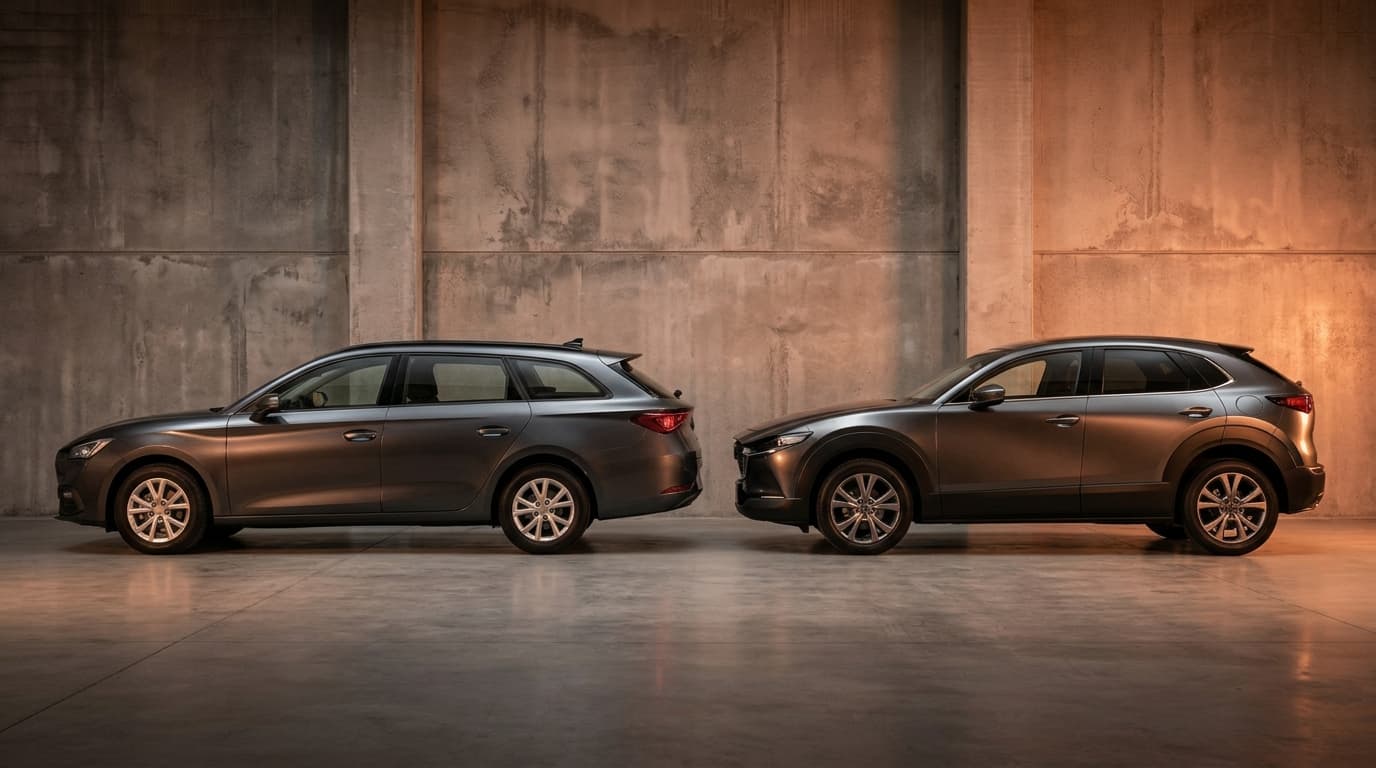
The estate wins on boot space, fuel use and the Walloon tax, provided you compare two cars with the same engine. Across three pairs sold in Belgium, it offers up to 123 litres more and uses around 0.5 l/100 km less. The SUV, for its part, is not always dearer to buy.
Three pairs, one engine per pair
Comparing any SUV with any estate proves nothing. A diesel Tiguan against a petrol Golf is an engine gap, not a body-style gap.
So we picked three couples that share a platform and a strictly identical hybrid powertrain, so that the only variable left is the body: its height, its frontal area and its kilos. Toyota Corolla Touring Sports against Corolla Cross, as the 140 hp 1.8 Hybrid. Peugeot 308 SW against 3008, as the Hybrid 145 e-DCS6. Volkswagen Passat against Tiguan, as the 204 hp eHybrid plug-in.
The market has already voted, and not for the estate. According to Dataforce figures reported by Motor1 on 5 January 2026, estates went from 10.2% to 7.1% of European registrations between 2020 and 2025, while SUVs climbed from 41.3% to 59.2%. In the first half of 2026, Motor1 France puts them at 5.9%.
SUV or estate: the three duels in one table
The figure that matters: in all three pairs, the estate has the larger boot and the lower maximum authorised mass.
| Pair (same engine) | Belgian entry price | Boot | WLTP CO2 | WLTP fuel use | Max. authorised mass | Length / height |
|---|---|---|---|---|---|---|
| Corolla Touring Sports 1.8 Hybrid | €34,940 | 596 l | 100 g/km | 4.4 l/100 km | 1,885 kg | 4.65 / 1.44 m |
| Corolla Cross 1.8 Hybrid | €39,945 | 473 l | 112 g/km | 4.9 l/100 km | 1,940 kg | 4.46 / 1.62 m |
| 308 SW Hybrid 145 | €31,045 | 608 l | 109 g/km | 4.8 l/100 km | 2,010 kg | 4.64 / 1.48 m |
| 3008 Hybrid 145 | €33,015 | 520 l | 120 g/km | 5.3 l/100 km | 2,080 kg | 4.54 / 1.64 m |
| Passat eHybrid 204 | €62,225 | 510 l | 28 g/km | 1.2 l/100 km | 2,350 kg | 4.92 / 1.52 m |
| Tiguan eHybrid 204 | €56,900 | 490 l | 34 g/km | 1.5 l/100 km | 2,410 kg | 4.54 / 1.66 m |
Checked on 3 November 2026. Prices: toyota.be and Moniteur Automobile for Toyota, November 2026 offers on peugeot.be (Style trim, discounts deducted according to the brand), volkswagen.be offer for the Passat, autogids.be (undated page) for the Tiguan. Boot, CO2, mass and dimensions: Belgian 308 SW brochure (September 2025), Belgian 3008 brochure (November 2025), Toyota Belgium price list of 1 July 2025 and the ADAC catalogue.
Two caveats. The entry trims are not strictly equivalent at Toyota (Corolla on one side, Dynamic on the other). And for the 308 SW, ADAC measures 551 litres where the Belgian brochure states 608: the measuring standard is not specified.
Does an estate really use less fuel than an SUV?
Yes, and the gap is consistent: 0.5 l/100 km in type approval at Toyota as at Peugeot.
The cause is well known. An SUV 14 to 19 cm taller pushes more air, and drag grows with the square of speed. The extra 55 to 70 kg of maximum mass also count, especially in town, but the motorway is where the difference opens up.
In practice, here is what that means over 15,000 km a year: 75 more litres of petrol for the SUV, or €150 at the maximum price of €2.002 for 95 E10 petrol set on 21 October 2026, according to Paris Match Belgique. Over four years, €600.
Real-world measurement adds nuance. ADAC put the Passat Variant eHybrid through its test in July 2025 and the Tiguan eHybrid in September 2026: 6.2 l/100 km against 6.4 with an empty battery, 19.1 against 20 kWh/100 km on electricity, and 122 km of measured electric range against 108. The estate keeps the edge everywhere. It is simply slimmer than in type approval: 0.2 litres, or €60 a year at the same price. For the Corolla Touring Sports, ADAC measured 5.0 l/100 km in 2024; no equivalent test of the Corolla Cross 1.8 exists.
Which boot is bigger, estate or SUV?
The estate, in all three cases. That result always surprises people in the showroom, because the SUV looks roomier.
Its height only helps above the parcel shelf, where nobody loads without a net. The estate gains floor length instead, and length is what counts for a pushchair, a dismantled bike or a suitcase laid flat. The Corolla Touring Sports is 19 cm longer than the Corolla Cross, and the Passat 38 cm longer than the Tiguan.
ADAC's own measurements, filling the boots itself, confirm the gap at Volkswagen: 455 litres for the Passat against 380 for the Tiguan below the parcel shelf, 1,545 against 1,400 with the rear bench folded and up to the roof. Seventy-five litres is a cabin suitcase.
Our SUV boot space ranking in litres puts the Corolla Cross and the 3008 at the average of their segment, not below it. It is the estate that stands out.
Wallonia charges for the extra 60 kilos
Since 1 July 2025, the Walloon registration tax (taxe de mise en circulation, TMC) multiplies four terms: a base amount set by kilowatts, CO2 divided by 136, maximum authorised mass divided by 1,838 kg and a fuel coefficient of 0.8 for a hybrid, according to the SPW Finances leaflet (June 2025). An SUV takes both penalties, more CO2 and more mass, on the same line of the calculation.
| Pair, new car | Kilowatts used | Walloon TMC, estate | Walloon TMC, SUV | Gap |
|---|---|---|---|---|
| Toyota Corolla 1.8 Hybrid | 103 kW | €523 | €603 | +€80 (+15%) |
| Peugeot Hybrid 145 | 100 kW | €347 | €395 | +€48 (+14%) |
| Volkswagen eHybrid 204 | 110 kW | not calculated | not calculated | +25% on the formula |
Calculated on the 2025-2026 scale, before the 1 July 2026 indexation. The leaflet publishes no coefficient specific to plug-in hybrids: for the Volkswagen pair, only the relative gap is given. For Peugeot, we use the 100 kW of the petrol engine printed by Peugeot Belgium; if your registration certificate shows 107 kW in box P.2, the two amounts rise to €608 and €693, and the percentage gap stays the same.
Brussels makes no such distinction. Its TMC depends on power, in kilowatts and fiscal horsepower, and two versions with the same engine pay exactly the same amount. Flanders calculates its BIV (the Flemish registration tax) from CO2 and the Euro standard: the SUV pays more there too, without mass coming into it. Our guide to the registration and road tax on SUVs details all three scales.
Is the SUV always dearer to buy?
No.
At Toyota, the Corolla Cross starts €5,005 above the Corolla Touring Sports, but in a better-equipped trim. At Peugeot, the gap falls to €1,970 between two Style trims. And at Volkswagen, the order flips: the Tiguan eHybrid is listed at around €56,900, the Passat eHybrid at €62,225. The two no longer play in the same category: the Passat is a D-segment tourer, 4.92 m long, while the Tiguan remains a 4.54 m compact SUV.
To avoid: drawing conclusions from a single duel. The estate costs less when it is the SUV's twin; it costs more when it is its big sister.
Estate or SUV for a family: does the SUV still have an edge?
Yes, four. The estate wins on the figures, but the SUV keeps arguments the spec sheets do not measure, and they weigh heavily for a family with young children:
- the higher seating position, which spares your back every time you buckle a child seat, an advantage we detailed for compact SUVs and baby car seats;
- easier access for an older driver or a passenger with fragile knees;
- ground clearance, useful on a dirt track or a high kerb, regardless of the drivetrain;
- the shorter length, which makes parallel parking in town easier: 19 cm less at Toyota, 38 cm at Volkswagen.
Towing capacity, on the other hand, does not separate them. Toyota approves 750 kg braked for both Corollas, Volkswagen 1,800 kg for both the Passat and the Tiguan. Only the 3008 climbs to 1,200 kg with the towbar option, against 1,100 kg for the 308 SW. If the real question is the people carrier, our SUV or people carrier comparison replays the match.
Our verdict by profile
The high-mileage motorway driver takes the estate, and the figures back that up: lower fuel use, more boot space, and in Wallonia a registration tax lighter by €48 to €80.
The parent loading two child seats every morning has good reasons to choose the SUV, accepting around €150 a year in fuel and a shorter boot. And anyone torn between a Passat and a Tiguan should know that here the estate is the dearer of the two, with 20 litres more official boot space and 75 litres more measured. To set two models side by side on their spec sheets, use our comparison tool, and our explainer on what an SUV is recalls why no Belgian law tells the two body styles apart.
Frequently asked questions
Does an estate use less fuel than an SUV? Yes, with the same engine. Under WLTP, the Toyota Corolla Touring Sports 1.8 Hybrid is rated at 4.4 l/100 km against 4.9 for the Corolla Cross, and the Peugeot 308 SW Hybrid 145 at 4.8 against 5.3 for the 3008. Measured by ADAC with an empty battery, the gap between a Passat and a Tiguan eHybrid shrinks to 0.2 l/100 km.
Does an SUV have a bigger boot than an estate? No, in all three pairs we checked. The estate wins by 20 to 123 litres on the official spec sheets, and by 75 litres on the Volkswagen pair when ADAC measures both boots itself (455 litres against 380). The SUV only regains the edge in loading height under the tailgate.
Can an SUV tow more than an estate? Not with the same engine. Toyota approves 750 kg braked for both the Corolla Touring Sports and the Corolla Cross, Volkswagen 1,800 kg for both the Passat and the Tiguan eHybrid. At Peugeot, the 3008 Hybrid 145 goes up to 1,200 kg with the towbar option, against 1,100 kg for the 308 SW.
Why does an SUV pay more registration tax in Wallonia? Because the Walloon formula in force since 1 July 2025 multiplies CO2 divided by 136 and the maximum authorised mass divided by 1,838 kg. An SUV takes both penalties. In Brussels, the TMC depends on power and does not change between two versions with the same engine.
Estate or SUV: which holds its value better? We found no Belgian study comparing depreciation of the two body styles with the same engine. Demand leans towards the SUV: according to Dataforce, estates fell to 5.9% of the European market in the first half of 2026. An estate therefore sells to a narrower audience, which can weigh on resale.
Frequently asked questions
Yes, with the same engine. Under WLTP, the Toyota Corolla Touring Sports 1.8 Hybrid is rated at 4.4 l/100 km against 4.9 for the Corolla Cross, and the Peugeot 308 SW Hybrid 145 at 4.8 against 5.3 for the 3008. Measured by ADAC with an empty battery, the gap between a Passat and a Tiguan eHybrid shrinks to 0.2 l/100 km.
No, in all three pairs we checked. The estate wins by 20 to 123 litres on the official spec sheets, and by 75 litres on the Volkswagen pair when ADAC measures both boots itself (455 litres against 380). The SUV only regains the edge in loading height under the tailgate.
Not with the same engine. Toyota approves 750 kg braked for both the Corolla Touring Sports and the Corolla Cross, Volkswagen 1,800 kg for both the Passat and the Tiguan eHybrid. At Peugeot, the 3008 Hybrid 145 goes up to 1,200 kg with the towbar option, against 1,100 kg for the 308 SW.
Because the Walloon formula in force since 1 July 2025 multiplies CO2 divided by 136 and the maximum authorised mass divided by 1,838 kg. An SUV takes both penalties. In Brussels, the TMC depends on power and does not change between two versions with the same engine.
We found no Belgian study comparing depreciation of the two body styles with the same engine. Demand leans towards the SUV: according to Dataforce, estates fell to 5.9% of the European market in the first half of 2026. An estate therefore sells to a narrower audience, which can weigh on resale.
We dig through the Belgian market data — TÜV reliability, real-world ADAC consumption, company-car taxation, list prices — to call it straight. No brand pays us.