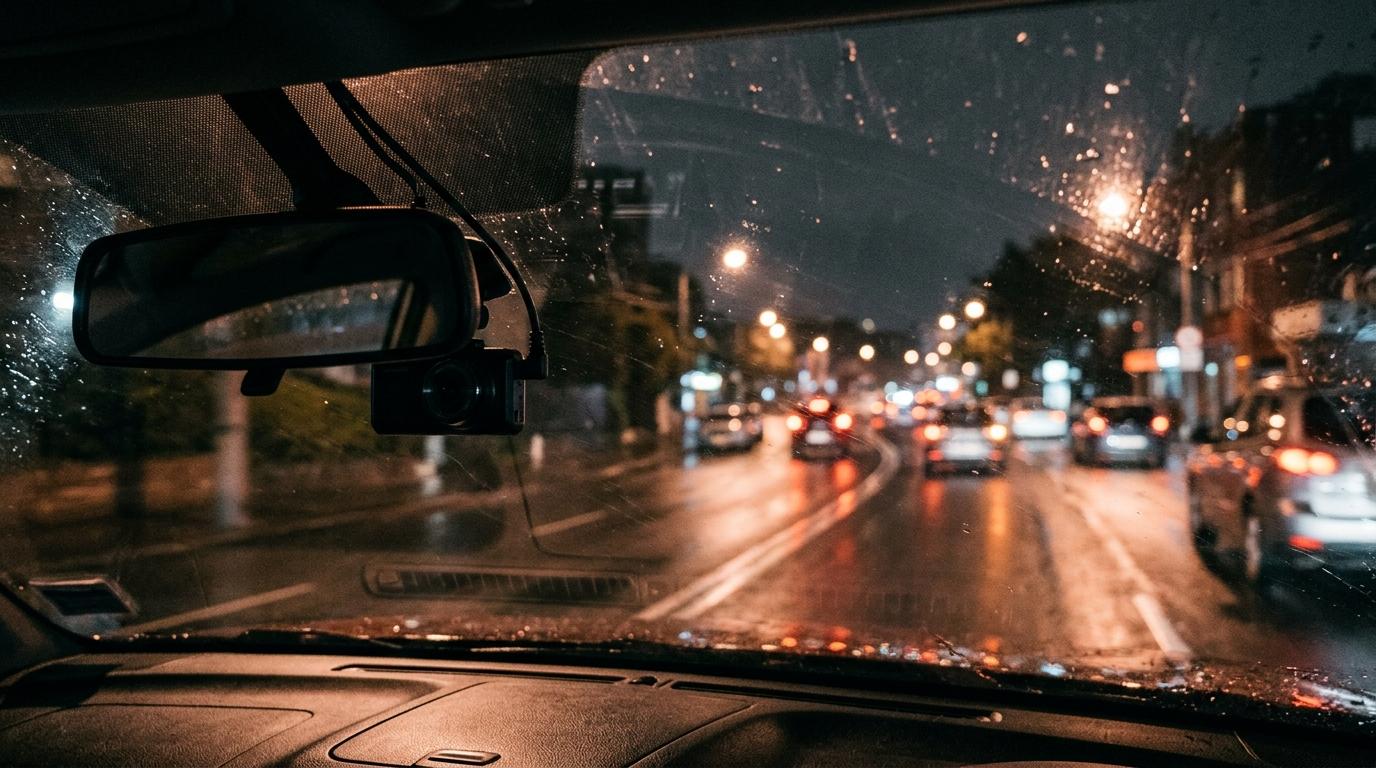
For most Belgian drivers a front-only dash cam is enough: it settles right of way disputes, costs 130 to 300 €, and raises no legal problem as long as you publish nothing. Front and rear is worth it in three specific cases. On a hybrid SUV, the real trap lies elsewhere, in parking mode.
Front only or front and rear: which one films the dispute?
The front, in the vast majority of cases.
A fender bender is almost always argued over what happened in front of you: a priority to the right ignored, a light run on amber, a car cutting into the left lane of the Brussels ring. A rear-end shunt is argued over far less, because the Belgian Highway Code requires the following driver to keep a sufficient distance (article 10.1). Whoever runs into you while you are stationary has, in principle, already lost, camera or not. The rear camera comes into its own in pile-ups, when a third car pushes you into the second and everyone blames everyone else, and in parking manoeuvres nobody saw.
In practice, the rule is simple. If you mostly drive a smooth commute, the front is enough. If you spend an hour a day in stop and go traffic on the E40 or the E19, the rear starts to pay for itself.
The contest on eight criteria
| Criterion | Front only | Front and rear |
|---|---|---|
| Price recorded in Belgium (17/11/2026) | 130 to 299 € | 279 to 849 € |
| Right of way dispute, failure to give way | Covered | Covered |
| Rear-end shunt while stationary | Not filmed, rarely disputed | Filmed |
| Pile-up, pushed into the car ahead | Half the footage | Full footage |
| Installation | One 12 V or USB socket, 15 minutes | 6 m cable to route under the headlining to the rear window |
| Rear window of an SUV | Not applicable | Wiper and tinted glass to check |
| Memory card | One video source | Two sources, card full twice as fast |
| Parking mode | Same base consumption | Two sensors powered, more strain on the 12 V battery |
The table leans towards front only for reasons of cost more than image. The price gap comes less from the rear camera itself than from the step up the range it forces: at Nextbase, the rear module only plugs into the 322GW, 422GW, 522GW and 622GW, and paired with a 422GW the front camera drops from 1440p to 1080p or the rear falls to 720p, according to the manufacturer's page.
How much does a dash cam cost in Belgium?
Survey of 17 November 2026 on the Coolblue and Vanden Borre product pages. Specifications come from Garmin's press release of 5 September 2024 (in French), the Nextbase page and, for the field of view, the retailers' data sheets.
| Model | Cameras | Resolution | Screen / GPS | Price recorded |
|---|---|---|---|---|
| Garmin Dash Cam Mini 3 | Front | 1080p, 140° | No screen, no GPS | 130 € (Vanden Borre) |
| Garmin Dash Cam X310 | Front | 4K, 140° | 2.4 inch touchscreen, GPS | 299 € (Coolblue), 314 € (Vanden Borre) |
| Nextbase 422GW | Front, optional rear module | 1440p, 140° | 2.5 inch, GPS | 299 € (Coolblue) |
| Nextbase Rear Window Camera | Rear module | 1080p, 140° | 6 m cable | Not recorded in Belgium |
| Nordväl DC202-2CH 4K | Front and rear | 4K claimed | Not verified | 279 € (Coolblue) |
| BlackVue DR590X-2CH Plus | Front and rear | Not verified | Not verified | 350 € (Coolblue) |
| BlackVue DR970X-2CH LTE Plus II | Front and rear, connected | Not verified | Not verified | 849 € (Coolblue) |
The number that counts: a 15 € gap for the same Garmin X310 between two Belgian retailers on the same day. We have tested none of these cameras, and we found no Belgian price for the Nextbase rear module, which Vanden Borre lists as no longer available.
Is a dash cam legal in Belgium?
Yes for filming while driving, no for publishing, and unclear for surveillance while parked. Three regimes in a single camera.
The federal police (in French), on a page updated on 7 October 2025, write that fitting a dash cam "is not prohibited" and that recording for private purposes is allowed without restriction. In a dispute, the footage becomes judicial data: you must tell the other party as soon as possible that they were filmed. Posting a reckless driver's video on Facebook to let off steam, on the other hand, breaches privacy law as soon as their identity can be guessed, number plate included. The camera law is federal and the GDPR European: the rule is the same in Namur, Brussels and Ghent.
Parking mode is another matter. The camera law, reformed in 2018, bans private individuals from using a mobile surveillance camera in a non-enclosed place, and the public road is one, as the law firm Loyens & Loeff noted on 3 April 2018, adding that no text said when a dash cam tips into that category. On 24 September 2025, Digital Minister Vanessa Matz answered a parliamentary question on Tesla's Sentry Mode, a camera that films the street while the car is parked, by saying that the 2007 law forbids private individuals from filming public space, according to L'Avenir (in French). No fine has been announced. A dash cam recording continuously outside your house while you sleep looks a lot like that Sentry Mode, though, and I would not bet on a judge's leniency if the footage served anything other than an accident.
Parking mode drains a hybrid's 12 V battery
This paragraph applies to every hybrid SUV. A full hybrid or a plug-in hybrid keeps a small 12 volt battery to wake the electronics, and only recharges it when the system is running: for a car left standing, Toyota recommends putting it in READY mode for about 60 minutes, then driving for at least 30 minutes, once a week (page updated on 3 March 2026). Plug a camera that watches day and night into that, and you add a load the car was not designed for.
The manufacturers know it. Nextbase explains that parking mode requires a permanent supply and that its hardwire kit cuts the camera off when the battery drops to 11.6 V. Garmin sells a cable that plugs into the OBD port and cuts off at 12 V, with a timer. At Garmin, parking surveillance with a smartphone alert also requires a Vault subscription.
Four points to check before switching parking mode on:
- the cable's cut-off threshold, 12 V rather than 11.6 V on a hybrid;
- a timer that stops surveillance after a few hours rather than running continuously;
- where the 12 V battery sits, sometimes in the boot on hybrids, which lengthens the wiring;
- where you park: on the street, parking mode falls into the grey zone described above.
The stakes are not theoretical. In 2025, the starter battery accounted for 45.4% of ADAC (German automobile club) call-outs across all vehicles, according to the figures published on 10 March 2026 (in German). If it fails, a jump starter also revives a hybrid.
Luxembourg, Austria, Portugal: put the dash cam away
A camera allowed in Arlon is not necessarily allowed in Luxembourg City. According to JeChange's round-up of 16 October 2026 (in French) and the Moniteur Automobile:
- Luxembourg: on 16 August 2023 the CNPD ruled this use "in practice very hard to reconcile" with the GDPR;
- Germany: footage accepted as evidence by the Federal Court of Justice in May 2018, permanent recording contrary to data protection;
- France: allowed, with no declaration for personal use;
- Austria: continuous recording banned, a 300 € fine imposed in September 2018;
- Portugal: deemed unlawful since 2019, fines reported from 500 €;
- Switzerland: covert recording ruled contrary to data protection by the Federal Supreme Court on 26 September 2019.
Unplug it before the Luxembourg border. It is not part of the compulsory equipment anyway.
Verdict: front only, except in three cases
Buy a front camera, 1080p at the very least. The Garmin Mini 3 at 130 € is enough if you do not need a screen; the X310 or the Nextbase 422GW at 299 € add GPS, which dates and locates the scene. Move to front and rear if you queue on the ring road every day, if you tow a trailer or a caravan, or if your SUV sleeps on the street in a city where mirrors get knocked off. Avoid: permanent parking mode on a hybrid that is rarely driven, and any posting of footage on a social network.
And if you have roadside assistance included with your insurance, drive little and almost never in town, spend nothing: a properly completed accident report remains the first piece of evidence. For the car itself, the comparison tool helps you choose, and the article on hybrid SUV maintenance details the other costs to budget for.
Frequently asked questions
Yes. The Belgian federal police write that fitting a dash cam is not prohibited and that recording for private use is allowed without restriction. Publishing the footage, on Facebook or YouTube for example, breaches privacy law as soon as a road user can be recognised. The rule is federal: identical in Wallonia, Brussels and Flanders.
It can be used in a dispute, provided you tell the other party as soon as possible that they were filmed, according to the federal police. The judge remains free to accept it or not. Attach it to the accident report or send it to your insurer and the police, never to a social network.
Not for most journeys. It is worth it if you spend a lot of time in queues on the ring road, often park in the street or tow. Otherwise a good front camera at 130 € covers most disputes.
It can. Parking mode needs a permanent supply from the 12 V battery, which a hybrid only recharges in READY mode. Choose a cable with a low voltage cut-off, 11.6 V at Nextbase, 12 V on Garmin's OBD cable, and switch parking mode off before leaving the car for more than a week.
In Luxembourg, the data protection authority (CNPD) ruled in 2023 that this use is very hard to reconcile with the GDPR: unplug it. In Germany, the Federal Court of Justice accepted footage as evidence in May 2018, but permanent recording breaches data protection rules there. France allows it.
We dig through the Belgian market data — TÜV reliability, real-world ADAC consumption, company-car taxation, list prices — to call it straight. No brand pays us.