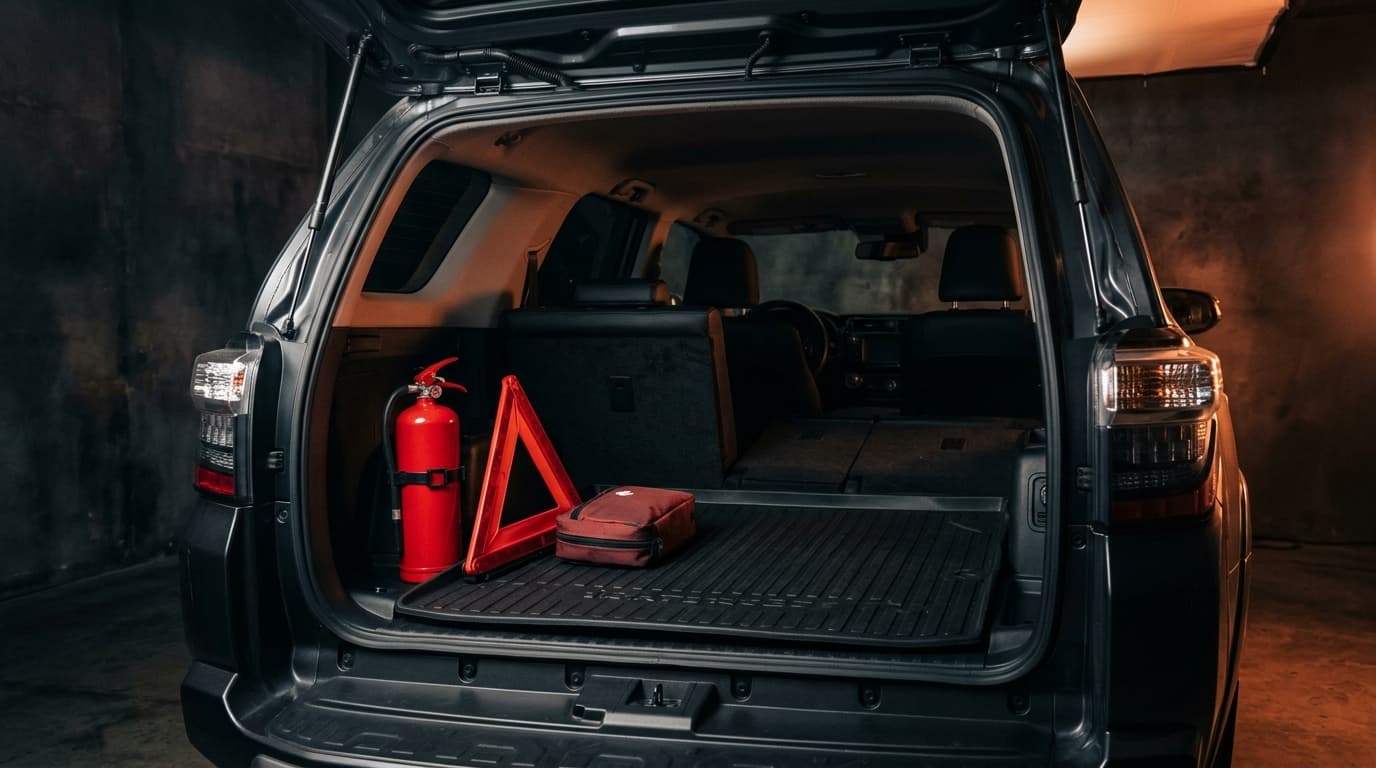
A car registered in Belgium must carry a fire extinguisher, a warning triangle and a first-aid kit, and its driver must put on a high-visibility vest when leaving a broken-down car on a motorway. The rule dates from 1968. The extinguisher and the kit cost under 23 € together in a Belgian shop, and the most common mistake is free: keeping the extinguisher in the boot.
Four items, one text from 1968
It all comes from the royal decree of 15 March 1968, Belgium's vehicle technical regulation, which most pages on the subject never cite. Three of its articles are enough. Article 70 requires the extinguisher and the triangle, article 70bis deals with the retroreflective safety vest, and article 71 describes the first-aid box. The table of contents published on codedelaroute.be (in French) files them under chapter VII, "Fittings".
Shops often sell a kit "compliant with the royal decree of 28 March 1968". That is not another text: 28 March 1968 is the date the decree of 15 March was published in the Belgian Official Gazette. Same source, two dates, and a confusion that ends up on the packaging.
| Item | Requirement for a car | Text | In practice |
|---|---|---|---|
| Fire extinguisher | on board, in date | royal decree of 15 March 1968, art. 70 | 1 kg minimum up to 3.5 t, seal intact, fixed inside the cabin |
| Warning triangle | on board | royal decree of 15 March 1968, art. 70 | placed at least 30 m away, 100 m on a motorway |
| First-aid kit | on board, complete | royal decree of 15 March 1968, art. 71 | a standard kit is enough outside taxis, buses and heavy goods vehicles |
| High-visibility vest | to be worn after a breakdown or accident on a motorway or expressway | royal decree of 15 March 1968, art. 70bis, and Highway Code | one vest within reach of the driver's seat |
Sources: federal police (in French, page of 18 March 2021, updated on 14 January 2025); Ethias fact sheet on mandatory accessories (September 2024, in Dutch) for extinguisher weights and the difference between a kit and a box.
Belgium is the exception here. According to Wikipedia (in French), it was probably the first country to require a triangle in every motor vehicle, and it remains one of the few in Europe to require an extinguisher in a private car.
Is a fire extinguisher really mandatory in a private car?
Yes. The federal police repeat it in two pages published in 2019 and 2021, and the 1968 text makes no distinction between a company car, a family car and a van.
The doubt comes from elsewhere. On 14 July 2025, the French-language edition of AutoScout24 Belgium wrote that an extinguisher was not legally required in a private car and only concerned light vans, taxis and some trucks. Its Dutch-language edition, dated 28 May 2025, says the opposite and adds that the obligation has existed "since 2019". Both pages are wrong, each in its own way: the obligation covers every car, and it is far older.
The requirements fit in four lines. The Ethias sheet sets the weight by maximum authorised mass: 1 kg up to 3.5 t, which covers any SUV you can drive on a B licence. The device must be "bedrijfsklaar", ready for use, so dated and sealed, and kept in a visible, easy-to-reach bracket. The federal police add that the driver must be able to grab it in under 10 seconds, that it must be firmly fixed inside the cabin, and that the boot will not do.
That is the trap. In a family SUV, the boot is the natural place for anything bulky, and it is also the one you can no longer open once it is full of suitcases, a pushchair and shopping bags. An extinguisher stuck under 40 kilos of luggage does not meet the rule, and it is useless when a fire starts under the bonnet.
Its lifespan matters as much as its presence. The federal police mention 5 to 6 years from manufacture, and advise checking the device for the first time after the first technical inspection, so around the fourth year of a new car. An SUV bought new in 2021, with the extinguisher supplied by the dealer, may already be driving around with an expired device, and nothing on the dashboard will tell you.
One last point, often overlooked at purchase: according to comparateur.be (in French, page modified on 26 September 2024), a professional seller must deliver the car, new or used, with an extinguisher. A private individual selling a car has no such obligation. After a private purchase, look under the seat before driving off.
BC or ABC powder: what are the extinguishers sold in Belgium worth?
On 27 October 2026 we checked the 1 kg and 2 kg extinguishers sold online by four chains present in Belgium. Prices include VAT, as displayed that day.
| Product | Shop | Classes | BENOR mention | Bracket | Price |
|---|---|---|---|---|---|
| Carpoint 1 kg powder | Auto5 | BC | not shown on the product page | not stated | 14.99 € (reduced) |
| Belmic 1 kg powder | Trafic | ABC | BENOR V | included | 17.99 € |
| Car extinguisher 1 kg | Auto5 | ABC | not shown on the product page | not stated | 19.99 € |
| Auto5 1 kg with pressure gauge | Auto5 | ABC | not shown on the product page | not stated | 22.99 € |
| Belmic 1 kg powder | Mr Bricolage | BC | "Benor" in the name | not stated | 22.99 € |
| Osec 1 kg powder | Gamma | BC | "BENOR 2028" | not stated | 24.49 € |
| Car extinguisher 2 kg with pressure gauge | Auto5 | ABC | not shown on the product page | included | 29.99 € |
Sources: product pages consulted on 27 October 2026, including Trafic and Gamma. The Gamma page also shows 20.24 € in its metadata; we use the visible price.
The figure that matters: four products out of seven only cover classes B and C, liquid and gas fires. Class A means fires in solids, so the seats, carpets and textiles of the cabin. A BC device is still compliant, it weighs the required kilo, but it is less versatile than an ABC sold at the same price.
Second surprise: none of the four Auto5 product pages mentions the BENOR label, even though the chain's category page reminds you to insist on one. The label is read on the device, not on the screen. The supplier ProtectionIncendieShop states that a BENOR V label also signals a maximum validity of 5 years.
Five things to read on the label before paying:
- the weight of extinguishing agent, at least 1 kg for a car;
- the class letters, ABC rather than BC;
- the BENOR V label and the year until which the device is valid;
- a mounting bracket in the box, otherwise add its price;
- a pressure gauge, which shows at a glance whether the device is still pressurised.
Should you go for foam, which comparateur.be recommends because it damages upholstery less than powder? In principle, yes. In our check, none of the seven products is a foam extinguisher.
The first-aid kit, a list unchanged since 1968
The kit is mandatory, and so is its content. The federal police refer to article 71 of the royal decree, whose first paragraph describes the "universal type" first-aid box required in taxis and paid passenger transport. The Ethias sheet specifies that a private car can make do with a standard kit, whose minimum content is set by the same decree.
The reference box contains three sterile triangular bandages, three cambric bandages of 5, 7 and 10 cm, three 10 g packs of cotton wool, a 5 cm elastic tourniquet, ten safety pins and ten ampoules of iodine alcohol with their file. The ampoule file says enough about the age of the text.
A "legal" kit sells for 4.99 € at Auto5 on 27 October 2026. It ticks the box. In practice, that means a box that handles a scratch and little more. The federal police advise adding compression dressings to slow heavy bleeding, and comparateur.be mentions scissors, gloves and a space blanket. Allow a few more euros, and check once a year that nothing has been raided for a child's grazed knee.
Triangle and vest: 30 metres, 100 metres, a vest to wear
The triangle goes at least 30 metres behind the stopped vehicle, and 100 metres on a motorway, according to the federal police. If the location does not allow it, you place it closer, or even on the vehicle.
The vest is the only one of the four items where the obligation concerns the act rather than the presence. In April 2019 the federal police wrote that carrying one was not mandatory, but that a driver stopped where stopping is prohibited must wear one to get out. The Ethias sheet targets leaving a broken-down vehicle on a motorway or expressway. Nobody chooses where they break down: keep a vest within reach.
Does the technical inspection check the extinguisher?
It depends on the Region, and it is the only point where regionalisation changes anything. The equipment rules are the same in Brussels, Wallonia and Flanders; the technical inspection, however, is organised by each Region, and not every body publishes its checkpoints.
| Region | Equipment required on board | Periodic inspection | Source consulted on 27 October 2026 |
|---|---|---|---|
| Flanders | extinguisher, triangle, kit, vest to be worn | extinguisher listed but marked (X), so not checked | KM list "Wat keurt KM precies?" (in Dutch) |
| Wallonia | identical | no public list of checkpoints | AIBV preparation page (in French), silent on the subject |
| Brussels | identical | no public list of checkpoints | same |
KM's list places the extinguisher in section 7, "miscellaneous equipment", with the note "presence, compliance with requirements", followed by an (X). The key is clear: every point is checked except those marked with an (X). The triangle and the vest do not appear.
Several websites claim the opposite, without citing any text. The supplier Brandbeveiligingshop writes that the extinguisher must be present at inspection, and AutoScout24 that the pre-sale inspection would fail the car. We found no official Walloon or Brussels source to settle it, either for periodic inspection or for the pre-sale check. In principle, do not count on the station to flag an expired extinguisher: a police check at the roadside will.
And the fine? No official page we consulted gives an amount for a car. The distributor Logistiek Direct mentions 350 € per missing extinguisher, with no reference to the text and no detail on the type of vehicle. We do not use that figure as a scale.
A foreign car in Belgium, a Belgian car abroad
The rule follows the plate. The table published by Hubo states that the extinguisher and the kit do not apply to foreign-registered cars, but do apply to cars rented in Belgium. A Dutch tourist does not need to equip their car at the border, and a Brussels rental company must supply the full kit.
The other way round, the Belgian kit covers most neighbouring countries, with two differences that matter for a family.
| Country | Mandatory in a private car | Difference from Belgium |
|---|---|---|
| France | triangle, vest for the driver | no extinguisher; Crit'Air sticker required in cities with a low-emission zone |
| Germany | triangle, first-aid kit, vest for the driver | no extinguisher |
| Luxembourg | triangle, vest for every occupant | extinguisher and kit only above 3.5 t |
Source: country table from comparateur.be (26 September 2024). For France, check the cities concerned on the official Crit'Air website (in French) before leaving.
Luxembourg is the surprise: with two adults and three children on board, you need five vests. Children's sizes exist, and they fit in a door pocket.
France also explains much of the confusion about extinguishers in French-language writing. They are not mandatory in private cars there, a proposal to make them mandatory drew attention in the summer of 2025, and most French-language guides are written from Paris or Lyon for French drivers. A driver from Liège or Namur who reads "an extinguisher is not mandatory" on a French site is reading an accurate sentence, just not one that applies to them.
The kit we would fit in a family SUV
A 1 kg ABC extinguisher with a BENOR V label and a bracket included, screwed to the foot of the passenger seat, for under 20 € at the 27 October check. A legal first-aid kit topped up with two compression dressings, gloves and a space blanket, slipped under a seat or into the centre console. One vest per adult in the front doors. And the triangle in the side compartment of the boot or under the floor, but never under the load.
To avoid: the cheapest BC extinguisher, thrown loose into the boot, bought once and forgotten until the car is sold.
The last tip costs nothing. The day you fit three child seats across or a roof box, redo the 10-second test: a child seat behind the passenger can make the extinguisher unreachable. Before your next technical inspection, also look at the date on the label, since nobody else will. And if you are still torn between two models to carry the whole family, our comparison tool puts their boots side by side.
Frequently asked questions
In which countries is a fire extinguisher mandatory in a car? In Belgium, for every car registered here, and in Poland, according to the table published by comparateur.be in September 2024. Luxembourg only requires one above 3.5 t, and France does not require one in private cars: a proposal to that effect circulated in 2025 without becoming law. In principle, a foreign-registered car crossing Belgium is not bound by the Belgian rule.
Where should the extinguisher be fixed in an SUV? Inside the cabin, on a screwed bracket, somewhere the driver can reach in under 10 seconds: that is the federal police guideline, which rules out the boot. The foot of the passenger seat is the most common spot, provided it does not obstruct the seat rail, the pedals or a side airbag. Check the owner's manual before drilling anything.
How many high-visibility vests do you need in a car in Belgium? Only one is required in practice, for the driver who has to get out after a breakdown or accident on a motorway or expressway. For a family, one vest per adult is safer, and in Luxembourg one per occupant is mandatory. Keep them in the door pockets, not in the boot.
Frequently asked questions
In Belgium, for every car registered here, and in Poland, according to the table published by comparateur.be in September 2024. Luxembourg only requires one above 3.5 t, and France does not require one in private cars: a proposal to that effect circulated in 2025 without becoming law. In principle, a foreign-registered car crossing Belgium is not bound by the Belgian rule.
Inside the cabin, on a screwed bracket, somewhere the driver can reach in under 10 seconds: that is the federal police guideline, which rules out the boot. The foot of the passenger seat is the most common spot, provided it does not obstruct the seat rail, the pedals or a side airbag. Check the owner's manual before drilling anything.
Only one is required in practice, for the driver who has to get out after a breakdown or accident on a motorway or expressway. For a family, one vest per adult is safer, and in Luxembourg one per occupant is mandatory. Keep them in the door pockets, not in the boot.
We dig through the Belgian market data — TÜV reliability, real-world ADAC consumption, company-car taxation, list prices — to call it straight. No brand pays us.