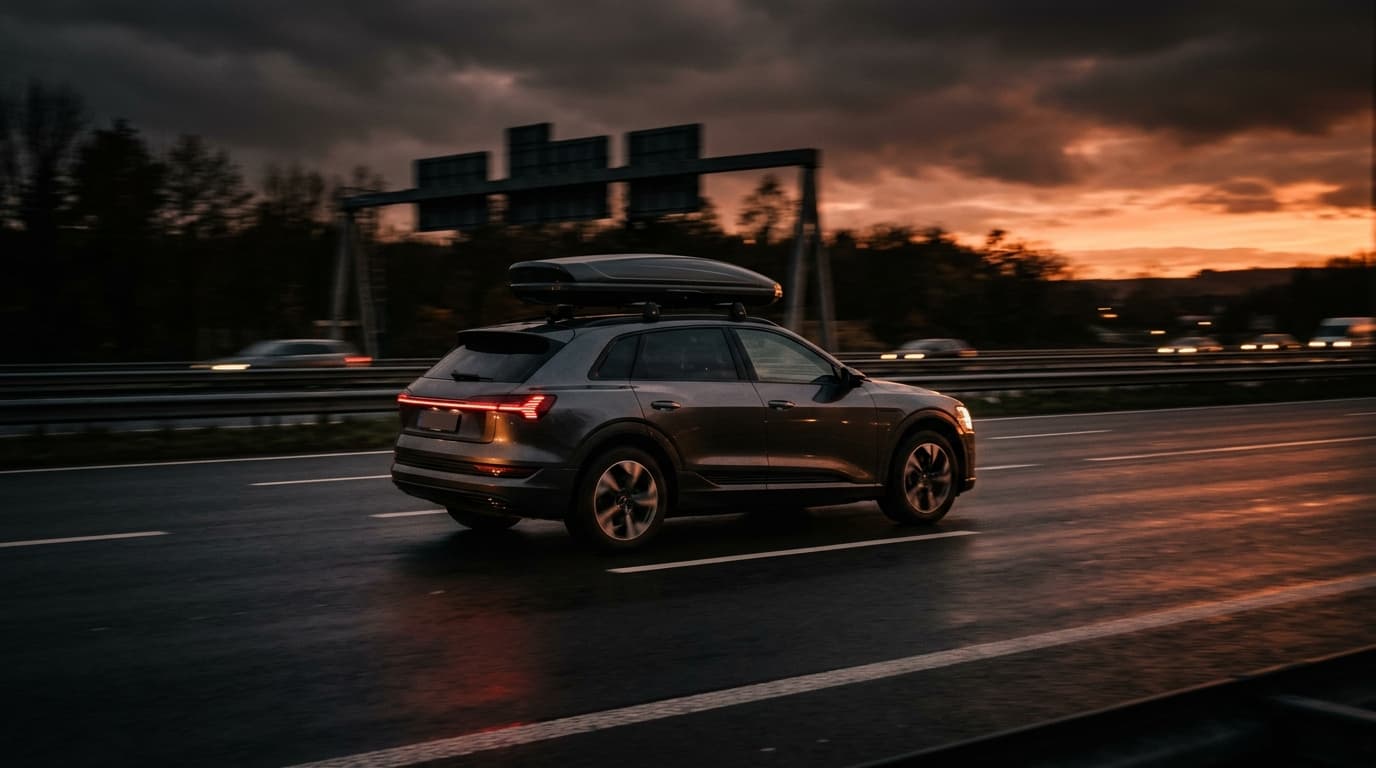
Between 7 and 26% extra consumption, according to five public tests. A roof box therefore takes 25 to around a hundred kilometres of range off an electric car. On an SUV, the relative loss tends to be low; the real price is one more charging stop on the road to your holiday.
How much range does a roof box cost an electric car?
The figures doing the rounds run from "10 to 20%" to "up to half", rarely with a source. We gathered the five public measurements we could trace back to a protocol, two of them carried out in Belgium.
| Test (source, date) | Car | Conditions | Without box | With box | Difference |
|---|---|---|---|---|---|
| VAB and Thomas More, Zolder circuit (published 16 June 2026) | Suzuki e Vitara, ten identical cars | 300 km between 50 and 100 km/h | 20.7 kWh/100 km | 22.2 kWh/100 km | +7% |
| Peugeot e-308 SW (Caradisiac, 31 January 2024) | compact estate, 51 kWh usable | motorway, 126 km/h average, 4 °C | 22.8 kWh/100 km | 25.7 kWh/100 km | +12.7% |
| BMW iX xDrive50 (auto motor und sport, July 2023) | large SUV | constant 100 km/h, Bosch test track at Boxberg | 19.7 kWh/100 km | 22.3 kWh/100 km | +13% |
| Audi Q4 Sportback e-tron (Auto 5, published July 2025) | compact SUV | E42, cruise control, three runs of just over 100 km | not published | not published | +23% |
| Polestar 2 (auto motor und sport, July 2023) | raised saloon | constant 100 km/h, same track as the iX | 19.3 kWh/100 km | 24.3 kWh/100 km | +26% |
The first instinct is to look for the average. It means nothing here. The gap runs from one to four times, and it has nothing to do with battery size or brand: it comes down to two things you can read in the conditions column and the car column. Speed first, since the VAB test (in Dutch), capped at around 100 km/h on a circuit, gives the lowest figure, while Auto 5's test on the E42, at Belgian motorway speed, gives one of the highest. Body shape next, and that is the point almost nobody makes.
On the combustion side, the benchmark remains the ADAC test of ten roof boxes (in German): a diesel Volkswagen Touran uses about 18% more at 130 km/h with a box on the roof. That figure lands right in the middle of the electric range.
An EV suffers no more than a diesel, in percentage terms
The claim you read everywhere says the opposite: an electric car is supposed to be more sensitive to a roof box than a combustion car. The measurements do not back it up.
The best clue comes from the auto motor und sport test reported by ecomento on 12 July 2023 (in German), because it ran a combustion car on the same track, at the same speeds, with the same load as two EVs. With a roof box and a loaded bike carrier together, at 100 km/h, the Mercedes C 220 d estate went from 4.2 to 5.5 litres per 100 km, about 31% more. The BMW iX, in the same set-up, took 19%. The Polestar 2, 37%. The diesel sits between the two EVs, not above them.
That makes sense once you look at what a box does. It adds drag, a force that slows the car and grows with the square of speed, as the ADAC points out in its Kia EV6 test (in German). That force is the same under an electric car and a combustion car of the same shape. What changes is what pushes against it.
The 90% efficiency objection
It deserves a closer look, because it is not wrong. An electric motor turns more than 90% of the battery's energy into motion, a combustion engine around a third. At 120 km/h, an EV therefore spends most of its energy pushing through the air, since it wastes very little as heat, and any added drag weighs heavily on such a lean budget. Regenerative braking changes nothing here: it recovers part of the energy spent accelerating, never the energy lost to the wind.
On a very aerodynamic car, the objection holds. The Polestar 2, low and slippery, takes 26% with the box alone, the worst figure in the table.
But it forgets the combustion engine. That engine works more efficiently when asked for more effort, and part of the added drag is absorbed by efficiency that improves. The two effects cancel out, which is why the auto motor und sport diesel falls between the iX and the Polestar. We therefore keep a narrower version of the claim: a box costs a lot, in percentage terms, on a car that cuts through the air well, whatever its powertrain.
Why does an electric SUV cope better than a low saloon?
Because it already pushes a large frontal area. The BMW iX has a drag coefficient of 0.25 for a frontal area of 2.82 m², according to the data published with the test. Before anything goes on the roof, it is moving a lot of air. The box adds its own resistance, but that resistance is a smaller share of the total than on a lower car. Hence 13% for the iX against 26% for the Polestar 2, in the same test, at the same speed, with almost identical baseline consumption.
It is only partial comfort. The SUV loses less in percentage terms because it was already using more. Auto 5's Audi Q4 Sportback, an SUV too, takes 23%: at motorway speed, on an open road, with a box whose model is not specified, the body shape no longer protects much. And the ADAC measured 0.35 litres per 100 km between the most and least efficient box in its test, at 130 km/h, on the same roof. The choice of box weighs almost as much as the choice of car.
The real cost is one more stop: a Brussels to Montpellier worked out
In euros, the bill is modest. In time, less so, and it comes in steps.
We took an electric SUV with 77 kWh usable, a common figure in the segment, and consumption of 22 kWh/100 km at 120 km/h without a box. That consumption is an assumption, not a measurement: it sits between the iX's 19.7 kWh at 100 km/h and the e-308 SW's 22.8 kWh at 126 km/h in winter. Departure with a full battery, charging from 10 to 80%, roughly 1,000 kilometres to Montpellier. Price of the extra energy: 0.77 € per kWh, the standard rate shown on Fastned's tariffs page for Belgium, read on 1 November 2026.
| Set-up | Consumption | First leg | Following legs (10 to 80%) | Charging stops | Extra energy, one way | Extra cost, return |
|---|---|---|---|---|---|---|
| No box (assumption) | 22.0 kWh/100 km | 315 km | 245 km | 3 | 0 kWh | 0 € |
| +7% (VAB) | 23.5 kWh/100 km | 294 km | 229 km | 4 | 15.4 kWh | 23.72 € |
| +13% (BMW iX) | 24.9 kWh/100 km | 279 km | 217 km | 4 | 28.6 kWh | 44.04 € |
| +23% (Audi Q4, Auto 5) | 27.1 kWh/100 km | 256 km | 199 km | 4 | 50.6 kWh | 77.92 € |
The surprising result is in the fifth column. The most favourable scenario, VAB's, is enough to tip the trip from three to four stops, because three legs of 229 km no longer cover the remaining distance. Beyond that, the box adds no further stop on this particular trip: it shortens every leg and lengthens every charge. Auto 5 reached the same conclusion for a Brussels to Nice run, roughly one more charge and 80 € return, very close to our last line.
The extra cost is a ceiling, since we bill all the extra energy at a fast charger's rate without a subscription. Part of it will be charged at home, for less.
For comparison, the auto motor und sport diesel Mercedes, with box and bikes at 130 km/h, still had 846 km of range per tank. The diesel pays for the box in litres. The EV pays for it in minutes at a motorway service area, and that is the difference the percentages hide.
Should you choose a tow-bar cargo box instead?
If your electric SUV has a tow bar, yes, and both Belgian tests point the same way. VAB measured +3% with a tow-bar box against +7% on the roof. Auto 5 found 1.8% against 23% on its Audi Q4, and no extra travel time. The rear box stays in the car's slipstream instead of sticking up above the roof.
Before loading the roof of an electric car, five checks:
- the maximum roof load in the owner's manual, bars and empty box included, covered in our article on the real load of a roof rack;
- the towing capacity and permitted vertical load on the tow bar, if you are considering a rear box;
- the total height with the box fitted, against underground car parks at 2.00 m;
- a route planner set with increased consumption, not the manufacturer's default value;
- removing it when you get back, since the box costs the same empty.
No Belgian region taxes a roof box or a tow-bar box, and no rule changes between Wallonia, Brussels and Flanders. A trailer falls under a completely different regime, covered in our article on trailer road tax by region.
The baseline figures for a combustion car are in our article on roof box fuel consumption, the cold-weather loss in the one on electric SUV range in winter, and to pick a model by battery and boot, the comparison tool filters both.
Our verdict for a holiday departure
Take the box if you need it, knowing what it costs: one more stop over 1,000 km and between 25 and 80 € return. Below 100 km/h, an electric SUV stays at the low end of the range; at 120 km/h, count on around 20%.
With a tow bar, the rear box wins both Belgian tests.
Sources: VRT NWS on the VAB test, 16 June 2026 (in Dutch), EV Update on the same test, 17 June 2026 (in Dutch), VRT NWS on the Auto 5 test, July 2025 (in Dutch), Caradisiac, 31 January 2024 (in French), ecomento on the auto motor und sport test, 12 July 2023 (in German), ADAC roof box test (in German), ADAC, Kia EV6 with bike carrier and trailer, 9 August 2022 (in German), Fastned tariffs, read on 1 November 2026.
Frequently asked questions
Almost, on the motorway. The auto motor und sport and Caradisiac measurements were made with an empty box, and they already show 13 to 26% extra consumption at 100 km/h and above. Weight matters mostly at low speed and in town, where regenerative braking recovers part of it.
Yes. Its drag does not depend on what is inside, and it costs range on every fast journey of the year. On an electric SUV, leaving the box and bars on is like driving all year with a smaller battery.
In percentage terms, not necessarily: Caradisiac measured +12.7% at 4 °C on a Peugeot e-308 SW. In kilometres, yes, because baseline consumption is already higher in cold weather and the starting range is shorter.
In Belgium, the motorway limit is 120 km/h, and every step below it pays. VAB, the Belgian motoring organisation, points out that the faster you drive, the more poor aerodynamics weigh on consumption: speed is what turns a 7% gap into more than 20%.
We dig through the Belgian market data — TÜV reliability, real-world ADAC consumption, company-car taxation, list prices — to call it straight. No brand pays us.