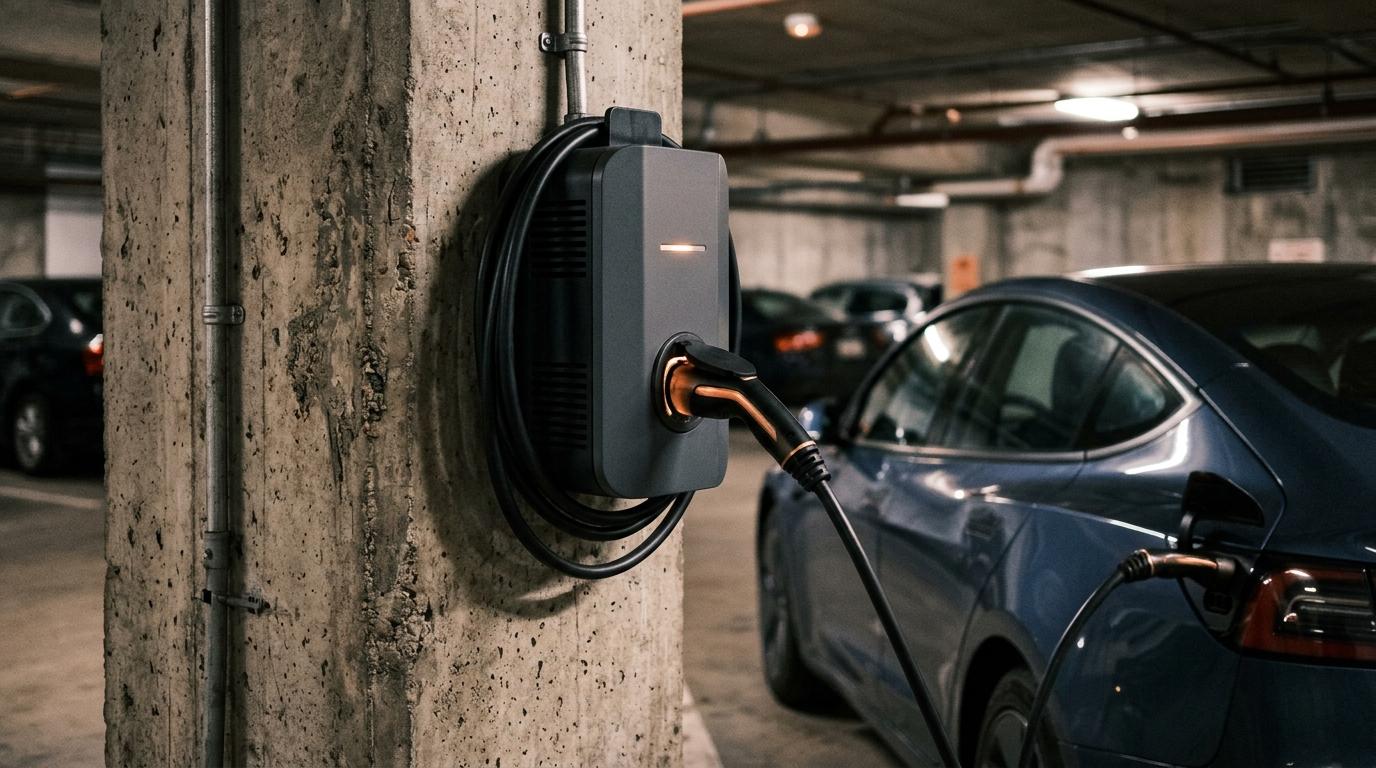
Yes, and without waiting for the general meeting. Since the 2018 reform, now article 3.82 §2 of the Civil Code, a Belgian co-owner can run a charger's cables through the common parts at their own cost. They notify the syndic by registered letter two months ahead. The others can only object on a legitimate ground.
Can you install an EV charger in a co-owned building without the general meeting's approval?
Yes, for an individual charger you pay for yourself. That is our thesis, and it often surprises people: Belgian law does not need a French-style "right to plug in" (droit à la prise), because it has contained a broader one since 2019.
Most pages on the subject are written for France. They talk about a general meeting vote, a three-month deadline, Enedis and "reinforced sockets". None of it applies to a building in Liège, Ixelles or Ghent.
In the Belgian market, the rule comes down to three cumulative conditions, all read in the text of article 3.82 §2:
- the works concern cables, ducts and associated equipment, in or on the common parts;
- they optimise the infrastructure serving your private parts in the field of energy, water or telecommunications, and a charger on your parking space falls under the first;
- the other co-owners bear no financial burden.
Meet all three and no majority is required. You remain the owner of the installation, even if it crosses the meter room and the car park ceiling.
Article 3.82, a rule few building managers mention
The text dates from the law of 18 June 2018, which rewrote the former article 577-2 of the Civil Code. It was carried over unchanged into Book 3 of the new Civil Code, in force since 1 September 2021. It was aimed first at fibre optics, which is probably why it is rarely linked to chargers: yet the word energy is there in black and white, next to water and telecommunications.
The procedure is precise, and this is where projects fail. You send a registered letter to the syndic, or to every co-owner if there is no syndic, at least two months before the works start. It states your address, describes the works and justifies the optimisation. In practice, that means a one-page letter with the electrician's quote and a plan of the cable route between your meter and your space.
The figure that matters: two months. A letter received by the syndic on 1 December 2026 opens an objection period until 1 February 2027, and the works cannot start before that date.
After that, the co-owners lose the right to object. The text says so "on pain of forfeiture".

What majority does a shared installation need?
Everything changes once the owners' association invests. A shared installation, with a main cable in the car park and a load management system, is work affecting the common parts: article 3.88 §1 then requires two thirds of the votes of the co-owners present or represented.
There is one exception, and Brussels makes it very real. Works required by law are decided by absolute majority. When a regulation obliges the building to equip its car park, the threshold therefore drops from two thirds to half plus one vote, a reading also put forward in the ASVEDEC guide published on 10 August 2026.
A well-run shared project is often smarter than a string of individual chargers. But it needs a vote, a budget and months. The individual charger needs a letter and some patience.
Brussels, Wallonia, Flanders: three regimes for the same car park
The Civil Code is federal, so it is the same everywhere. Equipment obligations are regional, and they differ sharply. We compared the three regions' texts on 16 November 2026.
| Situation | Brussels | Wallonia | Flanders |
|---|---|---|---|
| Individual charger at your own cost (art. 3.82 §2) | 2 months' notice, no vote | 2 months' notice, no vote | 2 months' notice, no vote |
| Existing car park of a residential building | Since 1 January 2025, 1 charging point per space of a resident who drives electric, in covered car parks with at least 10 spaces | No general obligation for a small building; above 20 spaces, obligation from 1 January 2025 to be checked (see below) | No obligation without a major renovation |
| New building | Under the environmental permit | Ducts for every space above 10 spaces (permits filed since 11 March 2021) | Ducts for every space from 2 spaces (since 11 March 2021) |
| Major renovation | Under the permit | Ducts for every space above 10 spaces | Ducts for every space above 10 spaces |
| Fire rules specific to car parks | Order of 29 September 2022: no fast charging above 50 kW without the fire service's opinion, emergency stop at the entrance, power cut if fire is detected | No specific regional rule found for residential buildings | No specific regional rule found for residential buildings |
| Declaring the charger to the grid operator | Sibelga, fine of up to 460 € | ORES or Resa, fine of at least 250 € | Fluvius, fine of 117.68 € |
The Brussels line is the strongest of the three. According to the Brussels Environment page on covered and underground car parks (in French), any covered car park with at least 10 spaces needs an environmental permit, and its holder must install a charging point on the space of a resident who reports owning an electric car, "within a reasonable time". In Brussels, the question is no longer whether the building can refuse: it has to provide.
Flanders is the clearest the other way. The Flemish Region's official page (in Dutch) says it plainly: for an existing residential building without a major renovation, there is "no obligation" for a charging point or ducts. A Flemish co-owner can only rely on article 3.82.
Wallonia sits in between, with one grey area. The summary by the Union of Walloon Towns and Municipalities (UVCW) (in French), updated on 20 September 2023, mentions an obligation from 1 January 2025 for existing buildings with more than 20 spaces that are "mainly non-residential or collective housing": one charging point and ducts for one space in five. The original European text was aimed mainly at non-residential buildings. Before using it as an argument with your syndic, ask the Walloon energy administration (SPW Énergie) to confirm your building is covered.
The syndic's objection: "the building's power supply can't cope"
It is the argument you hear most, and it is not wrong. A building from the 1970s was sized for cookers and washing machines, not for ten cars charging at 11 kW at the same time after work.
But it targets a shared installation, not yours. A charger connected to your private meter draws on your own connection capacity, which you pay for. The car park knows nothing about it. If your meter is too weak, it is your contract that needs upgrading, and the building does not have to bear the cost.
The objection becomes serious again in two cases. First, when the meter room is full or the cable has to cross a fire wall: an objection on safety grounds is then admissible, and the justice of the peace will decide if you disagree. Second, when several neighbours have the same plan in the same year, because five parallel cables in the same ceiling no longer optimise anything. The three grounds for objection the law accepts are exhaustive:
- similar infrastructure already exists in the common parts concerned;
- the works cause serious harm to the building's appearance, use, hygiene or safety;
- the works bring no optimisation, or place a financial burden on the other co-owners.
Our reading: from three or four candidates, a shared installation with load management becomes the best option for everyone. Below that, an individual charger on a private meter remains the shortest route, and the hardest to block.
How much does a charger in a building car park cost?
No regional grant covers it today. The ASVEDEC guide points out that the federal tax reduction for fixed chargers ended for expenses incurred after 31 August 2024, and that Brussels has no grant for private individuals.
| Item (Bobex ranges, page read on 16 November 2026) | Amount |
|---|---|
| Wallbox, excluding fitting | 300 to 3,000 € |
| Fitting by the electrician | 100 to 500 € |
| Compliance inspection of the installation | 100 to 200 € |
| Upgrading the electrical connection | 160 to 1,200 € |
In an apartment building, the line that grows is rarely the charger. It is the cable: the distance between your meter and your space, sometimes two floors and fifty metres of cable tray, moves the bill more than the choice of box. Ask for a quote that prices the route per metre.
How do you proceed, from the registered letter to the declaration?
- Check in the deed of division that your space is private property, and locate your meter.
- Have an electrician draw up a quote and a plan of the cable route, sizing the charger to your available power.
- Send the registered letter to the syndic at least two months before the works, with your address, a description of the works and the justification.
- Wait for the objection period to end. With no objection, start the works; if there is one, talk it through, then go to the justice of the peace if it seems unfounded.
- Have the installation inspected and declare the charger to Sibelga, ORES, Resa or Fluvius, depending on your address, as Test-Achats pointed out on 27 February 2026 (in French).
To avoid: having the charger fitted during the objection period because "nobody replied". The two months run from receipt by the syndic, not from sending.
For life without a charger at all, our selection of electric SUVs without a home charger remains the reference, and choosing a Type 2 charging cable comes up from day one. Before buying a large electric SUV for an underground car park, also check the clearance height, then compare batteries in the comparison tool.
Our verdict
Send the letter. An individual charger on your own meter, paid for by you, needs no majority in Belgium, and the building can only object on three specific grounds. In Brussels, a car park with at least 10 spaces is even obliged to equip you. In Flanders, article 3.82 is your only lever: use it.
Sources: Civil Code, article 3.82 §2 and article 3.88, consolidated text published by eJuris (in French), Brussels Environment, covered and underground car parks (in French), Brussels Environment, car parks and charging, 5 April 2024 (in French), Vlaanderen.be, charging obligations in car parks (in Dutch), UVCW, energy performance electromobility requirements, 20 September 2023 (in French), ASVEDEC, EV charger in a Brussels co-owned building, 10 August 2026 (in French), Test-Achats, declaring chargers, 27 February 2026 (in French), Bobex, price of a home charger (in French).
Frequently asked questions
No. The syndic receives the registered letter and passes it on, but does not decide. Only the co-owners or the owners' association can object, within two months, and on one of the legitimate grounds set out in article 3.82 §2 of the Civil Code. Outside that framework, a refusal can be challenged before the justice of the peace.
In practice, yes. The charger is fixed on your space, and only the cable route uses the common parts. On a common space allocated by custom, the status is less clear: have the deed of division (acte de base) checked before sending the letter.
You do, if the charger is connected to your private meter, which is the simplest set-up. On a shared installation, consumption is metered per charger and re-billed, often by the charge point operator, which then pays the association its share.
As a stopgap, it can charge an electric SUV at about 2.3 kW, roughly ten kilometres per hour. For daily use, a 7.4 or 11 kW wallbox is safer and faster, and that is what the declaration to the grid operator is aimed at.
We dig through the Belgian market data — TÜV reliability, real-world ADAC consumption, company-car taxation, list prices — to call it straight. No brand pays us.