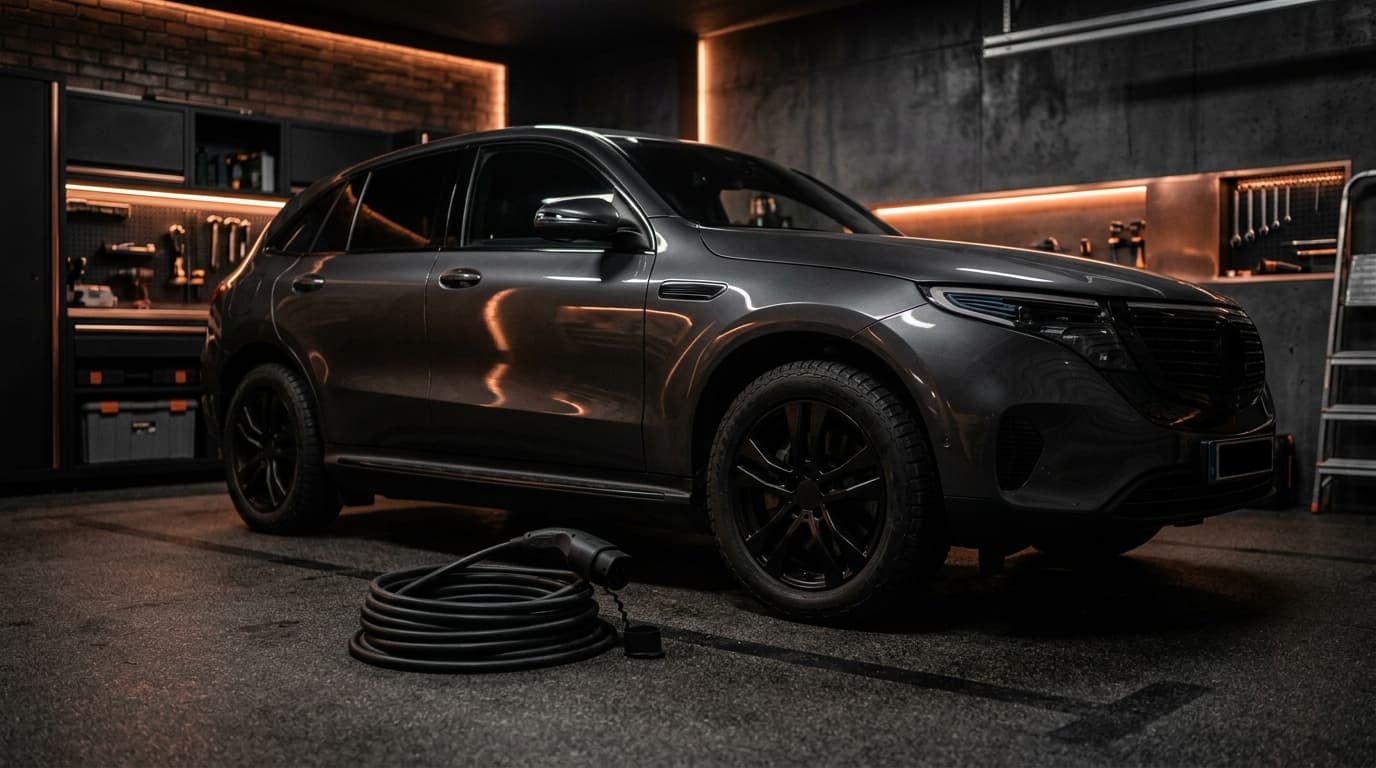
A type 2 cable comes down to three numbers: amperage, number of phases and length. In Belgium a fourth one matters just as much, the voltage of your grid connection. Budget 175 to 240 € for a 5-metre mode 3 cable, prices surveyed at a Belgian retailer on 6 September 2026.
Mode 2 or mode 3: which one do you need?
Both exist, they do different jobs, and an electric SUV usually ends up carrying both in the boot.
The mode 2 cable has a bulky control box in the middle. A household plug on one side, a type 2 connector for the car on the other. That box holds the safety electronics that talk to the vehicle and cut the current on a fault, because an ordinary wall socket has none of that. It tops out at 8, 10 or 16 amps depending on the setting, so 1.8 to 3.7 kW. On a 77 kWh SUV, a full night puts back around thirty kilowatt-hours: enough for a commuter's daily runs, not for a weekend in the Ardennes.
The mode 3 cable has no box. Type 2 at both ends, the intelligence lives in the charge point. That is the one you plug into a wallbox, into a street unit in Ghent or into a motorway service area.
In practice the split is simple. The mode 2 sleeps in the boot for emergencies at a friend's place or a holiday rental, the mode 3 works every day. At Auto5, the portable Norauto type 2 to household socket charger, 6 metres and 3.7 kW adjustable from 8 to 16 A, was listed at 199.95 € on 6 September 2026, which is 25 € above the same brand's entry-level mode 3 cable.
Single-phase 32 A or three-phase 16 A: which type 2 cable for your charge point?
The number that counts is not the power printed on the packaging. It is the amperage per phase and the number of phases. The advertised power describes what the cable's conductors can carry, nothing more: it does not make your charge point faster and it changes nothing about your SUV's on-board charger.
Four configurations cover the entire Belgian market.
| Configuration | Power carried | Price surveyed (Norauto, 5 m, Auto5, 6 Sept.) | Who it suits |
|---|---|---|---|
| Single-phase 16 A | 3.6 kW | 174.95 € | Plug-in hybrid, reinforced Green Up socket |
| Single-phase 32 A | 7.2 kW | 184.95 € | Home single-phase wallbox, the most common case |
| Three-phase 16 A | 11 kW | 189.95 € | 11 kW wallbox on a 3x400 V with neutral connection |
| Three-phase 32 A | 22 kW | 239.95 € | 22 kW public charge points, company cars |
A cable advertised at 22 kW plugged into a 7.4 kW single-phase wallbox charges at 7.4 kW. Not one watt more. And if your SUV's on-board charger tops out at 11 kW on alternating current, still the case for most models sold here, the cable's 22 kW will never be used, except on the day you sell the car and keep the cable. To find out where yours sits, our comparison of electric SUVs in Belgium lists AC charging power model by model.
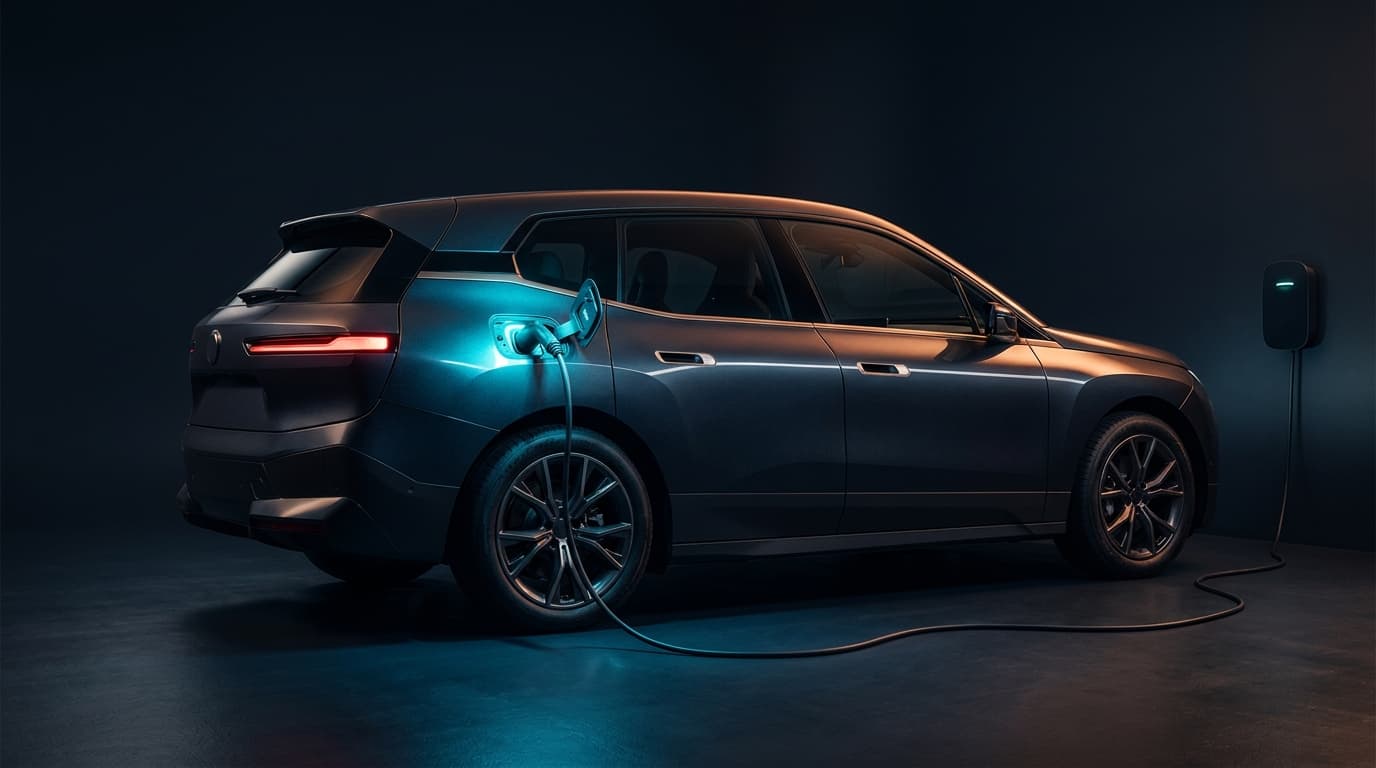
In Brussels, 88 % of the grid will not deliver the three-phase you paid for
Here is the point French guides cannot know, and it flips the answer for a large share of Belgian drivers.
Brugel, the Brussels energy regulator, puts it plainly: the vast majority of the Brussels electricity grid is built on 3x230 V without neutral, for historical reasons, and only 12 % of the grid is supplied in 3x400 V with neutral. Charging at 11 and 22 kW requires precisely that four-wire connection. On the remaining 88 %, a three-phase unit does not behave as advertised, and vehicles that demand 230 V between phase and neutral are asking for a neutral that simply is not there.
Two ways out, neither free. Sibelga, the Brussels distribution grid operator, can upgrade the connection to 400 V with neutral, provided a four-wire grid runs nearby, and the indoor installation then has to be adapted. Or you fit an autotransformer immediately upstream of the charge point, which builds 3x400 V with neutral out of 3x230 V.
In Flanders and Wallonia, 3x400 V with neutral dominates, and Fluvius, ORES and RESA, the regional grid operators, are migrating the remaining 3x230 V pockets as the network is renewed. Dominating is not covering: in the older districts of Antwerp, Liège or Charleroi, 3x230 V is still there. Check your meter or call your grid operator before ordering. Thirty seconds of verification against 50 € of useless cable.
How much does a type 2 cable cost in Belgium?
Between 175 and 240 € for a 5-metre mode 3, and the gap between the bottom and the top of the range is narrower than most people expect.
Surveyed on 6 September 2026 at Auto5, within one Norauto range and one 5-metre length: 174.95 € in single-phase 16 A, 184.95 € in single-phase 32 A, 189.95 € in three-phase 16 A, 239.95 € in three-phase 32 A. Sixty-five euros separate the most modest cable from the most capable one, for six times the power carried. Length costs considerably more than amperage: the 8-metre Blaupunkt type 2 in single-phase 16 A was listed at 279.00 € the same day, 104 € above the 5-metre Norauto at identical amperage.
One detail spotted that day deserves a warning. On the same page, two Norauto references carried contradictory titles and specification sheets: a cable titled "5 m, 22 kW" was described as "three-phase (11 kW)" in its characteristics, and a "5 m, 7.4 kW" as "single-phase (3.7 kW)". Trust the amperage and the number of phases, never the kilowatt figure in the title.
The rest of the Belgian offer fits into a few names. DEFA at 249.95 € in 7.5 metres three-phase 20 A. Juice Technology, whose 22 kW Booster 2 mobile unit was listed at 1,049.00 €, a price that only makes sense for someone constantly switching socket types. Legrand for the reinforced Green Up socket, sold at 199.95 € as a ready-to-fit pack. And Mennekes, the German manufacturer that designed the type 2 connector and gave it its nickname.
Five things to check before paying
- The amperage per phase, 16 or 32 A, and the number of phases: that pair alone determines what the cable carries.
- Usable length. Five metres covers a garage; eight becomes necessary when the charge point sits at the back of a carport and the charging flap on the wrong side.
- The IEC 62196 standard, the one behind the type 2 connector, printed on the plug or stated in the manual.
- Flexibility in the cold. A three-phase 32 A cable is heavy and stiffens in January, exactly when your electric SUV's winter range is already shrinking.
- The storage bag, missing from many entry-level offers, which keeps the boot clean at every plug-in.
Is an RGIE inspection required to charge at home?
For a cable, no. For a fixed charge point, yes.
A mode 2 cable plugs into an existing socket and changes nothing in the installation: no inspection, no paperwork, no electrician's invoice. Fitting a wallbox, on the other hand, adds a dedicated circuit to the consumer unit, and the RGIE, Belgium's general regulation on electrical installations, treats that as a significant modification: it has to be inspected by an approved body. The rate advertised by Belgian inspection bodies started at 135 € including VAT on 6 September 2026.
That inspection is not red tape. Charging an SUV draws 32 amps for six to eight hours at a stretch, a load no domestic installation from the 1980s was ever sized for, and the compliance report is also the document your insurer will ask for after a claim. If you have no private charge point and depend on the public network, our guide to electric SUVs without a home charger covers the question in detail, and the comparison tool lets you filter models by charging power.
The cable supplied with the car is often enough
Open the boot before ordering. Most electric SUVs sold in Belgium leave the dealership with a 5-metre mode 3 type 2 cable, sometimes with a mode 2 alongside it. If your charging happens between your own wallbox and the office car park, a second cable brings you nothing at all. Buy one the day yours turns out too short, or to keep a spare in the household's second car.
Frequently asked questions
A mode 2 cable carries a safety control box in the middle and plugs into a household or reinforced socket: it tops out at 16 amps, or 3.7 kW. A mode 3 cable has a type 2 connector at both ends, no box, and is meant for wallboxes and public charge points, where the electronics sit inside the unit. The first one gets you out of trouble, the second one does the daily work.
Rarely. The cable only carries what the charge point delivers and what the on-board charger accepts. Most electric SUVs sold in Belgium top out at 11 kW on alternating current, and many home wallboxes at 7.4 kW single phase. A 22 kW cable then shortens no charging session at all.
Usually not as intended. Brugel states that the vast majority of the Brussels grid runs on 3x230 V without neutral and that only 12 % is supplied in 3x400 V with neutral, while charging at 11 or 22 kW requires the latter. Two ways out exist: a connection upgrade by Sibelga, the Brussels distribution grid operator, provided a four-wire grid runs nearby, or an autotransformer fitted immediately upstream of the charge point.
Five metres covers a garage or a short driveway. Move up to seven or eight metres if the charge point sits at the back of a carport, if you reverse into your space, or if the charging flap is on the opposite side to the unit. On Belgian public charge points, five metres is almost always enough.
Not for a mode 2 cable plugged into an existing socket. A fixed charge point, however, adds a dedicated circuit to the consumer unit: the RGIE, Belgium's general regulation on electrical installations, treats that as a significant modification and requires an inspection by an approved body. The advertised rate started at 135 € including VAT on 6 September 2026.
We dig through the Belgian market data — TÜV reliability, real-world ADAC consumption, company-car taxation, list prices — to call it straight. No brand pays us.