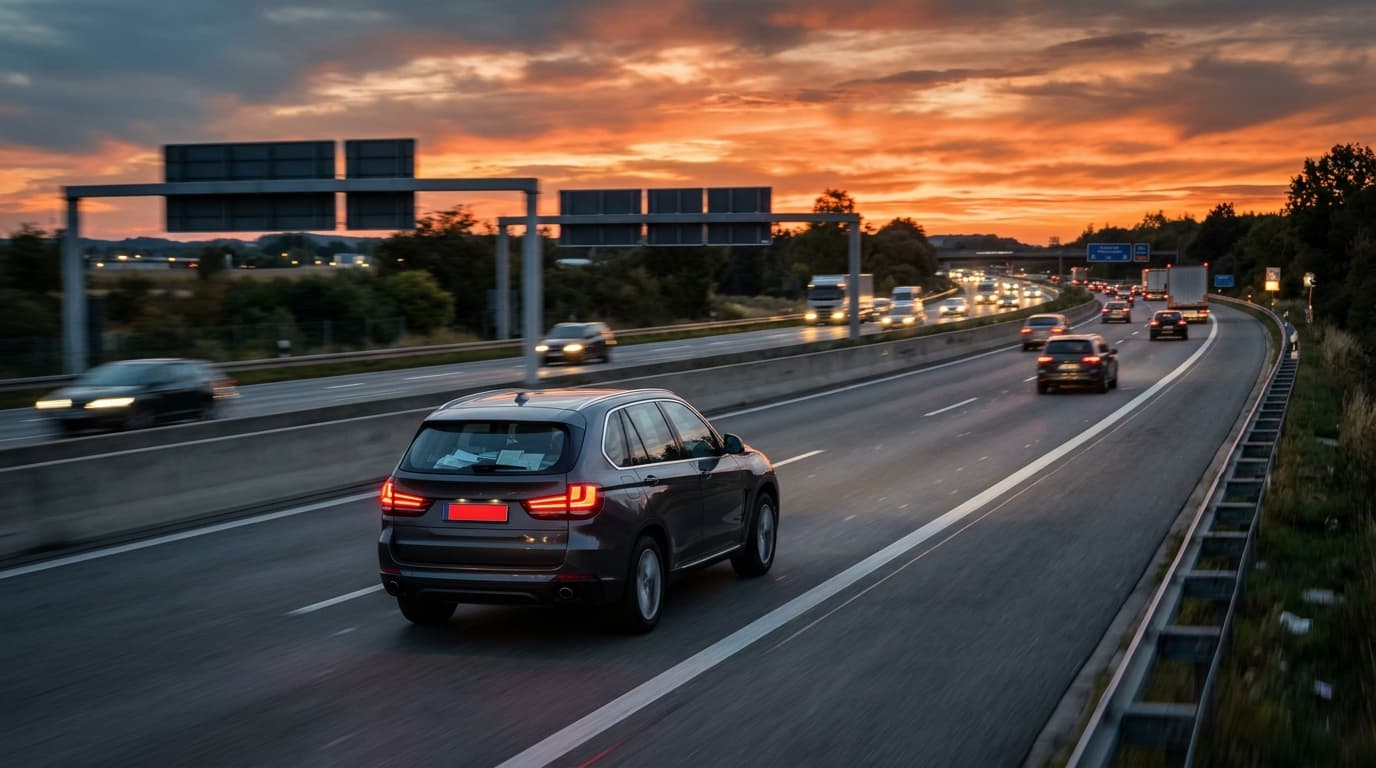
The Belgian transit plate has one job: getting a vehicle out of the country. It costs 75 €, lives for 30 days and is issued at a single counter, in Brussels. That headline price misleads everyone. Once insurance and the technical inspection are added, taking an SUV out costs up to four and a half times the advertised price.
The X plate is for leaving Belgium, and nothing else
People call it a transit plate, an export plate or a provisional plate, and the administration calls it a "short-term temporary plate for export". The official name already says it all.
It has existed in its current form since 1 May 2016. A royal decree of 19 February 2016, published in the Belgian Official Gazette on 21 April, overhauled temporary plates, as summarised by Polinfo (Kluwer) in its note of 25 April 2016 (in Dutch). Since then the export plate starts with an X, carries the last two digits of the year, then three letters, in white on a red background. Two square stickers show the expiry day and month: red for a vehicle in transit, blue for a vehicle under provisional registration.
The figure that matters: 30 days.
That is the default maximum validity, and the plate is cancelled automatically when it runs out. Nobody sends a reminder.
Who qualifies for a transit plate, and why are Belgians almost excluded?
The X plate is designed for people abroad. The X and W plate notice published by the Brussels agency Auto Transit (in French) and the page from DIV-Info (an unofficial site, page of 24 September 2024, in French) list who qualifies:
- a person domiciled abroad, not in the National Register or the waiting register, who bought a vehicle in Belgium to export it;
- a company established in another EU state, without a Belgian company number;
- a Belgian resident moving abroad with a vehicle bought under a VAT exemption;
- a Belgian company transferring a vehicle to its establishment abroad;
- an employee of an international organisation based in Belgium, under an exemption scheme;
- a Belgian resident leaving temporarily for abroad with their car, once a year per holder.
The list excludes the case most Belgians have in mind: buying a used SUV and driving it for a few days before registering it. For that, the X plate does not exist. You go through an ordinary registration, or the national U plate described below.
And the Belgian seller who sells their car to a buyer from Lille or Aachen? They apply for nothing. The buyer, or the agency the buyer hires, files the application in their own name.
What does leaving on an X plate really cost?
Between 250 € and 340 € in most cases, depending on the vehicle's age and the Region where the inspection takes place. The plate accounts for only a quarter to a third of it.
Three items add up. The plate first: 75 € for the front and rear set, certificate included, the same amount at every source consulted. Then transit third-party liability insurance, mandatory, taken out with an insurer licensed in Belgium or established in the destination country, and proven by a yellow sticker in box Z of the form. Finally the technical inspection, for a vehicle over four years old whose certificate is no longer valid.
Insurance is the opaque item. On 21 October 2026 we checked the pages of three transit agencies (Kikitrans, Auto Transit, VDB Transit) and of DIV-Info: none shows a price. The only public order of magnitude comes from compare-assurance.be (in French), which puts the insured plate at around 250 € on average (page updated on 23 January 2025), leaving roughly 175 € for one month's insurance. We use that figure as an assumption, not as a quote.
| SUV situation (2026 rates) | Brussels | Wallonia | Flanders |
|---|---|---|---|
| X plate, certificate included | 75 € | 75 € | 75 € |
| 30-day transit insurance (assumption) | ~175 € | ~175 € | ~175 € |
| Under 4 years, or certificate still valid | ~250 € | ~250 € | ~250 € |
| Over 4 years without certificate: pre-sale inspection | 74.40 € | 89.40 € | 74.40 € |
| Total over 4 years without certificate | ~324 € | ~339 € | ~324 € |
| Car-Pass, paid by a private seller | 11.10 € | 11.10 € | 11.10 € |
The inspection rates are those in force since 1 January 2026, checked at Selectra (in French) and identical to those we published in our article on selling a car without an inspection. The choice of station is free: a buyer who has the car inspected in Brussels rather than Namur saves 15 €.
In practice, it looks like this for a seven-year-old diesel SUV sold in Liège to a Dutch buyer, certificate expired since spring: 75 € for the plate, around 175 € of insurance, 89.40 € of inspection if it goes through in Wallonia. About 340 €, before filling the tank. The seller, for their part, pays the 11.10 € for the Car-Pass, which a sale to a foreign private buyer does not remove.
One detail differs between agencies and is worth checking before booking. Some require an inspection certificate still valid for at least 31 days, others an inspection less than two months old. Ask the agency filing your application for its rule, or you will pay for a second visit.
The objection: do the W plate or the national plate do better?
For leaving the country, no. For other needs, yes, and that is where the confusion starts: three temporary plates coexist, and online guides mix them up.
| Plate | For whom | Duration | Where it can be driven |
|---|---|---|---|
| X, export | foreign buyer or company, relocation, temporary stay outside Belgium | 30 days, up to 4 months or more under a VAT exemption | to the border and beyond |
| W, temporary stay | non-resident, non-EU student, visa holder, person temporarily absent | 30 days to 12 months depending on the case | in Belgium during the stay |
| U, national | any individual or company, once a year per vehicle | 20 consecutive days | in Belgium only |
| Z, dealer | motor trade professional | tied to the business | promotion and sale, drivers linked to the holder |
Sources: X and W notice published by Auto Transit; Brunau local police, page of 20 December 2021 (in French) for the U and Z plates.
The W plate suits a foreigner who lives in Belgium for a few months with a car bought here. It is not for exporting. The U plate, with green letters on a white background, covers a delivery, a technical inspection or an individual approval, for 20 days and on Belgian territory only.
Neither replaces the X plate at the border.
Thirty days, one chance, a five-year ban for misuse
The harshest rule is the least known. Once the X plate has expired, no new temporary registration is granted for that vehicle. The only exception is VAT-exemption schemes, where an extension is possible if requested before the deadline, and it means a new plate, a new number, two new stickers and another 75 €.
Misuse costs far more: it leads to a refusal of any new temporary registration for five years, with an appeal possible within 30 days to the FPS Mobility. The period runs from notification to the DIV.
Changing your mind is still possible, but not for free. A vehicle registered under an X plate can return to an ordinary Belgian plate, provided the customs formalities have been completed and VAT and any duties paid. Another person can no longer take it over under a temporary plate.
Why do so many exporters do without the Belgian plate?
Because thirty days, insurance you cannot price online and a single counter in Brussels add up to a lot for a two-hour drive.
Traders who buy used SUVs for export most often load the car onto a flatbed or into a container. No plate, no road insurance, no inspection to pass before departure. A private individual can do the same with a car transporter trailer, provided the combination respects their licence: an SUV on a trailer quickly exceeds the 3,500 kg of a B licence, and the B+E rule is explained in our article on towing with a B licence.
Foreign plates exist too. The Flemish agency VDB Transit (in Dutch) offers Austrian transit plates, valid for 21 days at most, on the basis of the invoice, an identity document and the registration certificate. We have not checked what this solution is worth for every destination country or every insurer: have it confirmed before signing.
In the other direction, an SUV bought in Germany arrives on a German export plate, around 150 € for a short validity, as we worked out in our guide to importing a car from Germany. The logic is the same: the plate is issued by the country the car leaves.
That leaves one case where the X plate has no rival: the private buyer who wants to drive home the same day, with papers in order. For them, 250 € to 340 € to drive legally to Lyon or Cologne is a reasonable outlay.
Brussels, and only Brussels
Belgian motoring taxation is regional; the transit plate, by contrast, is federal and centralised. A buyer from Mouscron, Arlon or Ostend files at the same DIV Transit counter, City Atrium, rue du Progrès 60, in Brussels.
Originals are mandatory: invoice or sales agreement, both parts of the registration certificate, identity document, proof of insurance, inspection certificate if the vehicle is over four years old. For a sale between private parties, a copy of the seller's identity card is required, and some agencies want proof of bank transfer above 3,000 € or 10,000 €. According to the X and W notice, an application processed before 2 pm means the plate can be collected the same day at a Brussels bpost office, late in the afternoon. An incomplete application is not processed, and a promise to send the missing document later is not enough.
The real hidden cost of a Belgian transit plate lies there: a weekday round trip to Brussels, or the fees of an agency that does it for you. On the Belgian market, that item, more than the 75 €, is often what tips the balance towards the flatbed. Before selling an SUV abroad, our comparison tool also helps you place its value against rival models, and reading the registration certificate will save you from arriving at the counter with a box missing.
Frequently asked questions
How much does a transit plate cost in Belgium? The X plate itself costs 75 €, registration certificate included, and each extension means a new plate at the same price. On top of that comes transit third-party liability insurance, which agencies do not publish, and a technical inspection if the vehicle is over four years old without a valid certificate: 74.40 € in Brussels and Flanders, 89.40 € in Wallonia at 2026 rates. In principle, budget 250 € to 340 € in total.
Can you apply for a transit plate online? Not directly. The application is filed with original documents at the DIV Transit counter, City Atrium, rue du Progrès 60 in Brussels. Specialist agencies and agents can do it on your behalf, which is what the offers advertised online provide. Copies, even certified ones, are refused.
Can a French buyer drive home on a Belgian transit plate? Yes, it is the most common use of the X plate: a buyer domiciled abroad bringing home a vehicle bought in Belgium. It is valid for 30 days, the time for the trip and the paperwork. Once home, French registration follows its own rules and deadlines, which the Belgian plate does not extend.
What happens if the transit plate expires before departure? The plate is cancelled automatically on the date shown on its stickers, and the vehicle may no longer be driven. Outside VAT-exemption cases, no new temporary registration is granted for that vehicle: it must then travel on a flatbed or be registered normally, after customs clearance and VAT settlement.
Frequently asked questions
The X plate itself costs 75 €, registration certificate included, and each extension means a new plate at the same price. On top of that comes transit third-party liability insurance, which agencies do not publish, and a technical inspection if the vehicle is over four years old without a valid certificate: 74.40 € in Brussels and Flanders, 89.40 € in Wallonia at 2026 rates. In principle, budget 250 € to 340 € in total.
Not directly. The application is filed with original documents at the DIV Transit counter, City Atrium, rue du Progrès 60 in Brussels. Specialist agencies and agents can do it on your behalf, which is what the offers advertised online provide. Copies, even certified ones, are refused.
Yes, it is the most common use of the X plate: a buyer domiciled abroad bringing home a vehicle bought in Belgium. It is valid for 30 days, the time for the trip and the paperwork. Once home, French registration follows its own rules and deadlines, which the Belgian plate does not extend.
The plate is cancelled automatically on the date shown on its stickers, and the vehicle may no longer be driven. Outside VAT-exemption cases, no new temporary registration is granted for that vehicle: it must then travel on a flatbed or be registered normally, after customs clearance and VAT settlement.
We dig through the Belgian market data — TÜV reliability, real-world ADAC consumption, company-car taxation, list prices — to call it straight. No brand pays us.