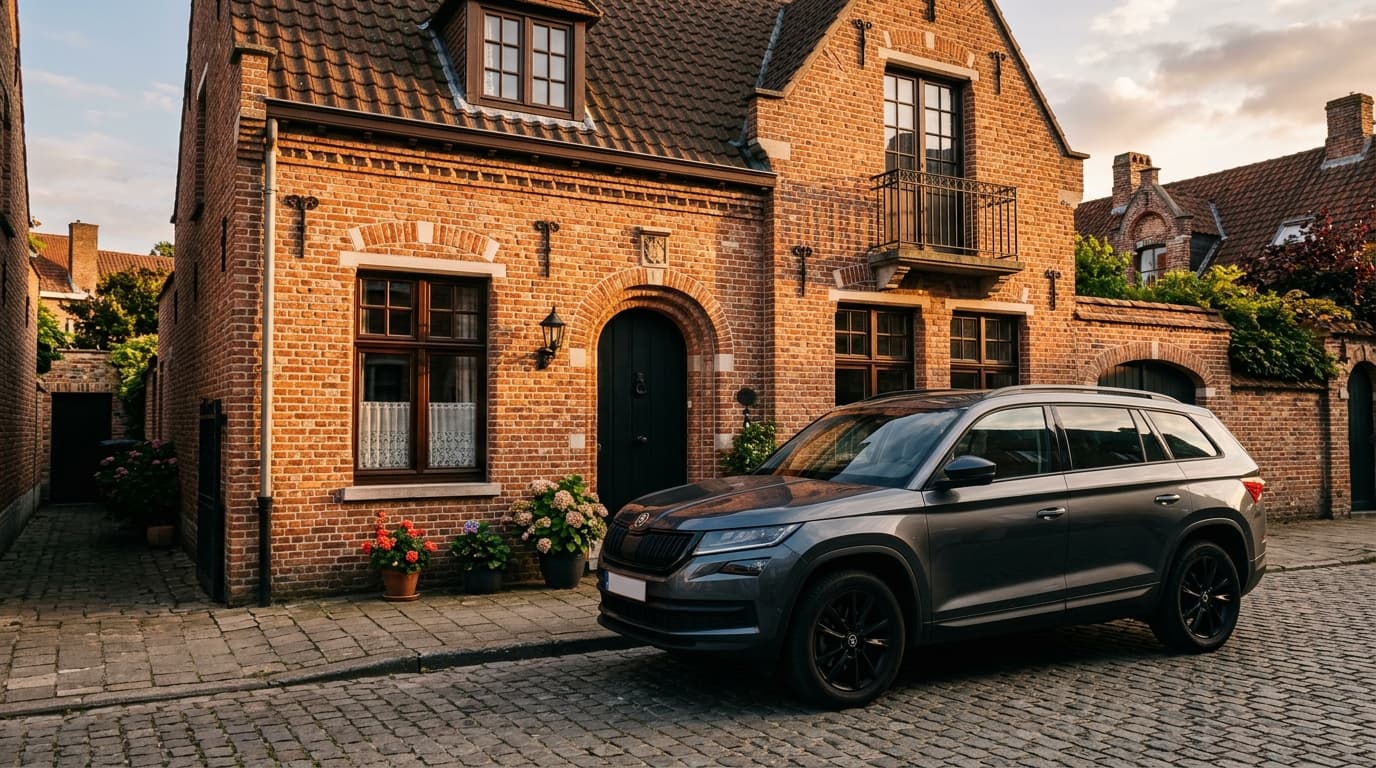
In Wallonia, yes: 250 € off the registration tax for a household with at least three children. In Brussels and Flanders, no. The condition that trips families up is not the number of children, it is the car's maximum authorised mass, which must sit between 1,839 and 2,749 kg.
250 € in Wallonia, nothing in Brussels or Flanders
The rule fits in one sentence. Since 1 July 2025, the Walloon Region takes 250 € off the registration tax (TMC, taxe de mise en circulation) of a vehicle registered by a large family, once the full tax has been calculated, and never below the 50 € floor.
We looked for an equivalent elsewhere on 5 November 2026. The Flemish government's page on BIV exemptions (BIV is the Flemish registration tax, in Dutch) lists disabled people, export, transfers between (ex-)partners, transport of wheelchair users and a few special plates. Not one line about children. It even specifies that there is no exemption when a car passes from a parent to a child. On the Brussels side, the Region's page on road taxes (in French) lists mobility aids for disabled people, taxis, agricultural vehicles and test vehicles, nothing family-related.
| Region | Family-related reduction on the TMC | Amount | Annual road tax |
|---|---|---|---|
| Wallonia | large family (3 children or more), since 1 July 2025 | 250 €, MMA of 1,839 to 2,749 kg | no family reduction |
| Wallonia | single-parent family, since 1 July 2026 | up to 250 €, MMA below 2,750 kg | no family reduction |
| Brussels | none | 0 € | no family reduction |
| Flanders | none | 0 € | no family reduction |
Sources consulted on 5 November 2026: SPW Finances rates (in French), Walloon TMC procedure page (in French, updated on 28 September 2026), Flemish and Brussels pages cited above.
A household in Waterloo and one in Uccle registering the same Skoda Kodiaq on the same day therefore do not pay the same amount, and not only because of the rates. The first is entitled to a 250 € discount, the second to nothing.
Who is entitled to the large-family reduction?
A household with at least three dependent children on the day the vehicle is put into use. SPW Finances defines a dependent child as under 21, or under 25 if still dependent, and presumes so if the child is registered in the household or if a household member receives family allowances for them.
Four other conditions come from the SPW Finances request form (in French), version of 8 July 2026. The vehicle must have been registered since 1 July 2025, in the name of a household member and not a company. No other vehicle in the household may already have received the reduction. Its calculated TMC must exceed 50 €. And its maximum authorised mass must fall within the window set by the decree.
The measure is not new; it has changed shape three times. Before July 2025, Walloon large families dropped one eco-malus band with three children and two bands with four, according to the Ligue des familles analysis (in French) of August 2023. The reform passed in 2023 planned 100 €. The next government raised it to 250 € in February 2025, according to L'Avenir of 13 February 2025, before it came into force.
A weight window between 1,839 and 2,749 kg
This is the line that decides everything, and you read it in box F.1 of the registration certificate: the maximum authorised mass, the MMA, meaning the fully loaded vehicle, not its kerb weight.
The logic is easy to guess. The Walloon formula divides the MMA by 1,838 kg: above that, weight increases the tax, below it, weight lowers it. The reduction seems aimed at the vehicles the formula penalises for their weight, with a 2,749 kg ceiling that leaves out the heaviest. The reasoning holds. Yet it produces odd results once you run it on real cars.
We took six family vehicles sold in Belgium, read their data in the ADAC catalogue on 5 November 2026 and applied the Walloon 2026-2027 rates published by Le Moniteur Automobile. Calculation for a new car, with no option that would change the MMA.
| Vehicle (ADAC data sheet) | Seats | Power used | CO2 WLTP | MMA | In the window? | Walloon TMC | After reduction |
|---|---|---|---|---|---|---|---|
| Dacia Jogger Hybrid 140 | 7 | 69 kW (combustion) | 108 g | 1,995 kg | yes | 50 € (floor) | 50 € |
| Peugeot 5008 Hybrid 145 | 7 | 100 kW (combustion) | 127 g | 2,330 kg | yes | 609.89 € | 359.89 € |
| Skoda Kodiaq 1.5 TSI mHEV | 5 to 7 | 110 kW | 136 g | 2,184 kg | yes | 1,072.24 € | 822.24 € |
| Kia Sorento 1.6 T-GDi Hybrid 2WD | 5 | 132 kW (combustion) | 150 g | 2,510 kg | yes | 3,107.70 € | 2,857.70 € |
| Kia EV9 99.8 kWh Air | 7 | 150 kW | 0 g | 3,070 kg | no | 430.79 € | 430.79 € |
| Peugeot e-5008 210 | 7 | 157 kW | 0 g | 2,900 kg | no | 1,465.25 € | 1,465.25 € |
Data: ADAC sheets for the Dacia Jogger, Peugeot 5008, Skoda Kodiaq, Kia Sorento, Kia EV9 and Peugeot e-5008 (in German). Base amounts: Le Moniteur Automobile (in French), 2026-2027 rates. Fuel coefficient of 0.8 for the Jogger and the Sorento (full hybrids), 1 for the two mild hybrids, since we cannot know which mention the certificate will carry; at 0.8, the 5008 would be 487.91 € and the Kodiaq 857.79 € before the reduction.

The figure that matters: of six family vehicles, only three collect the 250 €. The other three do not see a single euro of it.
The Dacia Jogger is the most telling case. A seven-seater at 1,995 kg of MMA, right inside the window, designed for families who count every euro, and it gains nothing: its calculation comes to 44.14 €, the floor lifts it to 50 €, and the reduction cannot go any lower. The decree rewards families who buy heavy and powerful, not those who buy frugal.
The Peugeot 5008 hybrid benefits the most: the discount wipes out 41 % of its bill, against 23 % on the Kodiaq.
At the other end, the Kia Sorento hybrid shows the opposite limit. Its 250 € amount to 8 % of a 3,107.70 € tax, because its 132 kW combustion engine puts it in the 2,579.10 € power band. A large family choosing a big petrol SUV therefore pays more than 2,800 € at registration, even after the reduction.
Used cars change the equation. The Walloon age coefficient brings the base amount down to 60 % after four years, while the reduction stays fixed. The same calculation on a Kodiaq 1.5 TSI of this profile aged four years gives 643.34 € before the reduction and 393.34 € after: the discount then weighs 39 % of the bill, against 23 % on the new car. The older the car, the more the 250 € count, until the 50 € floor swallows them.
Big electric 7-seaters miss out
The most unexpected case in our table is the electric one. A seven-seat electric family SUV is heavy, because of its battery, and its MMA easily exceeds the 2,749 kg ceiling.
The Kia EV9 shows 3,070 kg of MMA in its 99.8 kWh Air version. The Peugeot e-5008 210, 2,900 kg. Neither is entitled to the reduction, even though they are among the few electric seven-seaters a large family can buy in Belgium, as our Kia EV9 vs Peugeot e-5008 comparison shows.
The result becomes plainly counter-intuitive when you compare the petrol 5008 and its electric twin. Same body, same seven seats. The 5008 Hybrid 145 costs a Walloon large family 359.89 € after the reduction. The e-5008 210 costs 1,465.25 €, four times as much, because its 157 kW push it into the 0.18 electric coefficient and its 2,900 kg deprive it of the 250 €. The electric car, presented as the tax-friendly route, is here the most expensive option to register for a large family.
One nuance all the same. The EV9 Air, at 150 kW, stays below the 155 kW threshold and pays 430.79 €, less than many combustion cars. The deciding factor is the power entered in box P.2, well ahead of the weight. Our guide to reading the registration certificate shows where to find both.
What about single-parent families?
Since 1 July 2026 they have their own reduction, and the conditions are not those of large families. The SPW Finances procedure page (in French), updated on 26 August 2026, sets them as follows:
- a parent living alone with one or more children, recognised as a single-parent family under the Walloon decree of 8 February 2018 on family allowances;
- income below 55,599.36 € gross a year (tax year 2025, 2024 income);
- a vehicle registered in their name from 1 July 2026;
- a maximum authorised mass below 2,750 kg, with no lower threshold mentioned;
- up to 250 €, one vehicle only, and no combining with the large-family reduction.
One child is enough, where large families need three.
SPW writes "maximum 250 €" here, where it writes "250 €" for large families. The difference comes from the 50 € floor, which applies to both.
Why the reduction does not always appear on the payment notice
The payment notice arrives at the end of the month following registration. SPW Finances applies the reduction automatically when it holds the data, through the Crossroads Bank for data exchange in the case of single-parent families. It does not always have them, and then it is up to the household to claim.
Five situations come up in the SPW texts:
- shared custody, which must be proven by an agreement, a court decision or a mediation settlement dated no later than the registration day;
- a child aged 21 to 25 who is still dependent, which the administration does not detect on its own;
- family allowances paid by a fund or scheme outside the Walloon system;
- a car registered in the other parent's name, while the family file is in yours;
- a second household vehicle, which is never entitled if the first one has already been reduced.
The procedure takes three steps. Check the reduction line on the notice. If it is missing, fill in the form, online or as a PDF, with the chassis number, the plate and the children's national register numbers. Attach a household composition certificate, or the custody judgment, and the latest family allowance statement in the plate holder's name, then send everything to SPW Finances, boulevard Ernest Mélot 30, Namur.
The form sets no deadline for the request. The payment deadline, however, is printed on the notice.
Is there a reduction on the annual road tax?
No, in no Region, according to the official pages consulted on 5 November 2026. The Walloon reduction only applies to the registration tax, paid once. The annual tax is still calculated on fiscal horsepower in Wallonia and Brussels and on CO2 in Flanders, with no regard for how many seats are occupied. Our article on the registration and road tax of an SUV gives the rates for all three Regions.
The family SUV we would register in Wallonia
For a Walloon large family buying new, the 1,839 to 2,749 kg window points to a precise profile: a combustion or hybrid seven-seater of 100 to 110 kW, between 2,100 and 2,400 kg of MMA. The Peugeot 5008 hybrid and the Skoda Kodiaq 1.5 TSI land right in it, at 359.89 € and 822.24 € after the reduction. Before signing, run both through our comparison tool to check that the boot keeps up, then through our selection of 7-seater SUVs in Belgium.
To avoid: choosing a big electric seven-seater while counting on the family reduction. Above 2,749 kg it does not exist, and above 155 kW an e-5008 already pays four times its petrol version.
For a Brussels or Flemish family, the question does not arise. No reduction, so no threshold to aim for: weight does not even count in the Brussels calculation.
Frequently asked questions
Does the large-family reduction apply to a used car? Yes. In Wallonia, the registration tax is due at every registration, new or used, and the 250 € reduction has applied in the same way since 1 July 2025. On a used car the starting tax is lower thanks to the age coefficient, so the reduction weighs proportionally more, until it brings the bill down to the 50 € floor.
How do you calculate the Walloon registration tax with the large-family reduction? First calculate the full tax with the SPW Finances simulator, using the power (box P.2), the CO2 and the maximum authorised mass (box F.1) from the registration certificate. Then take off 250 € if the MMA is between 1,839 and 2,749 kg and the household has at least three dependent children. The result never goes below 50 €.
Do you need to apply to get the reduction? In principle no: SPW Finances applies it automatically when it holds the family data. Check the payment notice, sent at the end of the month following registration. If the reduction is missing, for example with shared custody or a dependent child aged 21 to 25, send the request form with a household composition certificate and the latest family allowance statement.
Frequently asked questions
Yes. In Wallonia, the registration tax is due at every registration, new or used, and the 250 € reduction has applied in the same way since 1 July 2025. On a used car the starting tax is lower thanks to the age coefficient, so the reduction weighs proportionally more, until it brings the bill down to the 50 € floor.
First calculate the full tax with the SPW Finances simulator, using the power (box P.2), the CO2 and the maximum authorised mass (box F.1) from the registration certificate. Then take off 250 € if the MMA is between 1,839 and 2,749 kg and the household has at least three dependent children. The result never goes below 50 €.
In principle no: SPW Finances applies it automatically when it holds the family data. Check the payment notice, sent at the end of the month following registration. If the reduction is missing, for example with shared custody or a dependent child aged 21 to 25, send the request form with a household composition certificate and the latest family allowance statement.
We dig through the Belgian market data — TÜV reliability, real-world ADAC consumption, company-car taxation, list prices — to call it straight. No brand pays us.