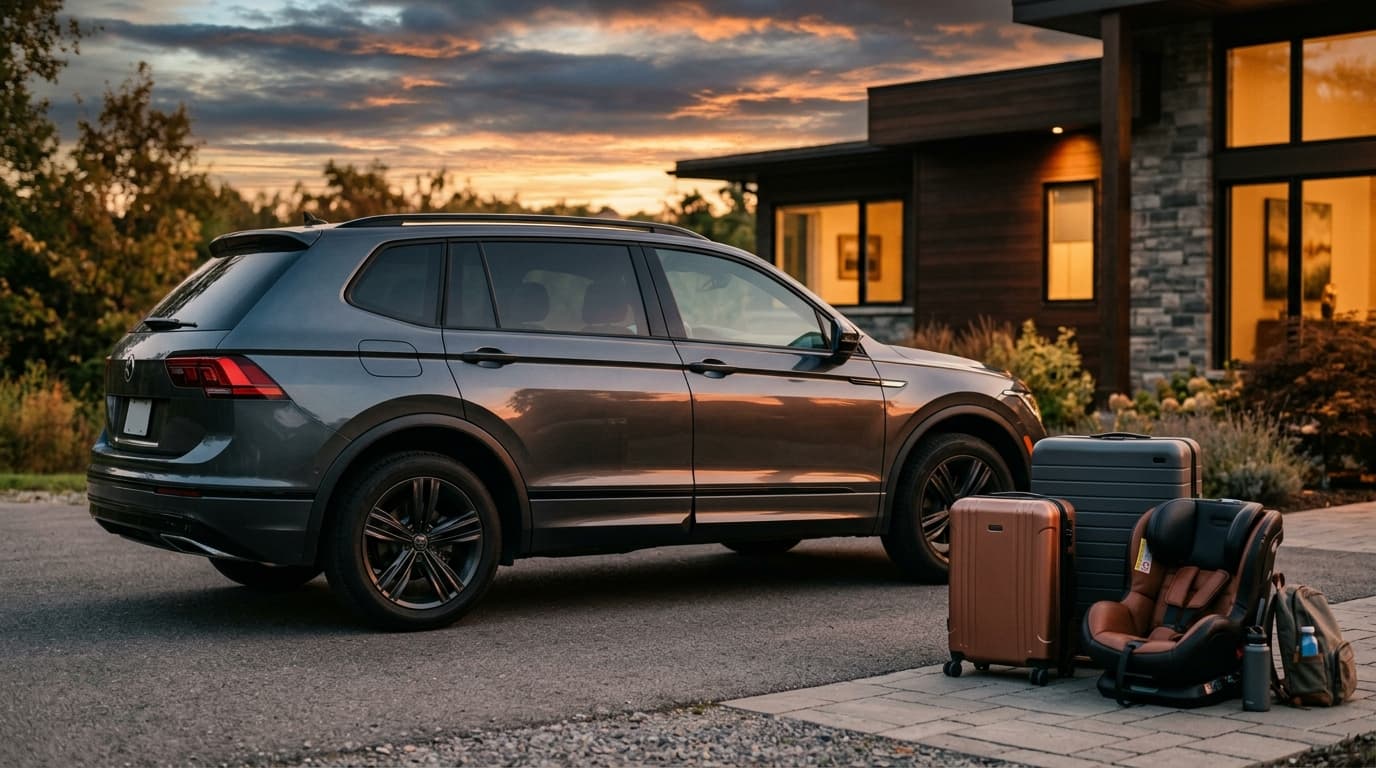
Under €35,000, the best family SUV in Belgium is the Dacia Bigster: 5 genuine seats, a 667-litre boot and a starting price of €24,122 incl. VAT (TVAc). The Škoda Karoq stays the most versatile alternative, the Renault Austral E-Tech the most modern. You still have to pick the right engine, because the most expensive one is not always the most practical.
Which family SUV to choose under €35,000 in Belgium?
The Dacia Bigster. It combines 5 adult seats, a 667-litre boot and an entry price of €24,122 incl. VAT: for a family that wants maximum space at the lowest price, no new rival does better in Belgium. The Škoda Karoq aims at versatility, the Renault Austral at modernity.
The Bigster, launched in late 2025, is Dacia's first C-segment SUV. At 4.57 m long, it plays in the Karoq and Austral league while staying €10,000 cheaper to buy. On the Belgian market, the Journey hybrid 155 hp version is listed at €30,690 incl. VAT, still nearly €4,000 under the ceiling. The number that counts: a 667-litre boot is 140 litres more than a Renault Austral, for a lower budget.
The Škoda Karoq plays a different card, modularity. Its VarioFlex bench, where each of the three seats slides or comes out, lets you adjust the boot between 479 and 588 litres, and reach 1,630 litres with the seats removed. It is the ideal tool for a family that juggles pram, bikes and big shopping runs. Budget €28,500 for the entry version, but the genuinely useful trims climb quickly towards €33,000 to €35,000.
Should you aim for the entry trim or move up?
It all depends on safety equipment. On the Bigster as on the Karoq, the entry trim is liveable, but it is by moving up one notch (Expression or Journey trim at Dacia, Selection at Škoda) that you get adaptive cruise control, the reversing camera and dual-zone automatic climate, equipment that matters on long family trips. What we would avoid: paying for a top trim that blows the budget past €35,000 for secondary comfort options.
Which family SUV offers the best boot for the budget?
The Dacia Bigster, no debate, with 667 litres in mild-hybrid form. The table cross-references the Belgian entry price, the quoted boot, the recommended engine and each model's watch point, for a budget capped at €35,000.
| Model | BE price from | Boot | Recommended engine | Watch point |
|---|---|---|---|---|
| Dacia Bigster | €24,122 | 667 L | mild-hybrid 140 | sound insulation could be better |
| Škoda Karoq | €28,500 | 521 L | 1.5 TSI mild-hybrid | useful trims near €34,000 |
| Renault Austral | €34,900 | 527 L | E-Tech hybrid 200 | only just under the ceiling |
| Toyota Corolla Cross | €33,900 | 433 L | hybrid 197 | smaller boot |
| Citroën C3 Aircross | €19,700 | 460 L | petrol/hybrid 145 | B-segment, not a real family car |
| Škoda Kamiq | €25,020 | 400 L | 1.0 TSI 116 | too small for 3 kids |
In short, two schools stand out. For sheer volume, the Bigster crushes the field and even leaves room for a hybrid engine. For bulletproof hybrid reliability, the Toyota Corolla Cross (€33,900) sacrifices boot space but offers Toyota's hybrid driveline, the most proven on the market. The Citroën C3 Aircross and the Škoda Kamiq, meanwhile, are B-segment SUVs: handy in town, quickly saturated as soon as you load a pram and a weekend's luggage for four.
Petrol, hybrid or electric for a family at this budget?
The non-plug-in hybrid (HEV) is the best compromise under €35,000. It burns 5 to 6 real litres in mixed use, needs no charger and stays within budget. Electric is out of the running: no genuine new electric family SUV comes in under €35,000 in Belgium.
In practice, at this budget the choice plays out between turbo petrol and full hybrid. A family that drives a lot in town has every interest in the hybrid: the Bigster hybrid 155 or the Corolla Cross sit around 5.5 real litres, where a pure petrol climbs to 7 or 8 litres in traffic. Conversely, for a high-mileage motorway driver under 20,000 km a year, a well-serviced 1.5 TSI mild-hybrid is enough and costs €2,000 to €3,000 less to buy. The PHEV (plug-in hybrid) is almost absent from this price bracket, and only makes sense when plugged in daily. To dig into this engine duel, see our hybrid SUV in Belgium comparison.
Does company-car tax change the choice under €35,000?
Yes, and it pushes these SUVs towards a private purchase. In Belgium, the 2026 tax deductibility only stays full, at 100 %, for 0 g CO₂ vehicles, meaning electric ones. Emitting engines see their deductibility shrink year after year.
Yet under €35,000, the electric family offer is non-existent when new: at this price you only find B-segment electric SUVs, too tight for a family. As a result, a petrol or hybrid Bigster, Karoq or Austral under €35,000 mainly makes sense in a private name, for a buyer paying cash or via a classic car loan. The fleet manager chasing maximum deductibility will look instead at a pricier electric SUV: we detail these trade-offs in our electric SUV in Belgium feature. What we would avoid: buying an emitting SUV as a company car hoping for a deductibility that melts away every year.
Which family SUVs should you avoid under €35,000?
To avoid first: taking a B-segment SUV for daily family use. The Citroën C3 Aircross, listed from €19,700, and the Škoda Kamiq, from €25,020, are excellent urban SUVs, but their 400-to-460-litre boots fill up in one weekend with a pram and the suitcases of a family of four.
Two other traps await the rushed buyer. First, stripped-out entry trims: a very cheaply listed SUV often loses adaptive cruise, the camera or automatic climate, which are expensive to add back as options. Second, new 7-seaters at this budget: under €35,000, an SUV that advertises a third row offers it at the cost of a tiny boot and a make-do habitability. For a genuine third row, a higher budget or a recent used car is better, as we explain in our 7-seater SUV in Belgium guide. On reliability, the reflex remains to favour proven hybrid drivelines (Toyota, Renault E-Tech) and to be wary of the very first model years of a recent engine, a topic we cover for the used market in our reliable used SUV comparison.
Frequently asked questions
The Dacia Bigster. It offers 5 genuine seats, up to 667 litres of boot space and an entry price of €24,122 incl. VAT, the best space-for-money in the new-car segment in Belgium. The Škoda Karoq (from €28,500) is the most versatile alternative, the Renault Austral E-Tech (from €34,900) the most modern.
The Dacia Bigster, with 667 litres in mild-hybrid form, comfortably beats the Renault Austral (527 L) and the Škoda Karoq (521 L). Watch out: in the 155 hp hybrid version, the Bigster's boot drops to 546 litres because of where the battery sits.
Barely. Under €35,000, the electric offer is limited to B-segment (city) SUVs too tight for a family. For a genuine electric family SUV you need to go above €40,000 new, or turn to a recent used car.
For under 15,000 km/year with lots of city driving, the non-plug-in hybrid (HEV) burns 5 to 6 real litres and stays under €35,000. Above 20,000 km/year with motorway use, a well-maintained 1.5 turbo petrol is enough and costs less to buy.
Rarely. In Belgium, the 2026 tax deductibility only stays full (100 %) for 0 g CO₂ vehicles, meaning electric ones. Yet no new electric family SUV comes in under €35,000. At this budget, these SUVs mainly make sense as a private purchase.
Avoid using a B-segment SUV (Citroën C3 Aircross, Škoda Kamiq) for heavy family use: their 400-to-460-litre boots fill up fast with a pram and luggage. Be wary too of stripped-out entry trims and of new 7-seaters at this price, which are always compromised.
Its mechanicals are proven: the Bigster reuses engines (1.2 mild-hybrid, hybrid 155) and a technical base shared with Renault, already run in on the Austral and Captur. The low-cost trade-off shows mainly in sound insulation and some trim, not in engine reliability.
We dig through the Belgian market data — TÜV reliability, real-world ADAC consumption, company-car taxation, list prices — to call it straight. No brand pays us.