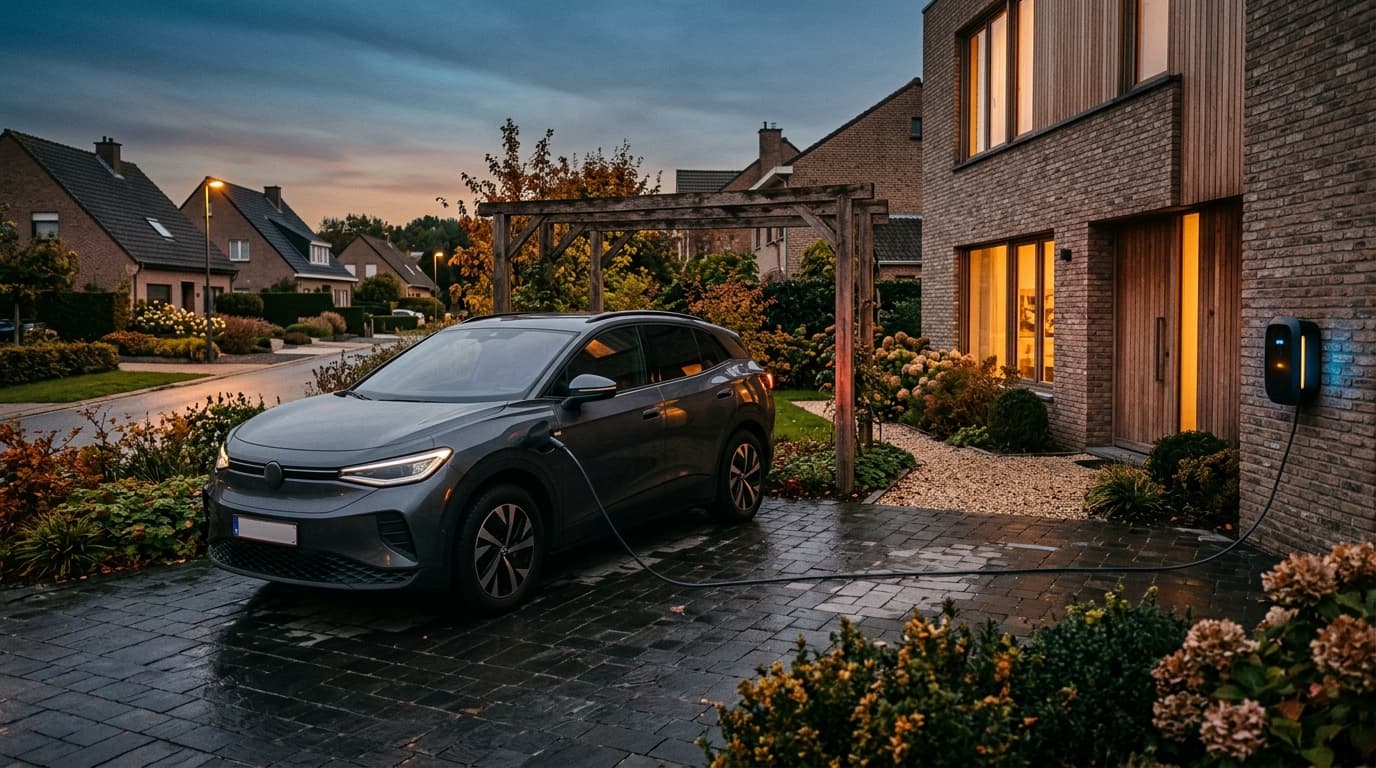
The first genuine family electric SUV on the Belgian market, the Skoda Elroq, starts at €33,810. Below that, you only find shorter B-segment SUVs. And in 2026, no region offers a purchase grant anymore. Here is the real floor, model by model, and who each choice actually fits.
Affordable family electric SUV: where does it start?
The entry point depends on what you call "family". For a genuine C-segment SUV, able to seat three children across the back and swallow a holiday boot, the Belgian floor sits at €33,810 with the Skoda Elroq. Going below that means dropping to the B-segment, which is shorter, or to a Chinese brand.
Here are the six models that shape the bottom of the market in Belgium, from cheapest to most spacious. Prices are list prices including VAT, options excluded.
| Model | List price BE | Battery / WLTP range | Boot | Segment |
|---|---|---|---|---|
| Citroën ë-C3 Aircross | from €25,490 | 44 kWh / 302 km · 54 kWh / 400 km | 460 L | B |
| MG S5 EV | approx. €27,000 | 49 kWh / 340 km · 64 kWh / 480 km | 453 L | C (Chinese) |
| Renault 4 E-Tech | from €29,990 | 40 kWh / 308 km · 52 kWh / 409 km | 420 L | B |
| Skoda Elroq | from €33,810 | 52 kWh / 375 km · 63 kWh / 504 km | 470 L | C |
| Kia EV3 | from €35,990 | 58.3 kWh / 436 km · 81.4 kWh / 605 km | 460 L | C |
| Renault Scénic E-Tech | approx. €40,000 | 60 kWh / 430 km · 87 kWh / 625 km | 545 L | C+ |
The number that matters: between the cheapest SUV badge (€25,490) and the first real family car (€33,810), there is more than €8,000 of difference. That gap is the price of size, battery and habitability — not a marketing premium.
Why does no genuine family electric SUV go below €34,000?
Because "SUV" and "family" do not mean the same thing. The Citroën ë-C3 Aircross and the Renault 4 E-Tech carry a raised body, but sit on B-segment city-car platforms. At around 4.15 m, they claim five seats, but rear legroom shrinks as soon as you fit two rear-facing child seats.
A real family SUV starts at the C-segment, around 4.50 m. That is where the wheelbase frees up room for three children side by side and where the boot passes the 450 usable litres, pushchair and sports bags included. The Skoda Elroq (4.49 m, 470 L) and the Kia EV3 (4.30 m, 460 L) are the first to tick those boxes when new, and their floor price reflects the cost of a 52 to 58 kWh battery.
In practice, that gives a realistic floor of €34,000 for a two-child family, and rather €40,000 for three growing children, with the Renault Scénic E-Tech and its 545 litres. The Renault 4 covers a young family; the Elroq sets up the real switch. Our guide to the best family SUV under €35,000 shows, in fact, that at this budget, a hybrid often remains more spacious than an electric.
Which grants are left in 2026 by region?
No direct purchase grant, in any of the three regions. This is the point most comparisons forget to state. The Flemish grant for private buyers, which climbed to €5,000 for a new car, has been definitively closed since 1 January 2025. Wallonia and Brussels never introduced an equivalent purchase incentive.
Support for electric has shifted towards taxation, and it varies strongly with the region of registration:
- Brussels: registration tax (TMC/BIV) at the minimum amount, around €75, and annual road tax capped at the minimum (about €103).
- Wallonia: new registration-tax calculation since July 2025 (power, CO₂, mass, fuel), but the "electric" coefficient stays very favourable; annual road tax also capped at the minimum. Since 1 July 2026, a €250 reduction applies for single-parent families, under conditions.
- Flanders: this is where the wind changed (see below).
What we would avoid: building your budget on a grant that no longer exists. For a family, the only genuinely usable support in 2026 runs through a company or self-employed activity, with 100% deductibility for electric vehicles bought until 31 December 2026.
How much does a family electric SUV really cost in Flanders in 2026?
More than before, but still little. Since 1 January 2026, Flanders has ended the full exemption that electric vehicles had enjoyed since 2012. A new EV registered in the north of the country now pays a flat BIV (registration tax) of about €61.50 and an annual road tax between €70 and €100 depending on fiscal horsepower. The change was set by regional decree and confirmed in early October 2025 (VRT NWS, 9 October 2025).
The amounts stay tiny against an equivalent combustion SUV, but the signal counts: electric is no longer "free" in Flanders. One detail that weighs on resale: an EV registered before 31 December 2025 keeps its exemption for life, as long as it stays with the same owner. A used family EV registered in late 2025 therefore becomes, on this specific point, more attractive than a new 2026 one.
On the Belgian market, the conclusion is clear: for the same model, the running cost of a family electric SUV stays lighter in Brussels and Wallonia than in Flanders in 2026. The annual gap is counted in tens of euros, not hundreds, but it now exists.
Which model should you choose for your budget and family?
It all depends on the size you really need and the distance you cover. Three profiles cover most Belgian families.
Tight budget, suburban use, one or two children. The Citroën ë-C3 Aircross with the 54 kWh battery (400 km WLTP) stays the most rational entry ticket under €30,000. The Renault 4 E-Tech 52 kWh (409 km, €33,490) does better on range and carries a bidirectional charger that powers the home. Neither is a real family car, but for two school runs and a shopping boot, they are enough.
Real family car, controlled budget. This is the core target of the Skoda Elroq (from €33,810) and the Kia EV3 (from €35,990). The Elroq offers the larger boot and the better price; the EV3 counters with an 81.4 kWh battery reaching 605 km WLTP and a 7-year warranty. For a family that keeps its car a long time, the EV3 with the big battery is the most durable choice.
Three children, long trips. The Renault Scénic E-Tech (around €40,000, 545 litres of boot, up to 625 km WLTP) is the only truly spacious family car at the bottom of the range. It costs €6,000 more than the Elroq, but that is the price of a real volume and a range that holds a holiday leg. Before aiming higher, check real winter range in Belgium: that is where the difference between comfort and ordeal is decided.
Which family electric SUVs should you avoid?
Three mistakes keep coming back, and they cost dearly. The smallest battery first: an SUV of 302 to 340 km WLTP (ë-C3 Aircross 44 kWh, MG S5 49 kWh entry) often drops below 220 real km in winter, loaded. For a family on holiday, the charging stop becomes a ritual every two hours. Pay for the big battery or change segment.
The SUV badge mistaken for a family car next. A raised B-segment has neither the legroom nor the boot length of a C-segment. On paper, five seats; on holiday, three suitcases too many. Measure the wheelbase before the logo.
The poorly negotiated Chinese used car last. The MG S5 tempts with its price, but the depreciation and parts delays of a Chinese SUV remain unknowns on the Belgian market, as we detailed in our analysis of whether a Chinese SUV is worth it. For long-term family use, residual value and the dealer network matter as much as the sticker price. If you are still unsure about the technology, our pick of the best electric SUV in Belgium sets the full context.
Frequently asked questions
If we mean a genuine C-segment family SUV, with enough wheelbase for three children across the back and a boot above 450 litres, it is the Skoda Elroq, from €33,810. The Kia EV3 follows at €35,990. Below €34,000, you only find B-segment SUVs that are shorter: the Citroën ë-C3 Aircross starts at €25,490 and the Renault 4 E-Tech at €29,990. They cover a small family, but their length (around 4.15 m) shows its limits quickly with two child seats and a pushchair.
No, no region grants a direct purchase incentive in 2026. The Flemish grant for private buyers, which reached €5,000 for new cars, has been closed since 1 January 2025. Wallonia and Brussels offer no equivalent. Support for electric now runs through taxation: reduced registration (BIV/TMC) and road taxes outside Flanders, and 100% tax deductibility for company vehicles bought until 31 December 2026. So you must budget on the net list price, without counting on a regional cheque.
Since 1 January 2026, the Flemish exemption has ended for new registrations. A new electric vehicle now pays a flat BIV (registration tax) of about €61.50 and an annual road tax between €70 and €100 depending on fiscal horsepower. The amounts stay low compared with a combustion car, but the 'all free' era is over. Important: an EV registered before 31 December 2025 keeps its full exemption as long as it stays in the same name.
It is an SUV, but a B-segment one. At 4.15 m, it claims five seats and a 460-litre boot, which is enough for a couple with one child or for suburban use. For a family of two or three children fitting child seats and going on holiday, rear legroom and boot length become tight. Its other limit is range: 302 km WLTP with the 44 kWh battery, 400 km with the 54 kWh, to discount by at least 20% in winter. It stays the cheapest entry point, not the ideal family car.
The two are very close. The Skoda Elroq is a bit cheaper (€33,810 versus €35,990), offers the larger boot of the pair (470 litres) and a sober, solid design. The Kia EV3 counters with a long-range 81.4 kWh battery reaching 605 km WLTP, where the Elroq tops out around 573 km, plus a 7-year warranty. For a tight budget and mostly regional use, the Elroq. To drive far without piling up stops, the EV3 with the big battery.
Aim for at least 400 km WLTP, which is around 300 km real on a loaded motorway, and much less in deep cold. Below that, the small batteries (302 to 340 km WLTP of the ë-C3 Aircross or the entry MG S5) force too-frequent stops on a long family trip. A Kia EV3 81.4 kWh or a Renault Scénic E-Tech with the big battery cover a holiday leg towards the south of France with two charging breaks, which stays manageable with children.
For a private buyer without a company, cash purchase or a classic loan stay the clearest: outside Flanders, electric taxation is already low, and there is no grant left to capture. Private leasing (renting) becomes attractive if you want to smooth the monthly cost and avoid depreciation risk, which is real on electric. If you have a company or self-employed activity, the 100% deductibility until 31 December 2026 changes the whole equation and tips clearly towards a company vehicle.
We dig through the Belgian market data — TÜV reliability, real-world ADAC consumption, company-car taxation, list prices — to call it straight. No brand pays us.